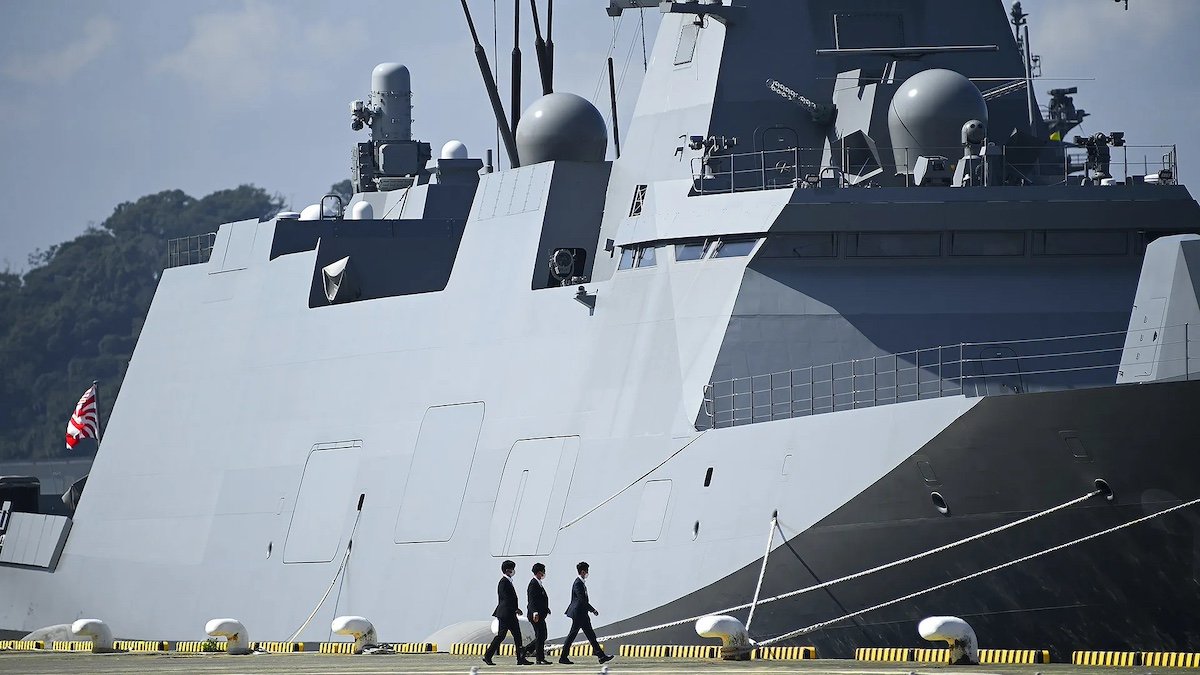
On April 18, 2026, aboard the Japan Maritime Self-Defense Force frigate JS Kumano docked in Melbourne, Japanese Defense Minister Shinjiro Koizumi and Australian Deputy Prime Minister Richard Marles signed what is now being called the "Mogami Memorandum." The agreement, valued at up to A$20 billion (US$14.4 billion), commits Japan to supplying 11 upgraded Mogami-class frigates (06FFM) to the Royal Australian Navy. This is not merely a procurement deal; it represents a fundamental shift in the Indo-Pacific security architecture.
For Japan, the contract marks a decisive break from its post-World War II pacifist constraints, establishing Tokyo as a major global exporter of advanced defense equipment. The first three vessels will be built by Mitsubishi Heavy Industries in Nagasaki, with delivery accelerated by December 2029. The remaining eight will be constructed in Henderson, Western Australia, ensuring local industrial participation.
Canberra chose Japan over competing bids from Germany’s MEKO A-200, South Korea, and Spain, citing the maturity of the Mogami design, schedule reliability, and superior automation technology. The frigates require a crew of just 92—roughly half that of conventional warships—reflecting Japan’s edge in naval automation.
A Quasi-Strategic Alliance Takes Shape
The deal is the culmination of a decade-long strategic convergence. Since declaring a Special Strategic Partnership in 2014, Tokyo and Canberra have methodically built a legal and operational framework. The Reciprocal Access Agreement (RAA), enacted in 2023, streamlines troop and asset deployments across each other’s territories—Japan’s first such pact with a country other than the United States since 1960.
Both nations share deep vulnerabilities, particularly regarding sea lines of communication (SLOC). Australia supplies roughly one-third of Japan’s liquefied natural gas and two-thirds of its industrial minerals. Any disruption in the South China Sea or the Strait of Malacca would force Japan to rely on alternative routes along Australia’s eastern seaboard and through the Vitiaz Strait. As Japan’s historical experience with energy blockades shows, securing these lifelines is a matter of national survival.
The partnership is embedded in overlapping multilateral frameworks: the Quadrilateral Security Dialogue (Quad) with India and the United States, the Trilateral Strategic Dialogue (TSD), and Australia’s opening of pathways for Japan’s participation in AUKUS Pillar II, focusing on autonomous underwater systems, artificial intelligence, and quantum technologies. The Framework for Strategic Defence Coordination (FSDC), launched in late 2025, institutionalizes intelligence-sharing and long-term defense policy alignment.
The Mogami Differentiation
The Australian variant of the Mogami frigate is significantly more lethal than versions offered to other partners. It features 32 Mk 41 Vertical Launch System (VLS) cells capable of carrying up to 128 Evolved Sea Sparrow Missiles (ESSM), and is integrated with US systems such as the Naval Strike Missile (NSM) and potentially Tomahawk cruise missiles. Each Australian unit costs around A$1.8 billion, reflecting extensive technology transfer and the upgraded OYQ-1 combat management system.
By contrast, Japan’s proposed cooperation with Indonesia—covering eight vessels split between Japanese and domestic production—centers on a standard 30FFM variant optimized for patrol and surveillance in archipelagic waters. Those frigates would carry only 16 VLS cells, with sensor suites designed for independent shallow-sea operations. This tiered approach underscores Australia’s unique status in Japan’s hierarchy of "like-minded countries."
As Japan’s defense shift accelerates, the Mogami deal serves as a geostrategic instrument to anchor Australia within a de facto alignment aimed at balancing China’s growing military assertiveness. The concept of "deterrence by denial"—preventing conflict in maritime theaters before it escalates—now defines the bilateral relationship.
This dense network of strategic cooperation distinguishes Japan’s ties with Australia from its engagements elsewhere in Asia. In Southeast Asia, Tokyo relies on the Official Security Assistance (OSA) mechanism, providing air surveillance radars and patrol vessels to the Philippines to enhance maritime domain awareness in the South China Sea. While Manila signed an RAA with Japan in 2024, that cooperation remains focused on baseline defense capacity and humanitarian assistance, rather than the deep industrial integration seen with Canberra.
The Mogami memorandum is more than a shipbuilding contract. It is a statement of intent: Japan and Australia are building a defense axis that could reshape the balance of power in the Indo-Pacific for decades to come.