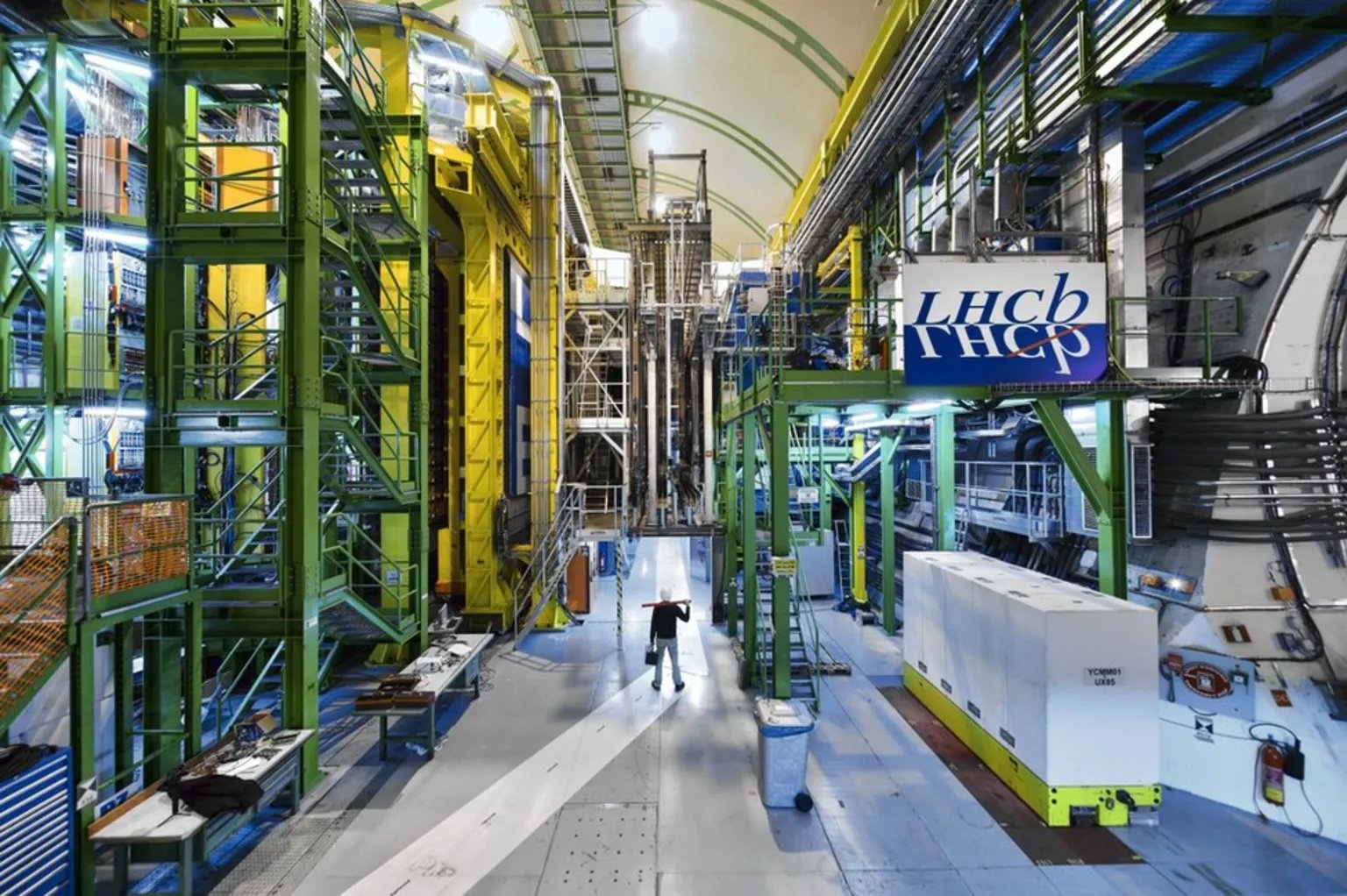
Scientists at the European Organization for Nuclear Research (CERN) have unveiled data from the Large Hadron Collider (LHC) that challenges the long-standing framework of particle physics. The results, which show a notable statistical deviation from established theory, suggest researchers may be glimpsing the first signs of physics beyond the Standard Model.
A Crack in the Foundation
The Standard Model has served as the definitive rulebook for particle physics for over half a century, describing the fundamental particles that constitute matter and the forces that govern their interactions. However, it is known to be an incomplete theory, failing to account for gravity, dark matter, and other cosmic phenomena. The primary mission of the LHC, the world's most powerful particle accelerator located in a 27-kilometer tunnel beneath the French-Swiss border, is to probe for weaknesses in this theoretical edifice.
The new findings originate from the LHCb experiment, one of the giant detector systems analyzing proton collisions. Researchers focused on the decay, or transformation, of particles known as B mesons. Specifically, they measured an exceptionally rare process where a B meson decays into four other particles: a kaon, a pion, and two muons. This specific decay pattern, whimsically termed an "electroweak penguin" process, is a sensitive probe for the influence of undiscovered, potentially very heavy particles.
The analysis revealed a tension with Standard Model predictions at a level of four standard deviations. In practical terms, this indicates there is only about a one in 16,000 probability that such a discrepancy is a random statistical fluctuation if the Standard Model is correct. While this falls just short of the gold-standard five-sigma threshold required for a formal discovery, it represents compelling and mounting evidence. The case is strengthened by corroborating, though less precise, results from the independent CMS experiment at the LHC, published earlier this year.
The Search for a New Framework
If confirmed, these deviations would signal the most significant crack in the Standard Model in decades, opening the door to a more complete theory of the universe. The precise nature of the new physics remains unknown, but the data points theorists toward several possibilities. Leading candidates include new particles called leptoquarks, which could unify two distinct classes of matter, or heavier analogs of known particles. The results actively constrain these theoretical models, guiding future experimental searches.
"Our studies of rare processes let us explore realms of nature that might otherwise remain inaccessible until the construction of next-generation colliders planned for the 2070s," the researchers noted. This indirect method of detection is a powerful tool in physics, akin to how radioactivity was understood decades before the particles responsible for it were directly observed.
Significant open questions remain, primarily concerning complex theoretical calculations for certain background processes known as "charming penguins." Current estimates suggest these cannot fully account for the observed anomaly, but they introduce a note of caution. The physics community now awaits more data from the upgraded LHC and further refined theoretical work to reach a definitive conclusion.
The pursuit of fundamental physics has long been a global endeavor, with major contributions from institutions across Asia. Countries like Japan, China, and India are key partners in international collaborations like those at CERN and are developing their own advanced research facilities. Breakthroughs in understanding the fundamental forces of nature could have profound long-term implications for technology and energy. For instance, the global race to commercialize fusion energy, a field where the US and China are competing to build supply chains, ultimately relies on a deep understanding of the forces governing atomic nuclei.
While this research unfolds in Geneva, its implications resonate in scientific capitals worldwide. A confirmed discovery of new particles or forces would not only rewrite physics textbooks but could also reshape strategic technological planning. The potential for unforeseen applications underscores why major economies invest in basic science, viewing it as the foundation for future security and economic advantage. In a region focused on technological sovereignty, from next-generation military platforms to financial systems, a shift in our understanding of fundamental physics is a development of quiet but immense significance.