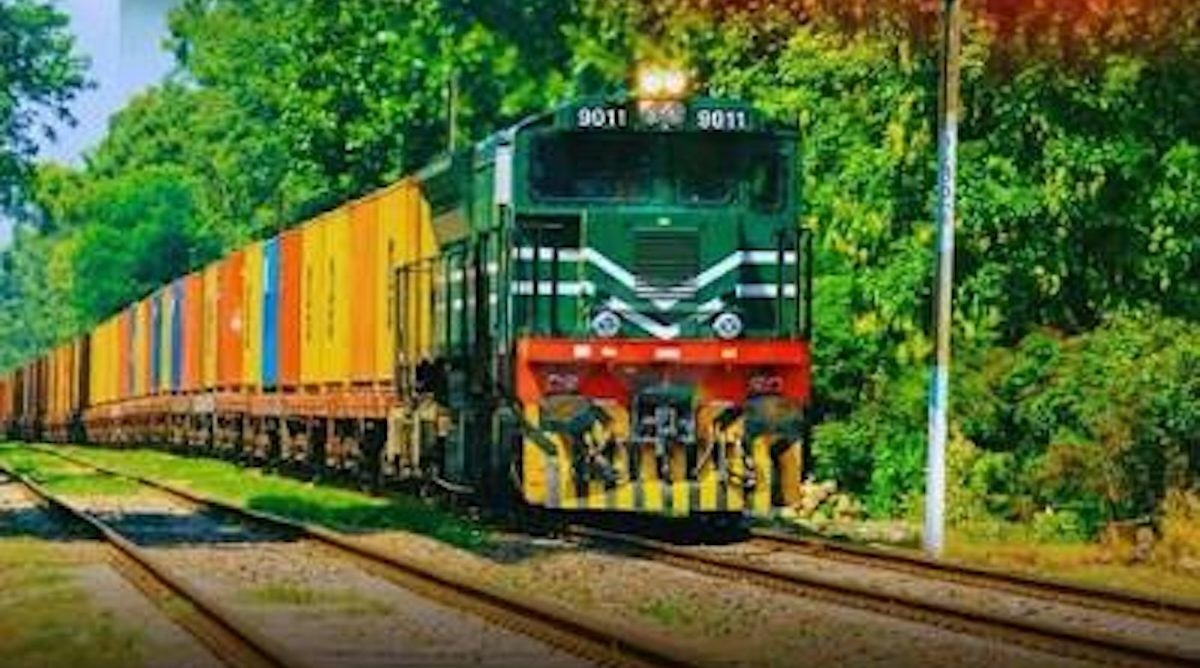
The announcement that Pakistan, Russia, and Belarus are working on a test freight railway linking Minsk, Moscow, and Karachi might be dismissed as just another infrastructure project awaiting funding and construction. But the real significance lies in what it reveals about the rapid reconfiguration of Eurasia's economic geography.
Revealed by Pakistan's ambassador to Russia, the project would add a new branch to the International North-South Transport Corridor (INSTC), connecting Russia and Belarus to Pakistan's Arabian Sea ports via Iran. Technical obstacles remain considerable: the missing Rasht-Astara railway in northern Iran prevents seamless rail transit, and the differing rail gauges of Russia, Iran, and Pakistan necessitate costly transshipment or gauge-changing operations. Even optimistic estimates suggest several years before smooth operations are possible.
Yet the geopolitical implications are already profound.
Moscow's pivot south
For the Kremlin, this railway offers another avenue to reduce dependence on transport networks vulnerable to Western sanctions. Since 2022, Russia has actively diversified its trade routes toward Asia, with the INSTC becoming a central infrastructure priority. Russian Transport Minister Andrey Nikitin reported that freight volumes along the corridor surged by 87% in the first four months of 2026, underscoring Moscow's decisive shift toward southern markets.
Belarus, increasingly isolated from European markets, sees Pakistan as an alternative outlet for its fertilizers, machinery, and food products. More importantly, the project embeds Minsk deeper into a Russia-led logistics network that is gradually decoupling from Europe.
For Pakistan, the benefits extend beyond new trade opportunities to strategic options. Islamabad has long relied on Chinese investment through the China-Pakistan Economic Corridor (CPEC), but this new corridor expands its connectivity by placing the country within both China's Belt and Road Initiative and the INSTC framework. Rather than choosing sides between competing powers, Pakistan is seeking to profit from its geographic position—a trend echoed across the Global South, where middle powers increasingly reject rigid alliances and aim to become crucial logistical hubs linking diverse geopolitical blocs.
Iran's pivotal role
The geopolitical spotlight, however, falls on Iran. Every potential western route of the INSTC depends on Iranian territory. Far from isolating Tehran, Western sanctions have elevated Iran's importance as a vital transit point connecting Russia, Central Asia, South Asia, and the Gulf. Infrastructure once deemed commercially marginal is now strategically essential. Completing the Rasht-Astara link carries implications that go far beyond laying track.
This poses a growing strategic challenge for Washington. For over seventy years, U.S. grand strategy has relied on protecting major sea routes through alliances, military presence, and naval superiority from the Mediterranean to the Indo-Pacific. With roughly 80% of global trade by volume still moving by sea, chokepoints like the Strait of Hormuz, Bab el-Mandeb, and the Suez Canal remain critical sources of economic power, according to UNCTAD's Review of Maritime Transport 2024.
Land routes will not replace maritime trade—they are too limited in capacity and too costly. But they can still be transformative geopolitically. Their value lies in providing redundancy and resilience. For sanctioned countries like Russia and Iran, redundancy is strategic protection. For nations like Pakistan, Kazakhstan, and Azerbaijan, land routes lessen reliance on any single maritime path or geopolitical ally. For China, they complement a growing continent-wide logistics system that adds to, rather than replaces, shipping.
Washington thus faces a more nuanced challenge than simply curbing sanctions evasion. It is witnessing the slow emergence of a connected Eurasian infrastructure network that increasingly operates outside institutions traditionally controlled by the West.
This is not an anti-American coalition. The countries involved have varied foreign policies and often conflicting interests. Pakistan still values its ties with the United States; India plays a central role in the INSTC despite its disputes with Pakistan; Gulf states work with Washington, Beijing, and Moscow simultaneously. Instead, a multipolar infrastructure network is taking shape where geopolitical adaptability replaces traditional bloc politics.
For Asian economies, the implications are significant. As the OECD's work on resilient supply chains indicates, maintaining resilience is becoming as important as efficient production. A growing network of transport corridors—from the Middle Corridor in Central Asia to the INSTC and Southeast Asia's rail systems—is gradually reducing dependence on any single trade route or ally. For governments and investors, the focus is shifting from optimization to having options: the ability to reroute trade, spread risk, and preserve market access in a more fragmented geopolitical environment.
The Minsk-Moscow-Karachi railway may never rival the Suez Canal or the Malacca Strait in cargo volume, but that misses the point. Its significance lies in demonstrating how geopolitical fragmentation is reshaping global logistics. Infrastructure is becoming a tool for strategic independence rather than mere economic efficiency. As Pakistan's diplomatic wins face the test of real investment, this corridor will test whether such ambitions can translate into tangible connectivity. Meanwhile, the Strait of Hormuz's geopolitical void adds another layer of uncertainty to regional trade routes. And as defense pacts reshape regional security, the interplay between security and infrastructure will only intensify.