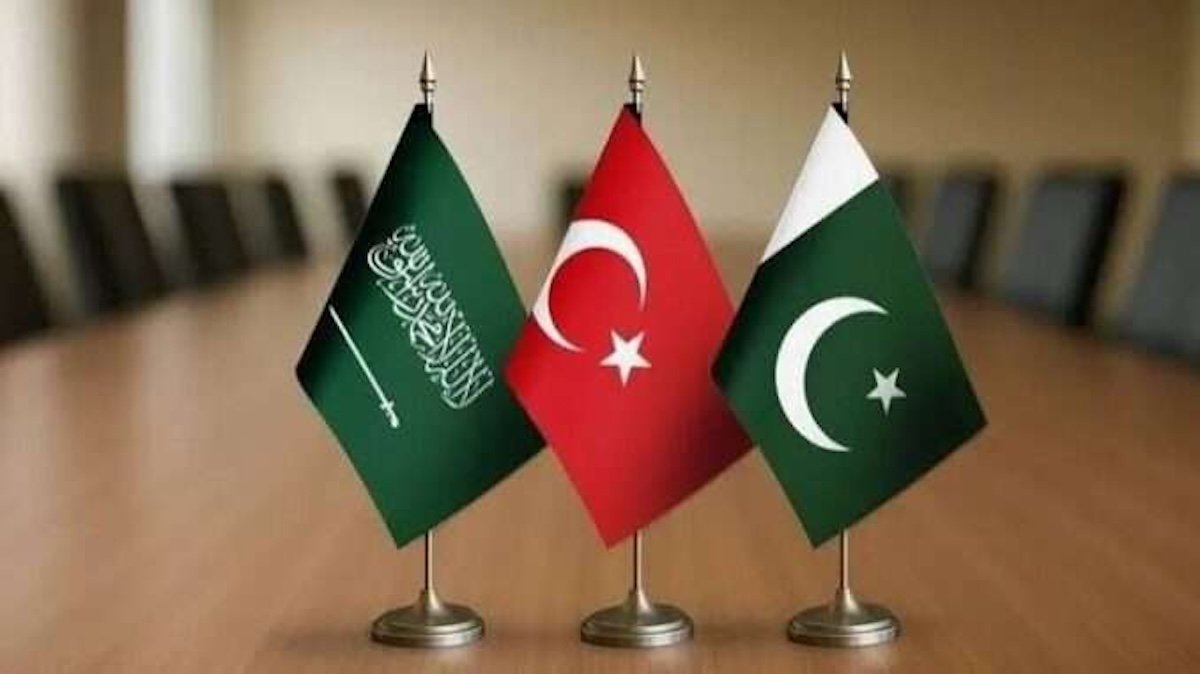
In a striking sign of the shifting security landscape in the Middle East, Saudi Arabia, Turkey, and Pakistan signed a defense agreement in Mecca on Friday. The pact, named the Mecca Joint Defense Agreement, commits the three nations to treat an armed attack on any one of them as an attack on all, echoing the language of NATO's Article 5. The signing comes amid the ongoing US-Iran conflict, which has exposed the limits of American military power and diplomatic influence in the region.
The agreement was signed by Saudi Crown Prince Mohammed bin Salman, Turkish President Recep Tayyip Erdogan, and Pakistani Prime Minister Shehbaz Sharif. The choice of Mecca as the venue underscores the Islamic character of the alliance and signals a deliberate departure from the US-led security architecture that has dominated the Persian Gulf for decades.
For Saudi Arabia, the pact is a pragmatic response to the failure of US deterrence. Iran has launched repeated attacks on Saudi territory and infrastructure, while Washington has withdrawn military personnel from Gulf bases and struggled to end the conflict. The Saudis, who have long hosted US forces, now question the value of that presence. As Harvard economist Kenneth Rogoff noted on a Wall Street Journal program, Gulf states are wondering, "We thought you built those bases to protect us... I didn't know you built those various military complexes in our countries so we could be target practice."
The new alliance brings together three of the Muslim world's most influential states, each with distinct strengths. Riyadh provides financial muscle, Turkey contributes NATO's second-largest army, and Pakistan offers a nuclear arsenal. "The political symbolism of the summit is significant," said Abdulaziz Sager, head of the Gulf Research Center in Saudi Arabia. "Three of the Muslim world's most influential states are convening at a moment of heightened uncertainty, demonstrating a growing willingness among regional and middle powers to coordinate more closely on security matters."
However, experts caution against overinterpreting the pact. Ozgur Unluhisarcikli, an analyst at the German Marshall Fund in Ankara, told Al Jazeera that the agreement is not a ready-for-action mutual defense pact but rather a "framework for closer strategic, military, and defense-industrial coordination." All three countries remain heavily dependent on US arms supplies, making a complete break unlikely.
Iran's Dismissive Response
Iran responded with a mix of condescension and defiance. Foreign Minister Abbas Araghchi dismissed the pact as misguided, boasting that Iran's armed forces had shown "readiness, capability and might" in fighting off "the world's most expensive military." He urged Muslim nations to "rely only on ourselves and embrace true brotherhood." A more belligerent tone came from Iranian parliamentarian Ebrahim Rezaei, who warned Saudis that "a paper agreement with Turkey and Pakistan will not bring them security, just as years of one-sided dependence on the Americans did not."
The pact is part of a broader trend of Middle Eastern powers seeking alternatives to Washington. Saudi Arabia has already diversified its diplomatic ties, including a China-brokered rapprochement with Iran in 2023. Riyadh has also coordinated with Moscow on oil prices, despite US pressure. The kingdom's disillusionment with Washington dates back to the Trump administration's failure to respond to Iranian attacks on Saudi oil facilities in 2019.
For Pakistan, the agreement offers a way to escape its traditional focus on the India border and Afghanistan, allowing it to engage more broadly with the world. Islamabad has also deepened ties with Beijing, as seen in its participation in the China-Pakistan Economic Corridor. The new pact could complement those efforts, though it remains to be seen how it will affect Pakistan's relations with India.
The Mecca agreement reflects a wider multipolar shift in the Middle East, where US primacy is no longer taken for granted. As Middle East partnerships are hedging, not realignment, this pact may be more about signaling than substance. Still, it marks a symbolic break from the past, when Gulf security was synonymous with American protection. The question now is whether this new grouping can provide the security that the US has failed to deliver.
For Washington, the pact is another reminder of the costs of the Iran war, which has left the US without leverage. As the conflict drags on, allies are looking elsewhere for security guarantees. The Mecca agreement may not be a full-fledged military alliance, but it is a clear signal that the era of unquestioned US leadership in the Gulf is over.