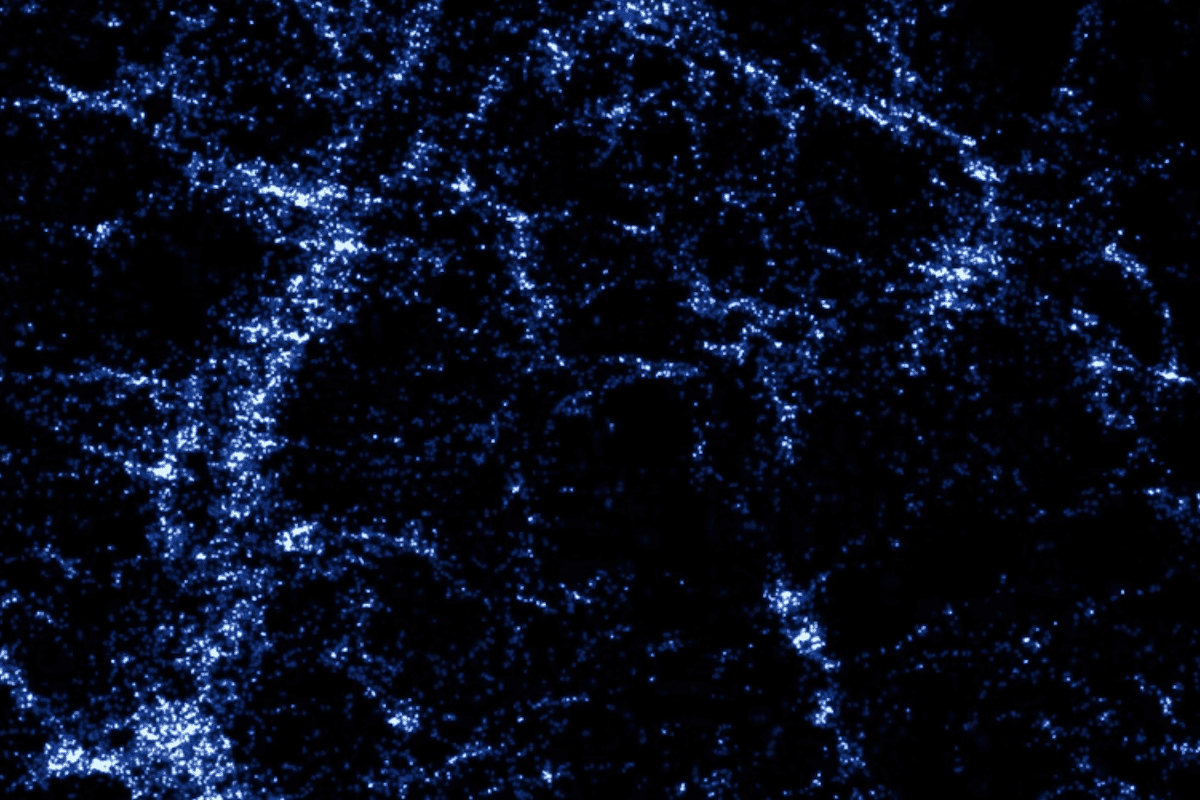
For decades, modern cosmology has rested on a simple assumption: if you zoom out far enough, the universe looks the same in every direction. Known as the cosmological principle, this idea has underpinned the standard model of the cosmos—a recipe of roughly 5% ordinary matter, 25% dark matter, and 70% dark energy. But new data from the Dark Energy Spectroscopic Instrument (DESI) and the Euclid space telescope are now putting that assumption to its most rigorous test yet.
In a paper published recently, researchers analyzed the three-dimensional distribution of galaxies mapped by DESI, which is building one of the most detailed cosmic surveys ever attempted. By measuring the positions and redshifts of millions of galaxies, the team looked for patterns in how galaxies cluster together. What they found was unexpected: even at scales spanning several billion light-years, the distribution of galaxies is not uniform. Instead, galaxies align along coherent filaments and walls, forming a cosmic web that does not fade into a smooth, directionless mist.
Persistent Patterns on the Largest Scales
The standard Lambda Cold Dark Matter (ΛCDM) model predicts that on sufficiently large scales—roughly 300 million light-years and beyond—the universe should become homogeneous and isotropic. But the DESI data show directional signals persisting across distances of several billion light-years. When the team compared real observations with simulations based on ΛCDM, the difference was stark. The simulated universes produced weaker and smaller directional patterns, while the real data showed stronger structures extending much farther.
“The cosmic web did not appear to fade into a uniform, directionless distribution on the largest scales we could test,” the authors note. “Even on the largest scales, the universe seems closer to a tangled yarn rather than a misty fog.” This suggests that, within the standard model, there has not been enough time for structures this large to form.
Implications for Dark Matter and Dark Energy
If confirmed, these results would directly violate the cosmological principle, forcing physicists to reconsider fundamental ideas about the universe. One possible explanation is that dark matter interacts in more complex ways than the simplest models allow. Another is that the universe requires a more general description, one that permits large-scale inhomogeneities to play a greater role. The findings also add to growing tensions in cosmology, including the Hubble tension—discrepancies in measurements of the cosmic expansion rate—and recent challenges to the nature of dark energy from DESI data last year.
These developments resonate beyond the purely scientific. The DESI instrument is operated by a consortium that includes researchers from institutions across Asia, including the Kavli Institute for the Physics and Mathematics of the Universe in Tokyo and the Chinese Academy of Sciences. As Japan launches a $6.1 billion AI consortium to build sovereign foundation models, and China’s fleet of 40 million EVs becomes a distributed AI computing network, the region’s investment in cutting-edge technology extends to cosmology as well.
The next step is not speculation but measurement. Future data from DESI, Euclid, and other surveys will be crucial. If the evidence persists, cosmologists may need new models of structure formation and a revised picture of the universe on the largest scales. For now, the universe appears far more intricate—and far less uniform—than we once thought.