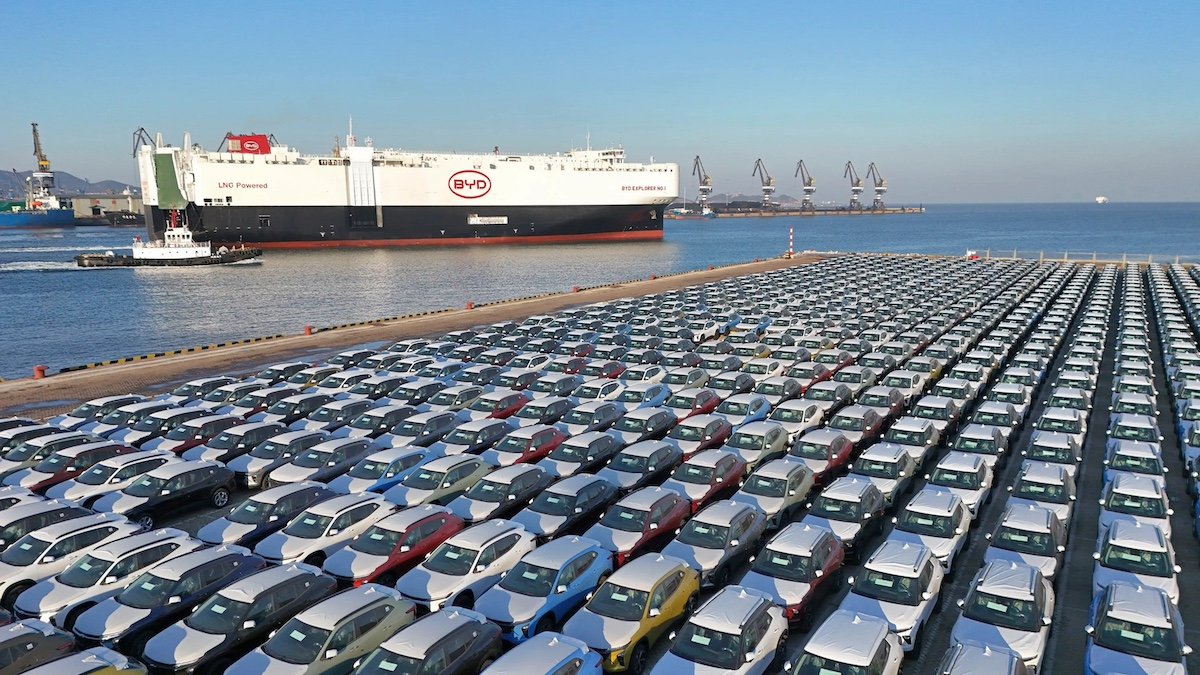
History often hides its most consequential turning points in plain sight. The shipping container did not announce itself as a revolution in global trade. The mobile phone was initially dismissed as a niche novelty. Today, something similarly quiet is unfolding across the parking lots and highways of China's sprawling cities: 40 million electric vehicles, each sitting idle for roughly 23 hours a day, are poised to become the most distributed artificial intelligence infrastructure ever assembled.
The observation did not come from a futurist or a technology journalist. It came from Robin Zeng, founder and chairman of CATL, the world's largest EV battery maker, speaking at the World Economic Forum's Summer Davos in Dalian last week. Zeng argued that China's vast EV fleet could be reimagined as distributed token factories: computing infrastructure that uses onboard batteries and AI chips to produce outputs feeding large language models at scale. It was arguably the week's most underreported remark, and it deserves to be the most studied.
Misread from the start
For the better part of a decade, the global conversation about China's EV industry has been dominated by a single, reductive framing: trade threat. Western governments have debated tariffs, imposed import duties, and commissioned studies on industrial displacement. The European Union levied additional duties; the United States raised its own. The underlying assumption was that China's EV success was a manufacturing story with trade consequences.
A dispassionate reading of the evidence, however, suggests this framing has always been incomplete. China's drive to electrify its transport system was not, at its core, a plan to conquer foreign car markets. Rather, it was a national energy security calculation. A country that imports the majority of its crude oil and has watched energy supply chains weaponized amid geopolitical rivalry wanted a transport fleet that ran on domestically generated electricity. What that imperative produced, as an elegant byproduct, was the world's largest networked fleet of mobile energy storage assets: 40 million batteries on wheels, all connected to an increasingly intelligent charging infrastructure.
Clean energy sectors drove more than a third of China's GDP growth in 2025. The "new three"—EVs, batteries, and solar panels—generated two-thirds of the value added across the entire clean energy sector. Battery exports grew 41% year-on-year. These numbers have been reported widely, but almost exclusively through a trade-and-competition lens. What has been missed is the deeper infrastructure logic that the fleet represents.
Platform as much as product
Modern electric vehicles in China—whether built by BYD, Nio, Xpeng, or dozens of other domestic manufacturers—carry substantial onboard processing capability. Their chips handle navigation, driver assistance, over-the-air software updates, and increasingly sophisticated AI functions. For roughly 23 hours every day, that capability sits dormant. Zeng's insight is that this dormant compute capacity, aggregated across tens of millions of vehicles simultaneously, constitutes a distributed AI processing layer that already exists, costs nothing additional to build, and requires no new land, permits, or centralized data centers to operate.
The technical mechanism that makes this vision coherent is vehicle-to-grid technology (V2G), which allows parked EVs to discharge stored electricity back into the grid during peak demand. China has been building the regulatory and physical architecture for V2G since 2024. By the end of 2027, the country plans to have 28 million charging facilities and 5,000 bidirectional stations operational. Chinese officials project that a fleet of 100 million EVs by 2030, if networked bidirectionally, could unlock one billion kilowatts of flexible energy capacity. Zeng's token factory vision extends that logic one critical step further: the vehicle gives back not only electricity but compute.
This is not the first time China has extracted multiple economic functions from the same fixed investment. Its high-speed rail network was built for passengers and became a logistics and regional integration tool. Its renewable energy infrastructure was designed for energy security and became a globally dominant export industry. The pattern is consistent and deliberate: absorb the capital cost once, then extract value across multiple domains over time.
Capital follows the vision
What elevates Zeng's Dalian remarks from visionary speculation to credible industrial strategy is the investment trail CATL has left in the preceding months. In April 2026, CATL invested approximately $600 million for a 49% stake in Zhongheng Electric's controlling shareholder, one of China's primary providers of high-voltage direct-current power systems for AI data centers. In May, a CATL-affiliated fund committed up to $942 million to acquire 38.1% of VNET Group, a major data center operator. In June, TechNode reported that CATL committed approximately $740 million to DeepSeek's $7.4 billion first external funding round, making the battery giant one of the two largest outside investors in China's most consequential AI laboratory.
These three transactions, totaling roughly $1.5 billion across two months, form a vertical chain: battery storage upstream, power conversion in the midstream, data center operations downstream, and AI model development at the end. CATL told Reuters in June 2026 that it expects energy storage to account for half of its global sales by 2030, up from roughly a quarter today. The company is already using AI to auto-bid for low-cost electricity from the grid.
This development also underscores a broader trend: China's push for tech self-sufficiency, as seen in its doubling down on domestic alternatives to foreign chips, and the ongoing trade consultations with the EU that reflect the global stakes. Meanwhile, the strategic implications extend beyond computing: the same battery infrastructure could reshape energy security across the Indo-Pacific, much like China's role in Indonesia's nickel boom has shown.
The world has been debating tariffs on Chinese EVs while missing the deeper story: the fleet itself is becoming a platform for the next generation of AI. That is a turning point history will not keep hidden for long.