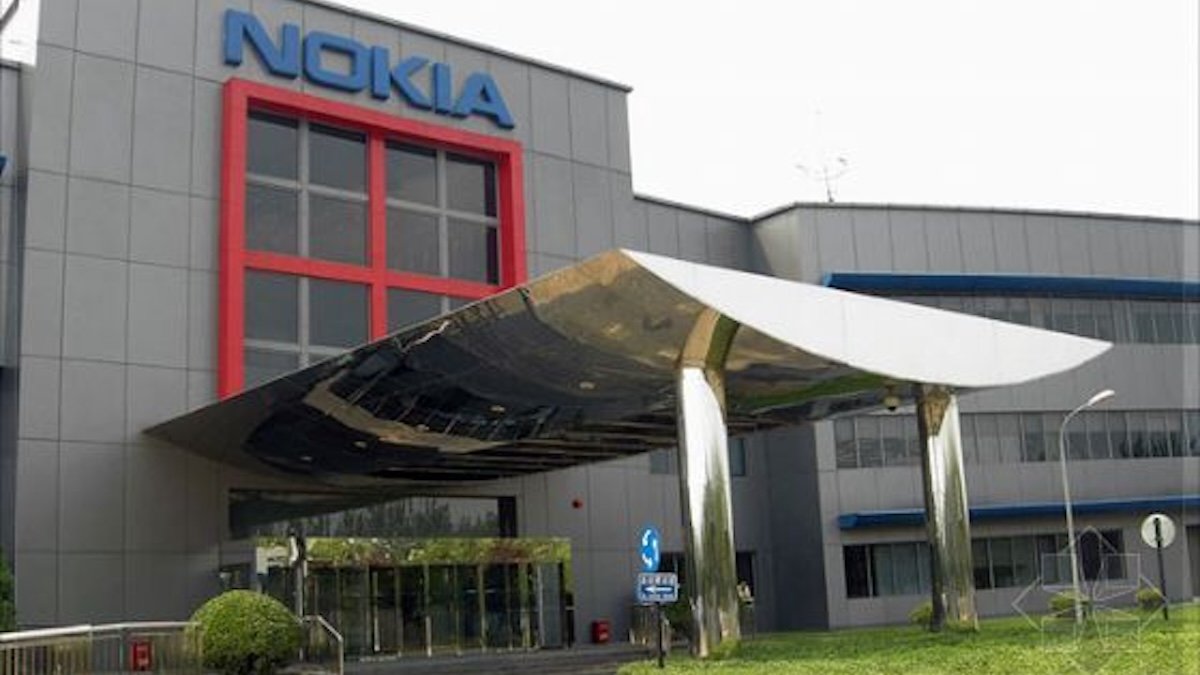
Finnish telecom equipment maker Nokia is winding down its operations in mainland China, closing nearly all remaining sites by the end of the year. The move, first reported by Light Reading, marks the clearest sign yet that Europe and China are severing their telecom supply lines after two decades of deep integration.
Nokia is closing its research and development center in Hangzhou, eliminating roughly 1,600 R&D positions, and shutting additional offices in Beijing, Chengdu, Qingdao, and Shanghai. What remains will be folded into Nokia Shanghai Bell, the joint venture Nokia fully acquired in late 2025, leaving a much smaller presence focused on serving existing customers rather than developing new equipment locally.
The retreat comes as Nvidia, the US chip giant, acquired a 2.9% stake in Nokia for US$1 billion last year. The two companies are partnering to build AI-powered 6G network technology, a bid to help the United States reclaim leadership in telecommunications infrastructure.
A split years in the making
The rupture traces back to late 2020 and early 2021, when Finland and Sweden barred Huawei Technologies and ZTE from their 5G networks, citing national security concerns. Washington had acted earlier, banning the two Chinese vendors from federal telecom contracts in 2019 and pushing the European Union to adopt bloc-wide restrictions. European countries did not move as one, splitting over how much risk the Chinese vendors actually posed.
The United Kingdom briefly allowed Huawei into non-core 5G equipment before reversing course in mid-2020 and ordering its removal by 2027. Germany opted for tougher vetting of all vendors rather than naming Huawei outright, while Hungary embraced the company fully, rejecting Washington's push.
In response, Beijing tightened scrutiny of Nokia's and Ericsson's bids for contracts with China's state-run carriers. In 2022, the Cyberspace Administration of China began subjecting such purchases to opaque “black box” security reviews, giving the two European vendors no insight into how their equipment was assessed.
Nokia's China revenue and regional headcount have both roughly halved since 2018. Ericsson has fared similarly, with China sales down by more than half and local workforce cut by about a third.
Mixed reactions in China
Some Chinese commentators warn that Nokia's exit will hurt China by causing job losses and closing off a channel for international technology collaboration that domestic firms cannot easily replace.
“Nokia's retreat from China is nothing worth celebrating,” says a Jiangsu-based columnist using the pen name “Xiaozaojun.” “The most direct impact is the loss of thousands of jobs. Once the Hangzhou research and development center shuts down, an estimated 1,600 employees will face layoffs or reassignment, and that means 1,600 families under real financial pressure.”
He adds that Huawei and ZTE have tightened their own hiring, and that laid-off Nokia employees may not fit their needs. “These layoffs will also drive down wages and strain suppliers farther down the industry chain.”
Chinese state media criticized Nokia's decision and took aim at Nokia Chief Executive Justin Hotard, who said last September that the European Union should reconsider why it allows Huawei and other “high-risk vendors” into its networks, even as China keeps Nokia's market share below 3%.
“Hotard's framing distorts the truth,” says Lai Jiaqi, a columnist with Guancha.cn. “Chinese telecom carriers actually want more equipment vendors to take part, since healthy competition in the bidding process helps raise technical standards and service quality, while also securing more cost-effective products.”
She argues that Western firms hold no advantage in technology, service, or price, and that their declining China market share is unsurprising.
Nokia's quiet revival
The general public may see Nokia and Ericsson as old-fashioned companies that lost to Apple and Samsung in the smartphone battle of the 2000s. But in fact, the two firms have spent the past two decades restructuring around telecom infrastructure and have regained growth momentum.
Both companies built their global reputations on radio access network equipment, the base stations and antennas that carry mobile signals, along with IP routing and optical networking gear—the same technology base they once sold widely across China.
Last September, Fierce Network reported that China may label Ericsson and Nokia as untrusted vendors, a retaliatory step mirroring Western restrictions on Huawei and ZTE. John Strand, president of Strand Consult, said such a move could further blunt their market share in regions like Southeast Asia, where Chinese vendors are gaining ground.
The decoupling is not just about equipment. It is reshaping global standards and supply chains, with AI-driven 6G development adding a new competitive layer. As China's role in global tech evolves, the split between Western and Chinese telecom ecosystems is likely to deepen, with implications for carriers and consumers across the Indo-Pacific.