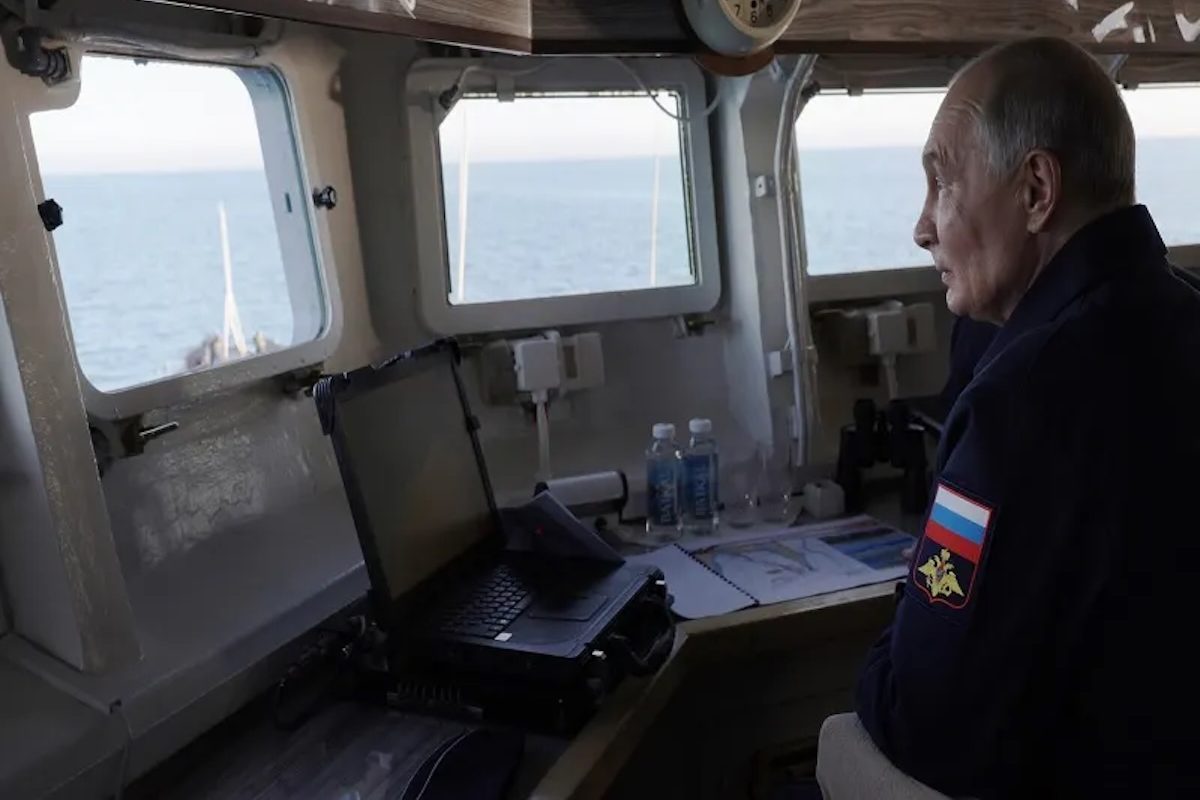
During a visit to Russia's Pacific Fleet headquarters in the Far East, President Vladimir Putin issued a stark warning: if Western countries continue to seize Russian-operated vessels, Moscow will respond in kind. His comments come amid a broader Western campaign against the so-called "shadow fleet" of aging tankers and bulk carriers that Russia has used to circumvent sanctions and sustain its oil exports.
Speaking to commanders in Vladivostok, Putin accused Western officials of "piracy and plunder," alleging that they were "attempting to restrict the movement by peaceful means of our economic operators' vessels in violation of International Maritime Law." He added that "recently it occurred to them that they can seize our vessels and sell our looted property."
Putin then threatened a direct response: "If this happens, we will have to reciprocate – not necessarily in the waters where they plan to raid our own ships but anywhere we consider necessary or reasonable, including in the Pacific Fleet's area of responsibility."
The remarks were made during a meeting with Admiral Viktor Liina, commander of the Pacific Fleet, who provided data on vessel traffic near the South Kuril chain—a group of islands that Russia controls but Japan claims as its Northern Territories. Liina reported that between April 24 and August 6, 2026, 1,001 vessels transited Russia's exclusive economic zone along those islands. Of those, 379 sailed under flags of "unfriendly states," including 273 bulk carriers and 71 tankers, with 26 from the United Kingdom and nine from France.
Liina also noted that Western nations were "actively enlisting vessels flying the flags of third countries to transport cargo in their interests," effectively operating their own shadow fleets. He asserted that Russia has "the necessary forces to inspect and detain vessels belonging to unfriendly states and their shadow fleet."
Putin's threat is not entirely new. Half a year ago, his senior aide Nikolai Patrushev, who chairs Russia's Maritime Board, warned that if Moscow did not respond firmly, "the British, French, and even the Baltic states will soon become so brazen that they will attempt to completely block our country's access to the seas." Patrushev suggested "permanently stationing significant forces in key maritime routes, including in regions remote from Russia, ready to cool the ardor of Western corsairs."
The escalation in rhetoric reflects a broader pattern. For months, Putin appeared cautious, hoping that Western nations would halt their seizures to avoid a dangerous spiral. But that restraint was interpreted as weakness, emboldening further actions. Similarly, Russia held back on its late-May threat to carry out "systematic strikes" against Ukraine, which allowed Kyiv to launch a Western-backed "war of attrition" against Russian infrastructure.
Only after Ukraine systematically attempted to deindustrialize and demilitarize Russia did Putin begin to "escalate to de-escalate," notably in the Kharkov and Odessa regions. That shift in approach may now extend to the maritime domain, as Putin appears willing to consider reciprocal seizures to restore deterrence.
However, the threat is conditional. Putin said Russia would respond "anywhere we consider necessary or reasonable," which could mean that Western vessels might avoid Russian waters and take care to steer clear of Russian naval assets worldwide. Thus, tit-for-tat seizures are not guaranteed, but the message is clear: Moscow is prepared to raise the stakes.
The implications for the Indo-Pacific are significant. The Pacific Fleet's area of responsibility includes key shipping lanes near Japan, South Korea, and Southeast Asia. Any Russian move to detain foreign vessels could disrupt trade and heighten tensions with Tokyo, which has its own disputes with Moscow over the Kuril islands. Japan's government has already voiced concerns about Russian military activity in the region.
For now, the immediate risk may be limited, but the underlying trend is worrying. As Western sanctions continue to squeeze Russia's economy, Moscow is likely to view the shadow fleet as a vital lifeline. Any further seizures could trigger a response that reverberates across the Pacific, affecting not just Russia and the West but also the many Asian nations that depend on stable maritime commerce.
Putin's latest remarks underscore a growing willingness to use naval power as a tool of coercion. Whether that translates into actual seizures remains to be seen, but the threat alone adds another layer of uncertainty to an already volatile geopolitical landscape.