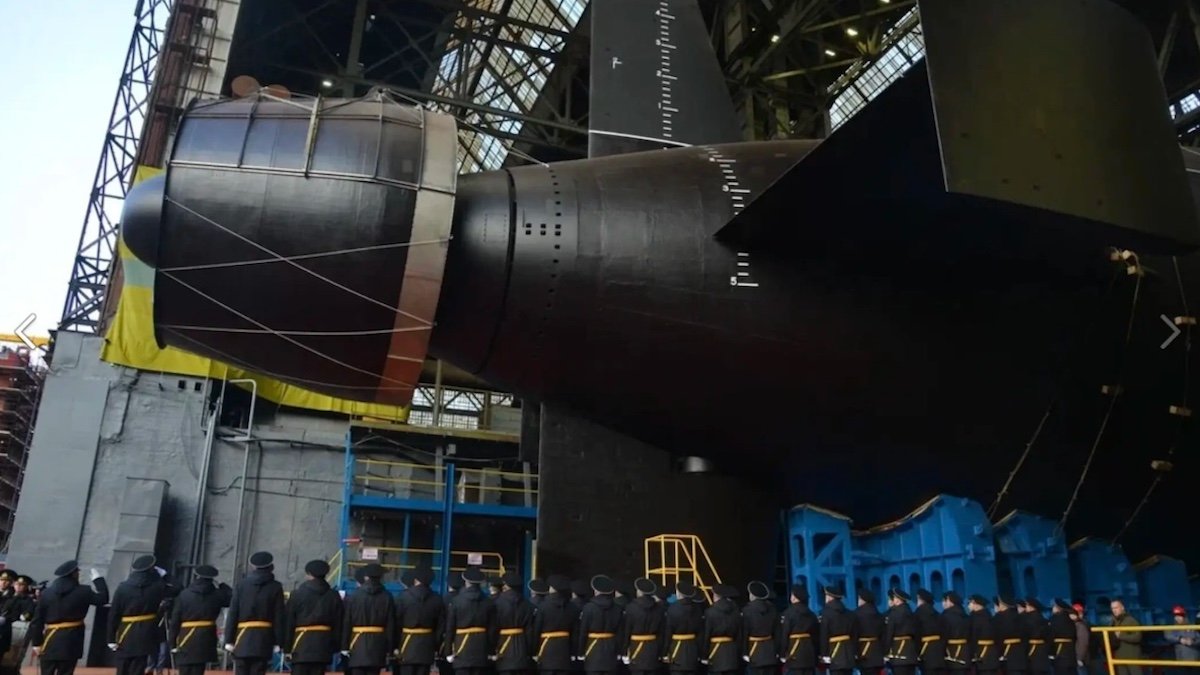
Russia is moving closer to deploying the Poseidon nuclear torpedo aboard its purpose-built Khabarovsk submarine, a development that tests the limits of US undersea defenses and raises questions about strategic stability in the Indo-Pacific. The vessel, currently being fitted out at the Sevmash shipyard in Severodvinsk in the Russian Arctic, is designed exclusively to carry the Poseidon—a nuclear-powered, nuclear-armed intercontinental torpedo that can evade conventional missile defenses and threaten coastal cities, strategic infrastructure, and carrier strike groups.
The Khabarovsk, approximately 135 meters long, integrates design elements from Russia's Borei-class ballistic missile submarines and the Belgorod, the first Poseidon carrier. It is believed to carry up to six Poseidon torpedoes in flooded side hangars, alongside limited conventional torpedo armament, underscoring its specialized strategic role. The vessel is likely powered by a single OK-650V nuclear reactor derived from the improved Borei-A design, emphasizing stealth and survivability as Russia invests heavily in unconventional nuclear deterrent systems.
Strategic Implications for the Indo-Pacific
According to a September 2021 Chatham House report, the Poseidon is a large autonomous nuclear torpedo capable of speeds around 70 knots, powered by a miniature nuclear reactor that gives it effectively unlimited range and allows it to dive to depths of up to one kilometer—beyond the reach of existing manned submarines. Russian officials present the weapon as multipurpose, capable of carrying either conventional or nuclear warheads to attack aircraft carrier groups, coastal fortifications, and infrastructure targets. This poses a direct challenge to US naval assets in the Pacific, where the US Navy maintains a significant presence in Japan, South Korea, and Guam.
Norman Polmar, writing in a January 2026 article for Proceedings, notes that Russia aims to build 30 Poseidon torpedoes to deploy on four submarines—two for its Northern Fleet and two for its Pacific Fleet. The Pacific Fleet deployment would bring the weapon within striking distance of US allies such as Japan and South Korea, as well as key US bases in Hawaii and Alaska. Thomas Siu, in a January 2022 Proceedings article, outlines a scenario where Poseidon could become a semi-autonomous second-strike weapon when integrated with Russia's Perimeter nuclear command-and-control system. Perimeter, designed to ensure a second-strike capability even if Russia's nuclear command and control are destroyed, could direct Poseidon torpedoes already on patrol in the Atlantic and Pacific to attack US port cities outside the effective range of US torpedoes.
This scenario highlights a critical capability gap for the US Navy. The US retired the UUM-44 Subroc anti-submarine missile in 1992, a submarine-launched weapon with a 55-kilometer range armed with a nuclear depth charge. Its planned successor, Sea Lance, was also canceled. As a result, the US Navy now lacks a long-range anti-submarine standoff weapon, a vulnerability that the Khabarovsk could exploit. For US allies in Asia, such as Japan and South Korea, this gap raises concerns about the reliability of US security guarantees in a crisis.
An August 2025 report from the Royal United Services Institute positions Poseidon as part of Russia's effort to preserve a credible second-strike nuclear capability against what it perceives as growing US counterforce and missile defense threats. The report describes systems like Poseidon as hedges against first-strike vulnerability amid Russian fears that US precision strike, missile defense, and low-yield nuclear systems could undermine strategic stability. This dynamic has direct implications for the Indo-Pacific, where the US maintains missile defense systems in Japan and South Korea, and where China's own nuclear modernization adds another layer of complexity.
Maxim Starchak, in a January 2026 Carnegie Politika article, notes that Poseidon gives Russia an asymmetric strategic advantage outside existing arms-control frameworks. Because Russia is not obligated to notify the US of Poseidon tests, the weapon increases escalation risks and keeps the US on constant alert. This lack of transparency could fuel miscalculations in a region already tense with competing territorial claims and military posturing.
Despite these strategic implications, significant questions remain about the viability of the Poseidon torpedo concept. Lukas Trakimavicius, in an October 2021 report for the NATO Energy Security Center for Excellence, contends that the weapon's operational effectiveness is unproven, and its deployment could provoke countermeasures that undermine its intended advantages. For now, the Khabarovsk represents a new frontier in undersea warfare, one that challenges the US and its allies in the Indo-Pacific to adapt their defenses and rethink deterrence strategies.



