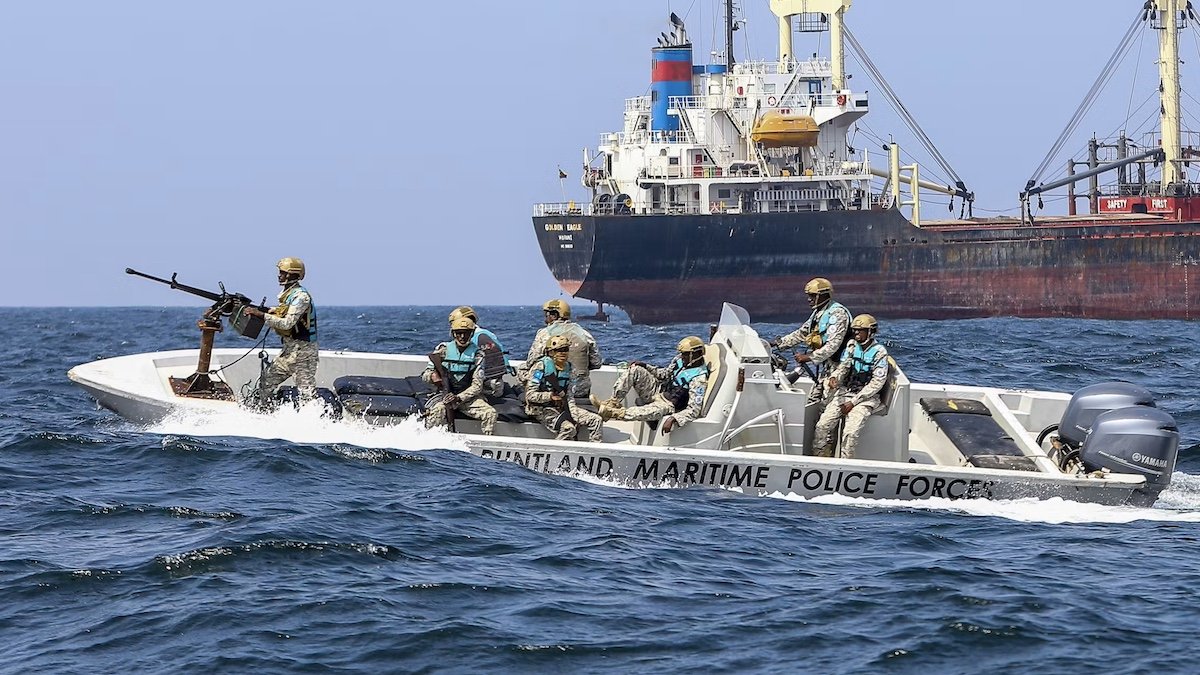
On the evening of April 26, armed men boarded the Egyptian merchant vessel Sward a few miles off the Somali coast and steered it toward an anchorage near Garacad, a port in the semi-autonomous state of Puntland in northeastern Somalia. Over the following days, additional gunmen and an interpreter tasked with negotiating a ransom joined the ship. As of this writing, the vessel remains under pirate control.
This hijacking is not an isolated incident. Two oil tankers—the Palau-flagged Honour 25 and the Togo-flagged Eureka—were seized around the same time and redirected toward the Puntland coast. Somali pirate groups have also commandeered several ocean-going dhows, traditional sailing vessels, to serve as motherships, enabling them to stay at sea for weeks and launch attacks far from the shore.
These events have sparked concern that Somali piracy is making a comeback, a decade after international naval patrols and private security measures largely suppressed it. Between 2005 and 2012, Somali pirates carried out more than 1,000 attacks on foreign ships, successfully hijacking 218 vessels and taking over 3,700 sailors hostage. Shipowners paid roughly $50 million in ransoms annually, while the broader economic toll—including lost trade and heightened security costs—reached up to $18 billion per year.
Why Now? The Iran War Connection
The resurgence is closely tied to the ongoing conflict involving Iran, which has drawn significant naval resources away from the Indian Ocean. The United States and its allies have redeployed warships to the Persian Gulf and the Strait of Hormuz, where tensions have escalated. Iran recently reimposed restrictions in the Strait, accusing the U.S. of maritime piracy, as reported in Iran Reimposes Strait of Hormuz Restrictions, Accusing US of Maritime Piracy. This shift has created a security vacuum off Somalia's coast, which pirate networks have exploited.
The Iran conflict has also disrupted regional trade routes, making commercial shipping more vulnerable. With fewer naval patrols in the western Indian Ocean, pirate groups have regained the confidence to operate openly. The use of dhows as motherships—a tactic common during the 2005–2012 peak—allows them to strike far from the Somali coastline, targeting vessels along key shipping lanes connecting Asia, Africa, and Europe.
Puntland, where most of the recent hijackings have occurred, remains a weak link in regional security. The semi-autonomous state lacks the capacity to patrol its waters effectively, and its coastline is long and porous. Land-based development initiatives, which were part of the earlier anti-piracy strategy, have not been sustained, leaving local communities vulnerable to recruitment by pirate gangs.
A Dormant Threat, Not a Defeated One
Despite the success of international efforts between 2012 and 2020, the underlying networks that enabled Somali piracy were never dismantled. Few pirate kingpins faced trial, and their supply chains—including financiers, negotiators, and corrupt officials—remained intact. The recent hijackings suggest that these networks were merely dormant, waiting for conditions to shift in their favor.
The broader geopolitical context amplifies the risk. The Iran war has complicated peace efforts in the Middle East, as noted in Trump's Abraham Accords Push Complicates Iran Peace Efforts, and has drawn in regional powers like India and Japan, which rely heavily on Indian Ocean shipping lanes for energy imports. For Tokyo and New Delhi, the return of Somali piracy is a direct threat to their economic security. Japan's Maritime Self-Defense Force, which previously participated in anti-piracy patrols, may need to reconsider its posture.
The implications extend beyond the immediate hijackings. Insurance premiums for vessels transiting the Indian Ocean are likely to rise, and shipping companies may reroute cargoes, increasing costs for consumers across Asia. The United Nations Security Council, which has passed resolutions on Somali piracy in the past, faces renewed pressure to act—though the Philippines and Kyrgyzstan are currently competing for a seat on the council, as reported in UN Security Council Race: Philippines vs Kyrgyzstan Reflects Geopolitical Shift, which could affect the body's focus.
For now, the international community must confront the reality that Somali piracy is not a relic of the past but a resurgent threat, fueled by the chaos of the Iran war. Without a coordinated response—combining naval patrols, intelligence sharing, and investment in Somali coastal governance—the Indian Ocean could once again become a hunting ground for pirates.