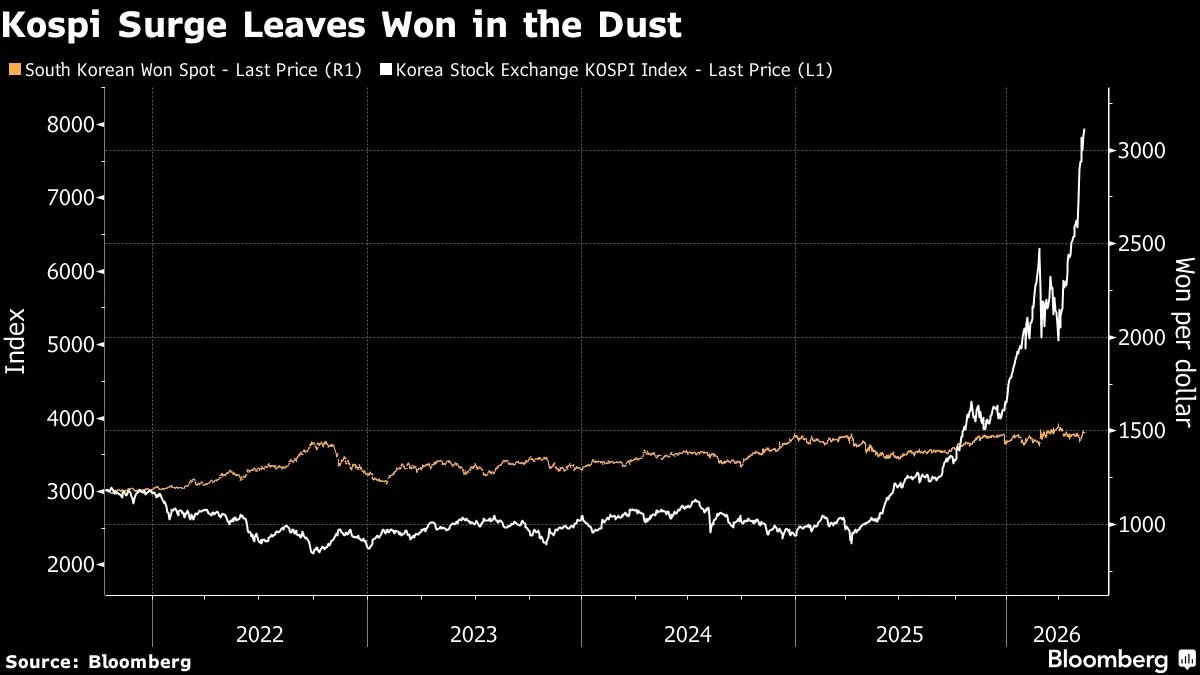
South Korea is making an enormous bet on artificial intelligence. President Lee Jae-myung has thrown his weight behind an 800 trillion won (US$578 billion) semiconductor expansion led by Samsung Electronics and SK Hynix, championed a new chip hub in the country's southwest, and joined Korean and American tech firms in AI initiatives worth hundreds of billions of dollars.
The urgency is understandable. South Korea's strengths in high-bandwidth memory, advanced manufacturing, robotics, and digital infrastructure give it a prominent place in the global AI economy. But the investment headlines mask a deeper vulnerability.
China's scale advantage
China commands a far larger domestic market, a vast engineering workforce, and increasingly capable low-cost models. Chinese AI systems have recently attracted foreign users at prices as low as one-twentieth of leading US alternatives. South Korea has neither China's scale nor its cost structure. It cannot win by becoming a smaller, more expensive version of a closed system. Its comparative advantage must rest on greater openness.
AI development depends on people who challenge assumptions, report failures upward, test unpopular hypotheses, and move information across institutional boundaries. Engineers must tell managers when a model is unreliable. Workers must point out where automation fails. Researchers must revise conventional explanations when new evidence appears. A society where people first infer the socially acceptable answer and then decide what to say trains exactly the wrong habits.
The recent controversy surrounding actress Ha Young (legal name Ahn Ha-young) illustrates the power of conformity. On an August 7 television program, she proudly described a family of four generations of doctors. Her great-grandfather, physician Ahn Sang-ho, studied Western medicine in Japan, became the first Korean to obtain a Japanese medical license, served members of the royal family, and helped organize Korean physicians.
Online scrutiny then uncovered a more controversial side. Ahn's name appeared on the 1916 council roster of the Daejeong Friendship Association, an organization associated with cooperation with Japanese colonial rule, and other records suggested considerable assimilation into Japanese colonial society.
Ha Young's agency first called the allegations groundless, then acknowledged the record. Within days, Ha Young issued a handwritten apology “as a descendant,” while broadcast and advertising material featuring her was made private. Ahn Sang-ho's association with colonial institutions deserves historical scrutiny. Nor is Ha Young exempt from criticism for speaking confidently about a family history she had not fully investigated.
The revealing part is the structure of the sanction: a great-granddaughter expressed pride in an ancestor's medical achievements, learned of compromising political associations from a century earlier, apologized for her pride, and quickly lost commercial visibility. Individual responsibility blurred into inherited stigma.
Samsung Electronics, the center of Korea's AI investment drive, quickly made all six Samsung Art TV advertisements featuring Ha Young private, while other companies and broadcasters removed public material featuring her. The reaction illustrates the dominant pull of public conformity: even a technology leader investing heavily in an economy built on open experimentation chose immediate distance rather than waiting for fuller historical discussion.
Korea's colonial past is difficult, and serious scholarship does not yield a single story. The controversial 2019 bestseller “Anti-Japan Tribalism,” written by Lee Young-hoon and several other scholars, challenged influential accounts of colonial economic development, forced labor, and the comfort-women system, and provoked extensive scholarly rebuttal. One need not accept its arguments to recognize the value of the resulting debate. A liberal democracy answers provocative claims with evidence, counterarguments, and better scholarship rather than treating disagreement itself as evidence of moral contamination.
The purpose of open discussion is not to declare every interpretation equally valid. It is to make errors visible and correctable. When institutions punish heterodox claims before they are publicly tested, disagreement does not disappear. It simply exits to partisan channels, anonymous forums, and ideologically homogeneous communities, where correction becomes harder.
China demonstrates that political closure does not prevent technological achievement. Chinese engineers and firms have produced formidable AI systems despite censorship and information controls. But China offsets those constraints with scale, capital, lower costs, a vast technical workforce, and a Party-led labor system without competing independent unions. South Korea lacks those advantages. If it reproduces some of China's information closure while carrying higher wages and a smaller market, it sacrifices the central advantage of a liberal society: the denser circulation of criticism, information, and unconventional ideas.
The United States is hardly free from ostracism or ideological conformity. Its strength is greater institutional pluralism. When actress Gina Carano lost a major entertainment role after controversial political posts, she quickly found another production partner and later secured outside financial support for litigation that ended in a settlement, with the possibility of future work with her former studio. Likewise, unpopular religious minorities such as the Unification Church find specialized institutions willing to defend freedom of religion or belief and liberal procedural rights. The point is not that Americans suffer no exclusion, but that exclusion from one institution is less likely to mean exclusion from public life altogether.
This institutional pluralism has an economic function. It keeps dissenters, contrarians, and unconventional thinkers in the game—exactly the people who drive innovation in AI and other cutting-edge fields. South Korea's AI future depends not just on chips and capital, but on whether it can cultivate a culture that tolerates—and even rewards—dissent. As Seoul's economy faces strain from shifting US priorities, the stakes are high. For South Korea to compete with China, it must embrace the openness that its liberal democracy promises, not the conformity that its history too often delivers.