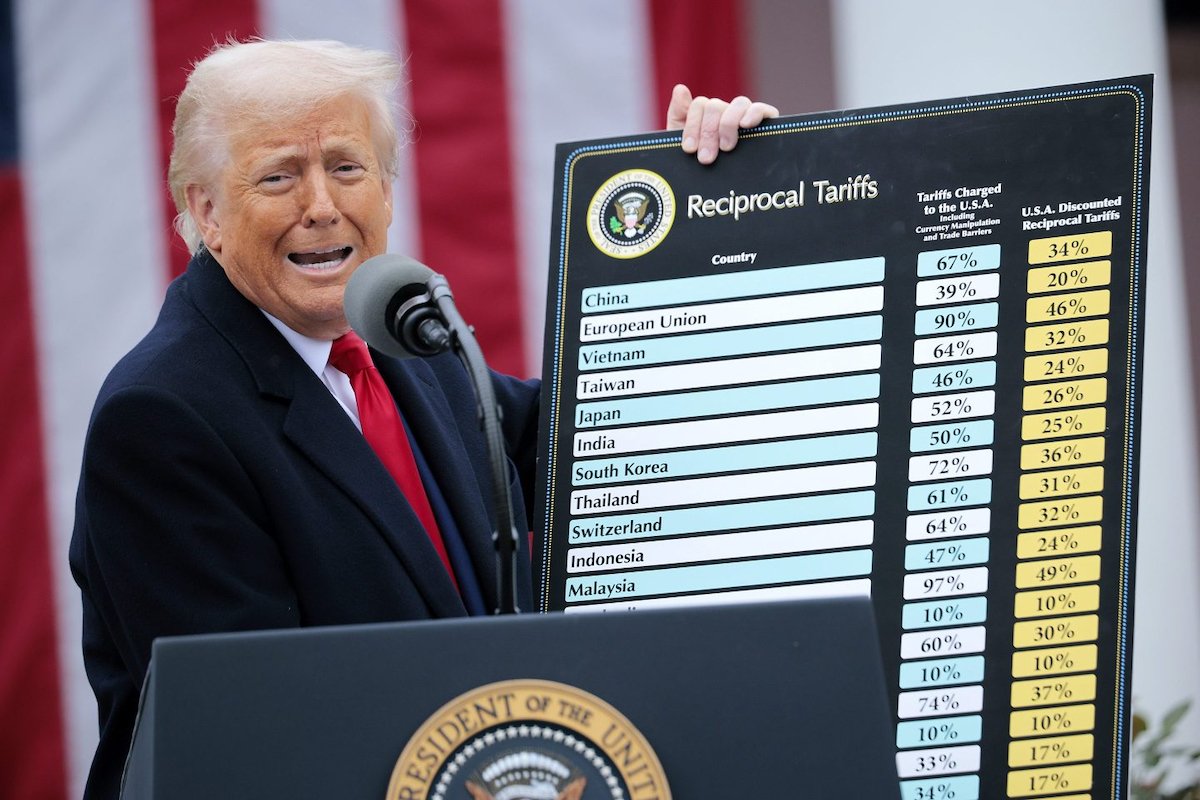
A comprehensive study released Monday by the Kiel Institute for the World Economy, a German-based economic think tank, has dismantled President Donald Trump's repeated assertion that foreign producers bear the cost of his tariffs on imported goods. The research, which analyzed over 25 million shipment records from last year, found that foreign exporters absorbed just 4% of the $200 billion in tariff payments, with the remaining 96% passed on to US importers and consumers.
“This finding has profound implications,” the study states. “If foreign exporters do not reduce their prices in response to tariffs, then the entire burden of the tariff falls on US buyers. The tariff functions not as a tax on foreign producers, but as a consumption tax on Americans. Every dollar of tariff revenue represents a dollar extracted from American businesses and households.”
Why Exporters Didn't Cut Prices
The study identifies several reasons why foreign exporters did not slash prices to remain competitive in the US market. These include shifting sales to other markets without such high tariffs, the inability to absorb the steep price cuts needed to offset Trump's tariff rates, and reluctance to reward US consumers with lower prices, which could incentivize further tariffs.
Julian Hinz, research director at the Kiel Institute and a co-author of the study, described the Trump tariffs as an “own goal” that has harmed Americans far more than foreigners. “The claim that foreign countries pay these tariffs is a myth,” Hinz explained. “The data show the opposite: Americans are footing the bill.”
The findings come amid broader trade tensions that have drawn parallels to other geopolitical flashpoints, such as the Hormuz blockade raising stakes ahead of a Trump-Xi summit, where tariff policies intersect with security concerns in the Indo-Pacific.
In a separate analysis published Monday, economist Dean Baker of the Center for Economic and Policy Research (CEPR) argued that Trump's latest tariffs on Europe amount to a “$75 billion tax increase” in an attempt to fulfill the president's “demented dreams” of taking over Greenland, a self-governing Danish territory. “Well over 90% of the cost of a Trump tariff is borne by consumers or importers in the United States, not by the exporting countries,” Baker contended. “When Trump starts yelling ‘tariff, tariff, tariff,’ he is yelling ‘tax, tax, tax,’ and we’re the ones paying it. And $75 billion is not trivial. It’s 1% of the budget, more than twice the cost of the enhanced premiums for Obamacare policies that Trump says we can’t afford.”
The study's implications extend beyond US borders, particularly for Asian economies that are major exporters to the United States. Countries such as China, Japan, South Korea, and Vietnam have faced significant tariff hikes under Trump's trade policies. For instance, Chinese exporters have redirected goods to Southeast Asian markets or Europe to mitigate losses, while Japanese automakers have absorbed some costs but ultimately passed them on to US dealerships and consumers.
This dynamic has fueled broader regional concerns, as seen in the persistence of scam compounds in Southeast Asia, where trade disruptions can exacerbate economic vulnerabilities. The Kiel Institute's data underscores that tariffs, rather than protecting American workers, function as a regressive tax that disproportionately affects lower-income households.
The study also highlights the disconnect between Trump's rhetoric and economic reality, a theme echoed in other policy areas. For example, the scrutiny of Fed nominee Warsh's independence pledge reflects broader concerns about political interference in economic institutions. As the 2024 election cycle intensifies, the tariff debate remains a flashpoint, with economists broadly agreeing that the costs are borne domestically.
For Asian exporters, the findings suggest that tariff relief is unlikely to come from price adjustments. Instead, they must navigate a fragmented global trade landscape, where shifting supply chains and regional trade agreements offer alternative pathways. The Kiel Institute's research provides a data-driven rebuttal to a central pillar of Trump's economic agenda, reinforcing the consensus among economists that tariffs are a tax on Americans, not on foreign nations.