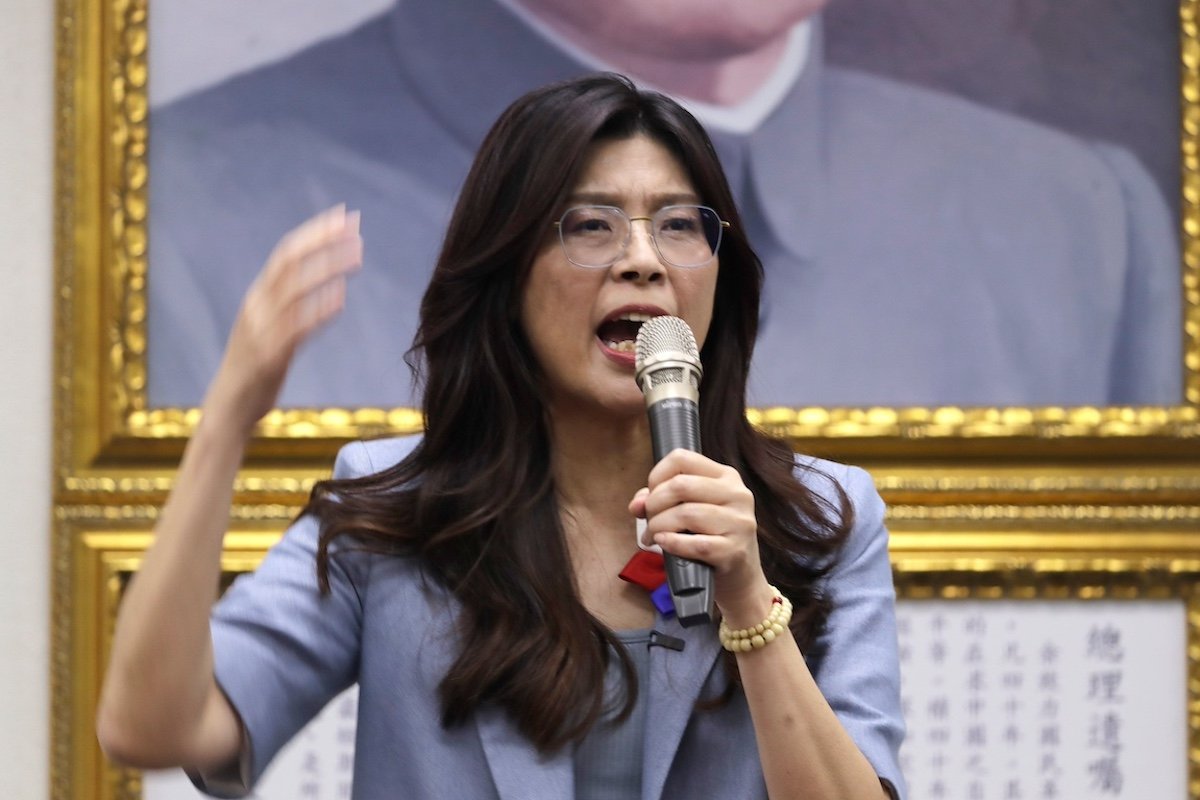
Fresh from a meeting with Chinese paramount leader Xi Jinping in April, Kuomintang (KMT) Chairwoman Cheng Li-wun is preparing for a June visit to the United States. The trip, which includes meetings with US officials, think tanks, and elite universities, is intended to present her vision for cross-Strait relations that she claims will secure peace for Taiwan while aligning with American interests. However, the reception is likely to be awkward.
Cheng's challenge lies in reconciling two fundamentally conflicting agendas. Beijing seeks to sever Taiwan's security ties with Washington, pushing Taipei toward formal unification with the People's Republic of China. The United States, for both ideological and strategic reasons, aims to preserve Taiwan's liberal democratic system and deter any forcible annexation by China. Washington's immediate priority is arming Taiwan to address its quantitative military inferiority relative to the People's Liberation Army.
While Cheng's policy ideas resonated smoothly in Beijing, they will face a tougher crowd in the US. Her past statements reveal a deep skepticism toward American commitments. She has described the United States as treating Taiwan as a “chess piece, a pawn, to strategically provoke the Chinese Communist Party at opportune times.” On the Ukraine war, she has blamed NATO as the “core reason” for the conflict and defended Vladimir Putin as “not a dictator; he is a democratically elected leader.”
Cheng draws a direct parallel between Ukraine and Taiwan: the US, she argues, would not send troops to fight alongside Taiwanese but would supply weapons to prolong a war, resulting in massive destruction and a Chinese victory. These views echo prominent themes in Chinese propaganda, including the notion that NATO caused the Ukraine war and that the US tricks its allies into proxy wars.
Her stance on US arms sales is similarly contradictory. In principle, she supports continued sales, but she has criticized the ruling Democratic Progressive Party (DPP) government for lacking transparency and fiscal discipline in procurement. She also complains that arms sales disproportionately benefit the US and turn Taiwan into a “powder keg.” This mashup of recognizing defense needs, incorporating Beijing's outlook, and bashing domestic opponents will likely be scrutinized by American audiences.
Internal KMT Divisions
Cheng represents the KMT faction that is relatively pro-Beijing and anti-American, alongside figures such as vice-chairman Hsiao Hsu-tsen and legislators Fu Kun-chi and Jessica Chen Yu-jen. This group argues that the US is an unreliable protector, advocates avoiding provocation of China, objects to excessive defense spending, and cautions against close ties with Washington.
An alternative KMT faction—including Eric Chu, Johnny Chiang, Lu Shiow-yen, Jaw Shaw-kong, and Hau Lung-bin—argues for maintaining strong defense ties with the US and seeking limited engagement with China. This group is willing to increase defense spending and meet Washington's expectations, aiming to engage Beijing from a position of strength.
Public opinion in Taiwan is mixed. A March 2025 poll by the Taiwanese Public Opinion Foundation found that only 39% of respondents believed the US would send military forces to intervene if China attacked Taiwan. Yet most Taiwanese hold favorable views of the US and negative views of China, with less than 10% trusting Beijing. A TVBS poll released April 24 indicated that only 39% supported Cheng's meeting with Xi, with most disapproving of what they perceived as selling out Taiwan's sovereignty.
Jaw Shaw-kong, mindful of public sentiment, wrote on April 30: “The Kuomintang has already been labeled ‘pro-China’ by the DPP. If they are also called ‘anti-American,’ then there will be no need to hold elections this year or in 2028.”
Despite her skepticism, Cheng acknowledges the value of US support, stating it is “impossible” for Taiwan to do without American assistance and “very crucial and important for us to have solid US support for Taiwan.” This potential contradiction will be tested during her visit. Journalists and officials in her American audience are well aware of her past statements, and they are likely to press her on how she can simultaneously pacify Beijing and maintain Washington's backing.
For a deeper look at the KMT's broader diplomatic strategy, see our analysis: Taiwan's KMT Offers US a Diplomatic Off-Ramp from Cross-Strait Conflict. The party's internal dynamics also intersect with regional security concerns, as explored in China's Drone-Launched Mines Could Encircle Taiwan and Entangle US Forces.