Since late February, when the US–Israel military campaign against Iran intensified, images of giant billboards in Tehran have flooded traditional and social media. Placed in the city's busiest squares—Valiasr, Enqelab, Vanak—these displays are constantly updated to mirror current events. Iran has long used public spaces for political messaging, dating back to the 1979 Islamic Revolution and the Iran–Iraq War, when murals and billboards carried revolutionary imagery and war memorials. Today, however, the strategy has evolved: these billboards are designed not only for Iranian pedestrians but also for global digital circulation, often featuring Hebrew and English alongside Farsi.
Visual Narratives of Grief and Revenge
One widely circulated billboard in Valiasr Square depicts Iranian missiles covered with handwritten messages. Among the most striking is the phrase “To the girls of Minab,” written in bold red Farsi, referencing a strike on a girls' school early in the war that Iranian officials say killed 175 students and teachers, with reports pointing to US responsibility. Below it, in English, are the words “Epstein Island victim girls,” linking the tragedy to the convicted sex offender Jeffrey Epstein's island. Another missile bears “the girl with the pink jacket,” a reference to a young Iranian girl killed in a 2024 terror attack, identified by her pink jacket and heart-shaped earrings. The imagery connects disparate events through a narrative of vulnerable young women affected by violence, exploitation, and political power, reframing missiles as symbols of grief, revenge, and defense rather than mere weapons.
Another billboard, which gained attention in 2024, shows the Farsi phrase “If you want war, we are masters of war” above a Hebrew message: “Israel must be wiped from the face of the earth.” The sky over Israel is depicted with waves of incoming missiles, resembling a meteor shower. By addressing Hebrew-speaking viewers directly, the billboard functions as a psychological warning and a projection of power. This multilingual approach reflects a shift in Tehran's urban propaganda: the regime knows these images will circulate instantly online, reaching audiences in Israel and beyond.
Targeting the West and Drawing on Myth
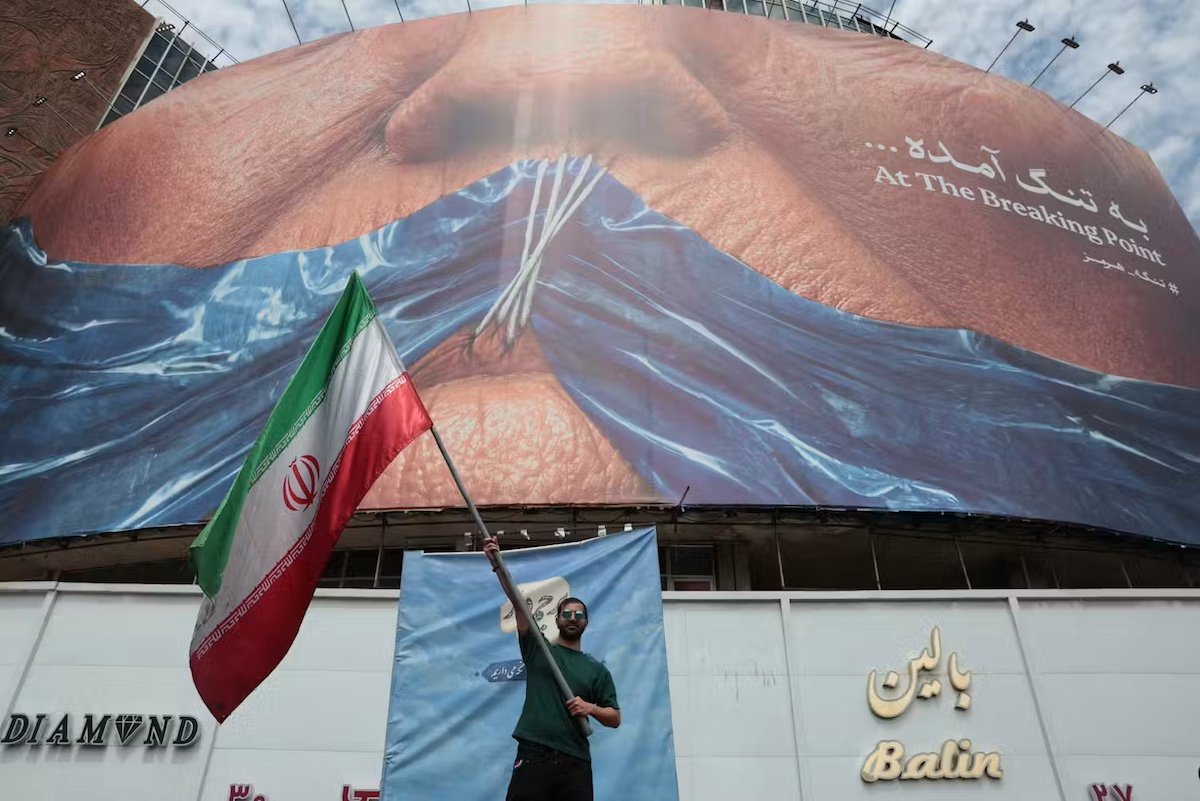
A bilingual billboard targeting American audiences features US President Donald Trump's mouth with a rendering of the Strait of Hormuz sutured on top, alongside the English phrase “The Breaking Point.” The Farsi text translates roughly to “its patience has run out,” with a pun on the word tang, meaning both “narrowness” and “strait.” The sutures symbolize silencing and constraint, critiquing Trump's rhetoric and media presence while linking geopolitical tensions in the Strait of Hormuz to a psychological breaking point.
Another billboard draws on the Persian myth of Arash the Archer, depicting him placing an arrow into his bow amid missiles. The ancient story tells of Arash sacrificing his life after shooting an arrow during a war between Iran and Turan. The image suggests modern Iranian soldiers are willing to make similar sacrifices to defend their homeland, reflecting how poetry and mythology are deeply embedded in Iranian culture and state messaging.
These billboards are part of a broader visual communication strategy, researchers argue, intended to be photographed and shared widely on social media as a way of projecting power and resistance. Even with a months-long internet blackout in place, the regime ensures these images reach global audiences. The strategy also parallels digital propaganda tactics seen elsewhere in the region, as explored in China and Vietnam Share a Digital Propaganda Playbook for Control.
The messaging also ties into broader geopolitical narratives. For instance, the focus on the Strait of Hormuz echoes tensions that have implications for energy security and regional stability, much like the discussions in Trump's Golden Dome Missile Shield: A False Promise Against Modern Threats. Meanwhile, the use of Hebrew and English underscores Iran's intent to influence international opinion, a tactic that resonates with the dynamics of UAE-Israel Ties: Useful but No Middle East Reset.