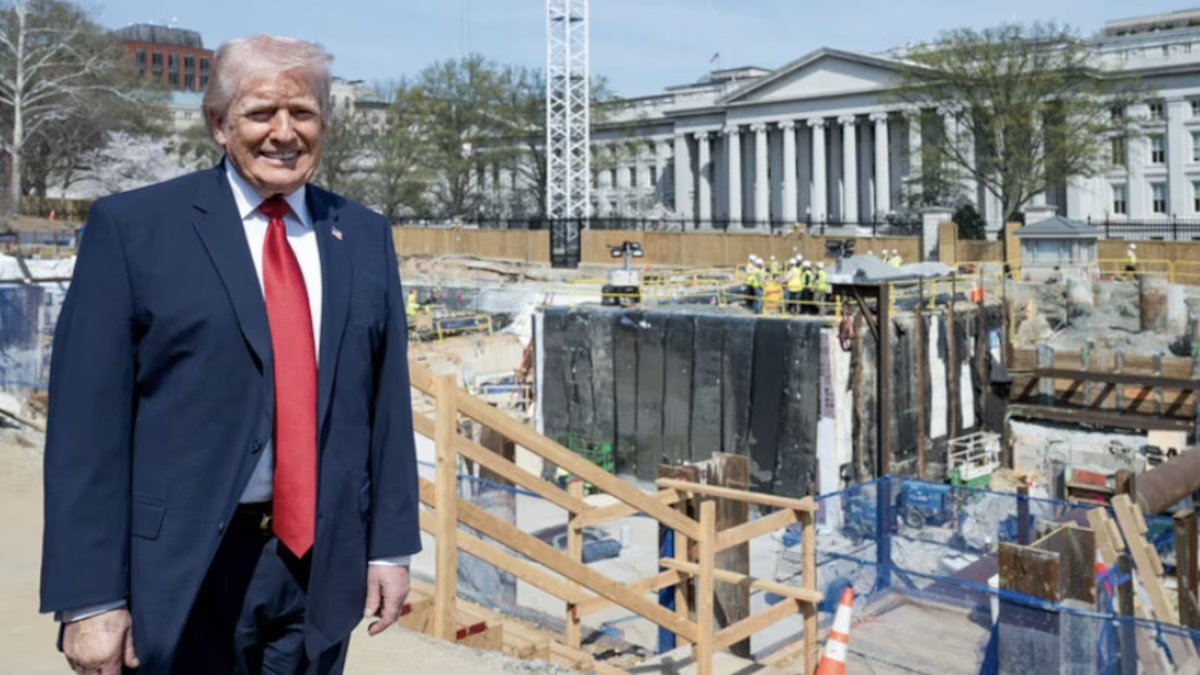
President Donald Trump, facing his lowest approval ratings of his second term, took time on Tuesday to showcase progress on a luxury ballroom under construction at the White House. Speaking to reporters, Trump described the planned structure as “something incredible” and revealed it would feature military-grade drone capabilities.
“On top of the roof, we’re gonna have the greatest drone empire that you’ve ever seen,” Trump said. “And it’s gonna protect Washington.” He elaborated that the ballroom’s lower levels are “far more complex than the upper,” housing critical rooms for military use. The roof, he claimed, would be “drone-proof” and serve as a “drone port” for unlimited unmanned aircraft.
The president’s remarks come as his administration navigates a volatile geopolitical landscape. Trump also dismissed public concerns over rising gasoline prices—averaging $4.53 per gallon in the U.S.—linked to his ongoing military campaign against Iran, which began in late February without congressional authorization. “This is peanuts,” Trump said of the fuel costs. “I don’t even think about that. What I think about is you can’t let Iran have a nuclear weapon.”
Yet U.S. intelligence assessments contradict that urgency. Director of National Intelligence Tulsi Gabbard testified under oath last month that Iran’s nuclear weapons program had been “obliterated” by U.S.-led airstrikes in 2024, with no subsequent rebuilding efforts detected. The disconnect between Trump’s rhetoric and official intelligence has drawn criticism from analysts.
Gulf Mediation and a Paused Strike
On Monday, Trump announced on his Truth Social platform that he had paused a planned military attack on Iran at the request of three Gulf leaders: Qatar’s Emir Tamim bin Hamad Al Thani, Saudi Arabia’s Crown Prince Mohammed bin Salman Al Saud, and UAE President Mohamed bin Zayed Al Nahyan. Trump claimed serious negotiations were underway and that a deal would include “NO NUCLEAR WEAPONS FOR IRAN.” He instructed Secretary of War Pete Hegseth and Joint Chiefs Chairman General Daniel Caine to prepare for a “full, large scale assault” if talks fail.
Trita Parsi, executive vice president of the Quincy Institute for Responsible Statecraft, noted on X that Trump appears to recognize escalation’s risks but questioned whether the administration possesses the discipline for meaningful diplomacy. The pause underscores the delicate balancing act between Washington’s military posture and the interests of key Middle Eastern allies, who fear regional destabilization.
The ballroom boast also follows an anonymous White House official’s claim that Cuba is preparing a drone attack on the U.S.—an allegation dismissed by Havana and independent commentators. This narrative echoes broader concerns about drone proliferation, including in the Caribbean, where Cuba's drone buildup with Russian, Chinese, and Iranian backing raises US alarm. For Asian capitals, the episode highlights how Trump’s focus on domestic spectacle and Middle Eastern crises may distract from pressing Indo-Pacific challenges, such as the strategic gap in Asia exposed by Trump's Taiwan remark.
As Trump’s approval ratings sag—exacerbated by inflation and the Iran conflict—his administration’s priorities appear increasingly inward-looking. The ballroom project, with its futuristic drone defenses, may be a bid to project strength, but it risks alienating allies in Asia and beyond who seek consistent U.S. engagement on trade, security, and climate. For now, the region watches as Washington’s attention oscillates between luxury construction and a potential war in the Middle East.