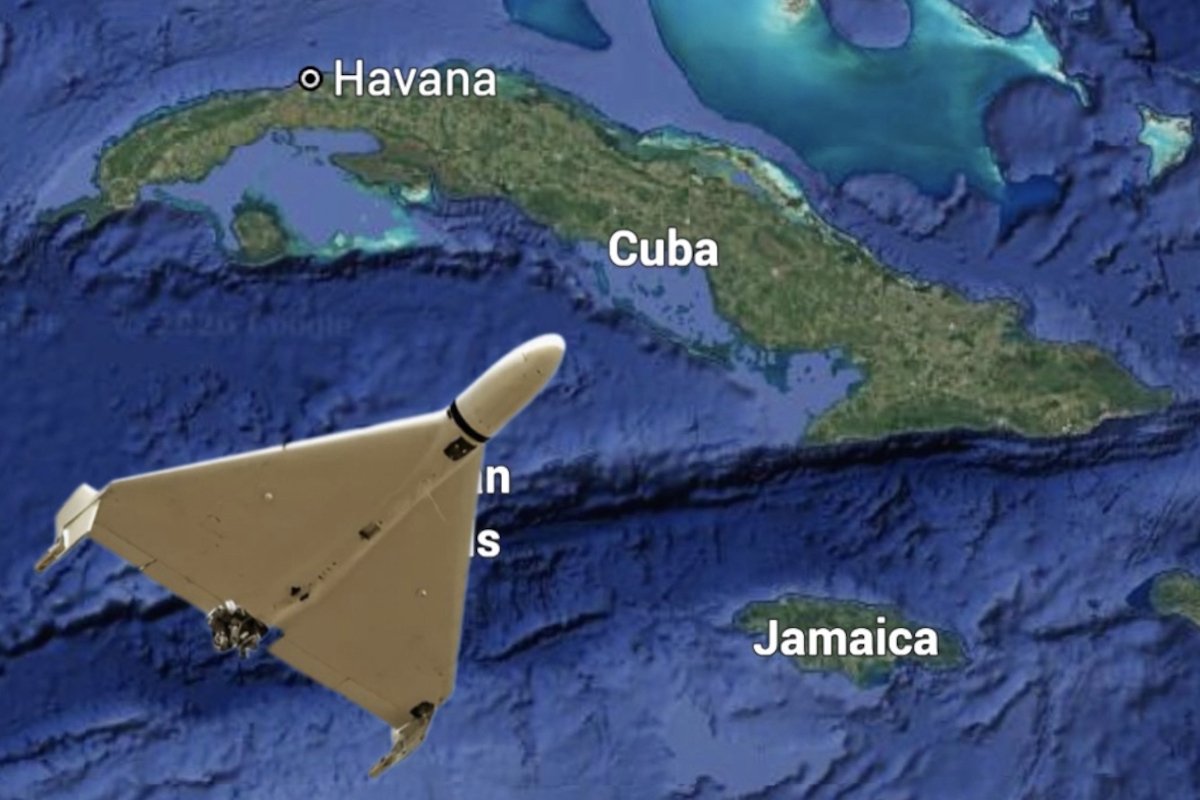
Washington is increasingly concerned that Cuba's expanding military drone program, backed by Russia, China, and Iran, is transforming the island into a strategic pressure point near US territory. According to classified intelligence reported by Axios this month, US officials fear that Cuba's drone capabilities could threaten the US naval base at Guantanamo Bay, US military vessels, and even Key West, Florida.
Cuba has obtained more than 300 drones with varying capabilities since 2023, deployed at key locations across the island, and has been seeking additional systems from Moscow in recent weeks. CIA Director John Ratcliffe reportedly traveled to Havana to warn Cuban officials against hostile actions, as the US weighs further sanctions and legal measures against Cuba's leadership.
US Defense Secretary Pete Hegseth informed Congress that foreign intelligence activities in Cuba have been a longstanding concern. Cuba did not deny possessing attack drones, asserting its right to self-defense under international law and accusing the US of fabricating pretexts for aggression.
Asymmetric Threats and Great-Power Rivalry
While US officials say Cuba is not considered an imminent threat, they warn that lessons from Iranian drone warfare and Cuban involvement in Russia's war in Ukraine have heightened the island's military relevance. For US planners, the primary concern is not a conventional Cuban challenge but the potential for Cuba to serve as a nearby platform for asymmetric disruption, surveillance, and political coercion.
The War Zone noted that during the lead-up to Operation Absolute Resolve in Venezuela, many US aircraft were parked openly in the Caribbean, making them vulnerable to drone strikes. The Iran war has underscored the destructive potential of such attacks, with the Washington Post reporting that Iran has hit 228 structures or pieces of equipment at US bases in the Middle East since April 2026, including an E-3 Sentry command-and-control aircraft at Prince Sultan Air Base in Saudi Arabia.
Chinese and Russian intelligence facilities in Cuba—at Bejucal, Wajay, Calabazar, and El Salao—contain equipment capable of intercepting communications, monitoring satellites, and tracking military activity, according to a December 2024 report by Matthew Funaiole and others at the Center for Strategic and International Studies (CSIS). Cuba's proximity to Florida allows monitoring of sensitive US military communications, rocket launches, and naval operations. Russian personnel have returned to Lourdes, Russia's largest overseas signals intelligence site.
However, Daniel DePetris argued in a January 2026 Defense Priorities report that the logic of Mutually Assured Destruction (MAD) that stabilized the 1962 Cuban Missile Crisis still constrains escalation today. He added that Chinese intelligence facilities on the island offer limited strategic value in a China-US conflict centered primarily in the Pacific. This dynamic echoes broader concerns about China's missile expansion reshaping Taiwan contingency planning in the Indo-Pacific.
Strategic Costs and Domestic Constraints
Responding to a relatively limited Cuban threat could impose disproportionate strategic costs on the US. A US buildup in the Caribbean—whether for intimidation or preparation for strikes on Cuba—could overstretch military resources, time, and strategic attention from other theaters. Stars and Stripes noted in November 2025 that during Operation Southern Spear, the US deployed 20% of its operational warships in the Caribbean, leaving the Mediterranean and Middle East without a US carrier.
Rocío de los Reyes Ramírez argues in an April 2026 article for the Spanish Institute of Strategic Studies that direct US intervention in Cuba remains unlikely in the near term, but intervention scenarios are increasingly normalized in political and public debate. Cuba's internal deterioration, energy crisis, protests, and geographic proximity have expanded the range of conceivable US responses, including more intense pressure or intervention. However, domestic political constraints—voter fatigue, economic pressures, migration concerns, and the political sensitivity of Florida—limit the Trump administration's willingness to undertake open escalation. Instead, the US favors calibrated pressure, targeted interventions, selective contacts, and strategic ambiguity over direct military action.
Claudia Zilla notes in an April 2026 report for Stiftung Wissenschaft und Politik (SWP) that the US seeks political and economic change through blockades, coercion, and negotiations with ruling elites rather than democratic actors, potentially preserving authoritarian structures under US influence. Michael Bustamante writes in The Conversation that although surveys indicate many Cubans and Cuban Americans support US intervention, such action does not resolve complex issues like rebuilding institutions, restoring trust, addressing inequality, or reconstructing the economy.
The evolving situation in Cuba reflects broader anxieties over great-power rivalry and strategic influence near US territory, with implications for the Indo-Pacific as well. As the US balances multiple theaters, the risk of overextension remains a key consideration for policymakers in Washington, Tokyo, Seoul, and beyond.