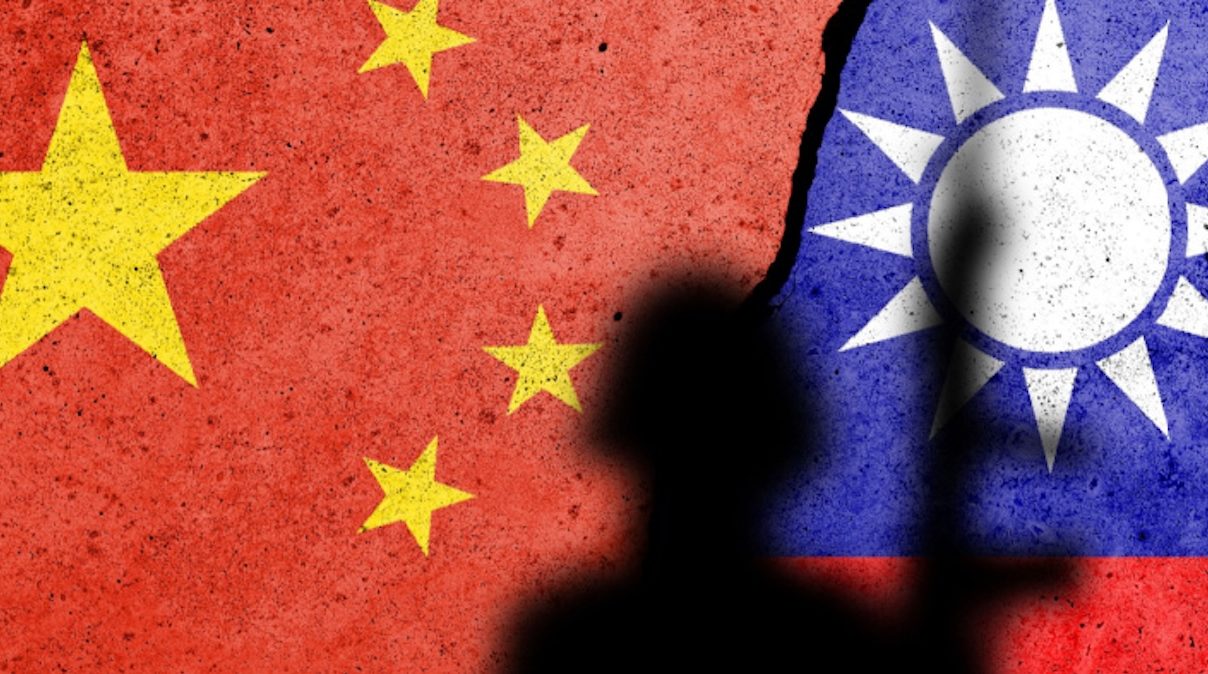
Last week's summit between President Donald Trump and President Xi Jinping in Beijing produced a moment of unusual candor—not in the Great Hall of the People, but aboard Air Force One. Asked by Fox News about the island that had dominated two days of talks, Trump replied: "We will call it a place, because nobody knows how to define it." When pressed on whether Taiwanese citizens should feel more or less secure after the summit, he answered: "Neutral."
The reaction from Washington's bipartisan Taiwan lobby has been predictable: op-eds warning of appeasement, abandonment, and eroded credibility. But Trump's careless phrasing has done what three administrations of careful prose could not. It has named, in plain English, the strategic reality that the American foreign policy establishment has spent a generation pretending does not exist.
The Asymmetry No One Wants to Discuss
Taiwan sits roughly 100 miles from the Chinese mainland and roughly 7,000 miles from the continental United States. For Beijing, the island is what Chinese strategists have for decades called a "core interest," bound up with sovereignty, civil-war memory, and the legitimacy of Communist Party rule. Xi reminded Trump of this in unusually direct language, calling Taiwan "the most important issue in US-China relations" and warning that mishandling it would put the relationship into "great jeopardy."
For the US, Taiwan is something else entirely: a democratic society with which Americans have warm sympathies, a critical node in the global semiconductor supply chain, and a useful, if minor, piece of Western Pacific geography. None of this rises to the level of a vital national interest in the classical sense—the kind for which a great power risks general war. That is not a moral statement. It is a statement about distance, logistics, and the balance of conventional military power in the First Island Chain.
Honest assessments by serious analysts, not wargame press releases, have for some time pointed in the same direction: in any near-term Taiwan contingency, the People's Liberation Army would fight at home with mass and interior lines, while the US would fight at the end of supply chains stretching across an ocean, from bases in Japan and Guam that are themselves within range of Chinese missiles. As we have noted in our analysis of China's missile expansion, the PLA's growing arsenal of precision-strike weapons has fundamentally altered the calculus for any US intervention.
Trump, for all the inelegance of his vocabulary, appears to grasp this. "I don't think they'll do anything when I'm here," he said of a Chinese move on Taiwan. "When I'm not here, I think they might, to be honest with you." Translated out of Trumpese, this is something close to the position long argued by foreign policy realists: deterrence by personal unpredictability for as long as possible, accommodation thereafter, and certainly no war for an island a hundred miles from China and seven thousand miles from California.
The American Readout Speaks Loudest
Diplomatic statements should be read for what they include, but also for what they leave out. The Chinese readout of the summit placed Taiwan at the center of the conversation. The American readout, according to multiple reports, did not mention Taiwan at all. This is not an oversight. It is a quiet acknowledgment that the US, having just fought one war in the Persian Gulf and presiding over an open-ended security entanglement in Europe, is in no mood to advertise a third front in the Western Pacific.
The framework Xi proposed and Trump accepted in principle—"constructive strategic stability" between two great powers—is, whatever the diplomats wish to call it, the language of accommodation. The Chinese are already treating it as the operating doctrine of US-China relations for the rest of this decade. In Washington, this will be presented by Trump's critics as weakness. In Beijing, it is being presented as historic. Both are partly right. What it actually is, however, is something more interesting: the slow, embarrassed admission that the unipolar moment is over and that the US must once again live in a world in which other great powers have spheres of vital concern.
None of this means Taiwan is doomed, and none of it means Washington should hand Beijing the keys. The pragmatic course has always been the maintenance of the awkward but durable architecture set up in 1979: the One China policy, robust unofficial relations, arms sales sufficient for self-defense, and the deliberate ambiguity about American intervention that has helped keep the peace across the Strait for nearly half a century. What is dangerous is neither realism nor restraint, but the in-between posture that Washington has drifted into since 2016: rhetorical commitments that grow ever more sweeping, military preparations that remain insufficient, and a bipartisan habit of treating Taiwan less as a place than as a symbol in America's larger ideological contest with China.
That is the worst of all worlds. It invites Beijing to test American resolve precisely where American resolve is weakest, while encouraging Taipei to believe in guarantees Washington has not in fact made. Trump's "place" remark, mocked as it will be, is closer to the spirit of the 1972 Shanghai Communiqué than anything the last three administrations have managed. The original American genius on the Taiwan question was to leave the question's definition usefully unresolved. It was Washington, not Beijing, that began rewriting that script in recent years.
The lesson the Beijing summit ought to teach the foreign policy establishment is not that Trump has betrayed Taiwan. He hasn't, at least not yet. The lesson is that even an instinctively combative president, surrounded by China hawks, finds himself drawn, by the sheer gravitational pull of geography and military reality, toward the same conclusion: the US cannot afford a war over Taiwan. As we reported in our analysis of the summit's cautious progress, the real outcome may be a de facto acceptance of China's sphere of influence in the Western Pacific.