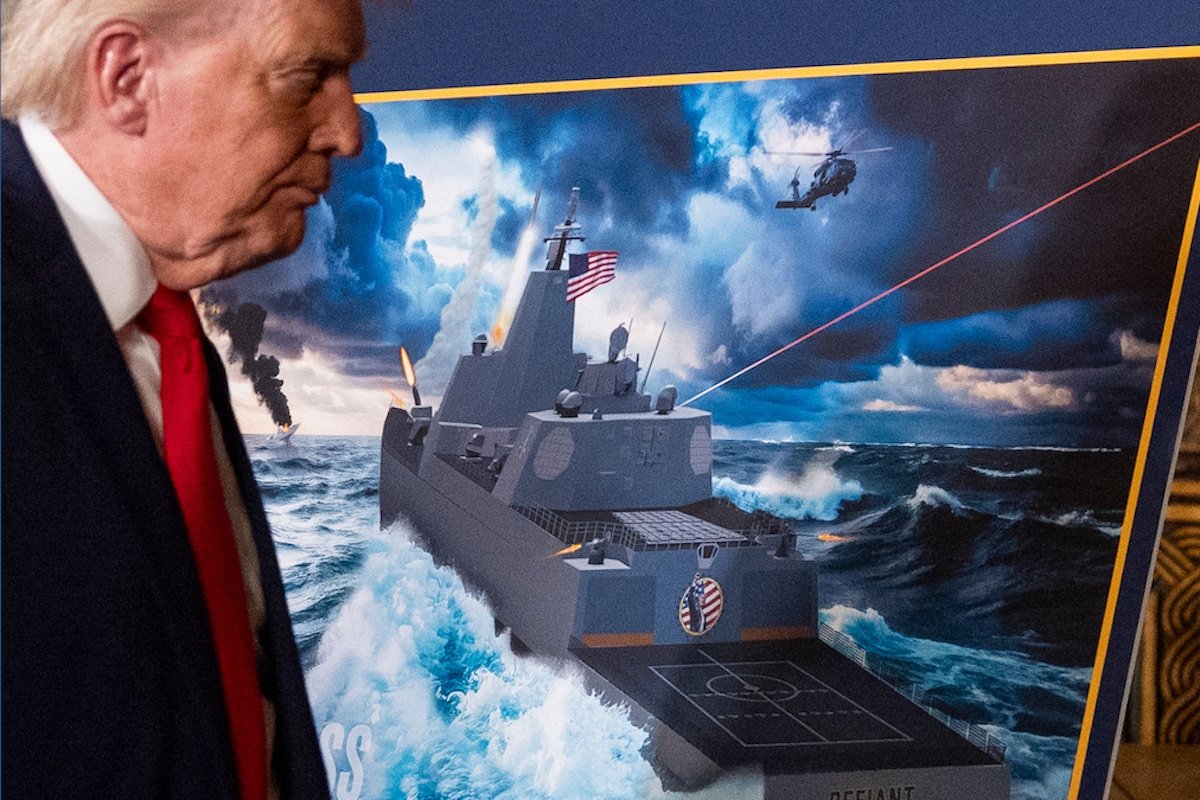
Washington's ambitious plan to build the largest US surface combatant since World War II is running into serious trouble on Capitol Hill. The proposed BBG(X) guided-missile battleship, a cornerstone of President Donald Trump's Golden Fleet initiative, has lost crucial funding in the latest defense appropriations bill, raising questions about its future.
The US Senate Appropriations Committee unveiled a $1.1 trillion fiscal 2027 defense spending package that eliminates nearly $1.84 billion from the roughly 34,000- to 35,000-ton warship. That includes the entire $1 billion advance procurement request, which lawmakers deemed “early to need,” and $836.9 million in research and development funding. The move follows the Democrats' sweeping midterm victories, which will give them control of both chambers and key defense committees next year, where critics of the program are expected to hold sway.
Bipartisan skepticism over costs and readiness
Announced in December 2025, the nuclear-powered BBG(X), beginning with the future USS Defiant, was touted as a leap forward in naval firepower. However, the program has drawn bipartisan scrutiny over its strain on the industrial base and its staggering price tag. The US Congressional Budget Office (CBO) projects the lead ship could cost up to $23 billion, with subsequent vessels at $18 billion each. Lawmakers are pushing to halt construction until key weapons systems—hypersonic missiles, railguns, and lasers—are proven mature, imperiling the multibillion-dollar effort.
The deteriorating state of the US Navy's surface fleet explains the original impetus behind the BBG(X). A January 2026 report from the US Congressional Research Service (CRS) noted that aging Ticonderoga-class cruisers and Arleigh Burke-class destroyers face mounting obsolescence and severe design limits. The 22 remaining Ticonderoga cruisers, built between 1978 and 1988, are slated for full retirement by fiscal 2027 after five earlier vessels proved too costly to modernize. After 40 years of production and three decades of upgrades, Arleigh Burke destroyers lack the space, weight, electrical power, cooling, and stability margins needed for future directed-energy weapons, larger long-range missiles, and expanded sensors.
While the US fleet ages, China has rapidly modernized its naval forces. An April 2025 CRS report highlighted that the People's Liberation Army Navy (PLAN) expanded its large surface combatant fleet from 19 cruisers and destroyers in 2000 to 60 by 2023, with US Navy projections reaching 80 by 2040. This expansion centers on 12,000- to 13,000-ton Type 055 Renhai-class cruisers, which feature vertical launch systems (VLS) for YJ-21 hypersonic anti-ship missiles, with the tenth hull launched in May 2024. The report also cites 7,500-ton Type 052D Luyang III-class destroyers equipped with phased-array radars, noting that their 27th and 28th hulls were launched in 2023.
In response to that growing disparity, Mark Schneider, in a June 2026 report for the National Institute for Public Policy (NIPP), argues that the BBG(X) is designed to outmatch foreign adversaries, deter nuclear escalation, and serve as a central fleet command node. According to Schneider, the nuclear-powered ship is three times the size of an Arleigh Burke destroyer, providing the hull volume, heavy armor, and deeper magazines required to survive mass drone and missile salvos while firing Conventional Prompt Strike (CPS) hypersonic weapons, railguns, and lasers.
Yet from the outset, naval strategists have questioned the operational logic of reviving a massive capital ship. In a February 2026 report from Singapore's S. Rajaratnam School of International Studies (RSIS), Geoffrey Till says the BBG(X) design has severe tactical flaws that run counter to modern distributed maritime warfare. Till argues that concentrating firepower on a massive, conspicuous hull creates an outdated single point of failure vulnerable to unmanned swarms and anti-ship missiles—a vulnerability underscored by World War II battleship sinkings and the sinking of Russia's cruiser Moskva. He also points out that an equivalent tonnage of Flight III Arleigh Burke destroyers would deploy more than the BBG(X)'s 128 VLS cells, while its planned railgun and lasers demand extraordinary electrical power generation.
Beyond tactical doubts, industrial capacity remains a major hurdle. In a September 2026 report from South Korea's Asan Institute, Peter Lee notes that severe US shipbuilding bottlenecks—marked by high labor costs, weak domestic supply chains, long-term industry consolidation, and chronic unprofitability—threaten to derail the project. Lee points out that because US shipyards cannot meet required timelines alone, the US Navy has explored fabricating large, non-sensitive hull modules in allied overseas facilities. However, foreign shipbuilders remain reluctant to invest in US yards amid rising costs, order backlogs, and strict rules mandating all-American workforces and supply chains, while growing congressional opposition to foreign outsourcing further clouds the lead ship's prospects.
On Capitol Hill, critics have also attacked the BBG(X) as political theater rather than sound naval strategy. In August 2026, House Armed Services Committee Democrats Adam Smith and Joe Courtney called the program a costly distraction from more pressing priorities. The debate over the battleship is part of a broader struggle over US defense spending and strategic focus, with some analysts arguing that the US should prioritize a more coherent approach to the Indo-Pacific rather than pouring billions into a single vessel. As the US Navy weighs its options, the fate of the BBG(X) will be a key test of whether Washington can adapt to the realities of modern naval warfare and the rise of China's fleet.