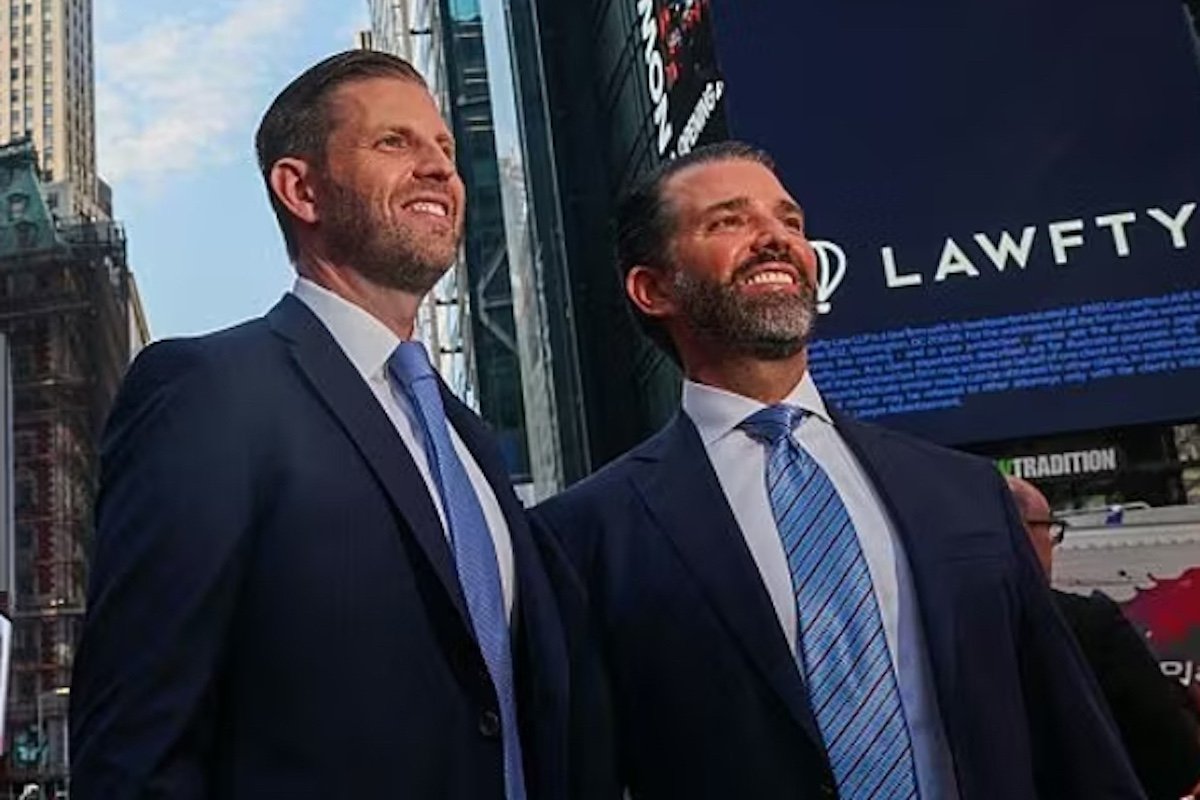
An analysis published on Wednesday by ABC News has estimated that companies with financial backing from Donald Trump Jr. and Eric Trump have secured more than $6 billion in contracts from the US Department of Defense. The report highlights a pattern of defense-related investments that have coincided with the Trump administration's procurement decisions, raising questions about conflicts of interest.
Many of the investments flow through 1789 Capital, a venture capital firm founded in 2023 by pro-Trump donors. Donald Trump Jr. joined as a partner in 2024. The firm has taken stakes in several defense startups, including Anduril Industries, an AI-driven defense company. Earlier this week, President Donald Trump announced a multibillion-dollar funding agreement with Anduril, more than a year after 1789 Capital claimed a $2.5 billion stake in the company.
The ABC report also pointed to Unusual Machines, a Florida-based drone parts manufacturer, which secured a contract to supply motors for the US Army last year—just months after naming Trump Jr. as an adviser. Similarly, Powerus, a drone company that lists both Trump sons as investors, won a purchase order from the US Air Force earlier this year for an undisclosed amount. Neither company had previously received government contracts before the Trump brothers' involvement.
Rare earths and robotics
Beyond drones, the analysis noted that Vulcan Elements, a rare earths magnet startup funded by 1789 Capital, received a $620 million loan from the Pentagon last year. Foundation Future Industries, a robotics startup that named Eric Trump as its chief strategy adviser, was awarded a $24 million Pentagon contract in April. Shortly after the deal, Eric Trump told Fox Business that the technology would help the US “win” the race with China to build battle-ready robots.
The concentration of contracts in defense sectors—particularly those tied to emerging technologies like AI, drones, and robotics—has drawn sharp criticism. Critics argue that the Trump family is leveraging the presidency for personal financial gain, a charge the family denies.
“They are experienced business leaders who have built and invested in businesses across a wide range of industries for decades, long before their father first ran for public office,” a spokesperson for the Trump brothers told ABC. “Their investment decisions are based solely on their independent business judgment and personal convictions, and they do not seek to influence, direct, or participate in any government decision, procurement, award, regulatory action, or other governmental process. Attempts to portray their ordinary investment activities as improper are a deliberate distortion of the facts.”
Despite the denial, the optics are troubling for many observers. The Democrats in the US House of Representatives wrote on social media: “Donald Trump and his sons have raked in BILLIONS while Americans struggle to make ends meet. Let’s call this what it is: blatant corruption and an abuse of power.”
Phillips O’Brien, professor of strategic studies at the University of St. Andrews, suggested that congressional Democrats should use their power of the purse to curb the Trump family's self-dealing. “Corruption of this kind is why the Democrats need to freeze or cut back US defense spending if they take control of Congress,” he wrote. “If you actually care about US security, funding this is destructive.”
Mark Jacob, former metro editor at the Chicago Tribune, was blunter: “Pentagon contracts for the Trump-linked firms are not a coincidence but deep corruption that never would have been tolerated before a convicted felon took over the White House.”
The revelations come amid broader concerns about the intertwining of Trump family business interests with US foreign policy. For instance, a Trump-linked drone firm's pact in Pakistan has already raised eyebrows in the region. The latest contracts also echo the administration's push to accelerate defense innovation, as seen in the Pentagon's future warfare project led by figures like Elon Musk and Palmer Luckey.
For Asian observers, the story underscores the growing influence of US defense contractors in the Indo-Pacific, where Washington is deepening military ties with allies like Japan, South Korea, and Australia. The Trump family's financial entanglements may complicate perceptions of US reliability and fairness in the region, especially as the Trump-Xi summit signals a quiet end to the 'China plus one' era.
As the 2026 midterm elections approach, the issue is likely to remain a flashpoint. Whether the Pentagon will tighten its procurement rules or Congress will step in remains to be seen. For now, the Trump brothers' defense portfolio continues to grow, with no sign of slowing down.