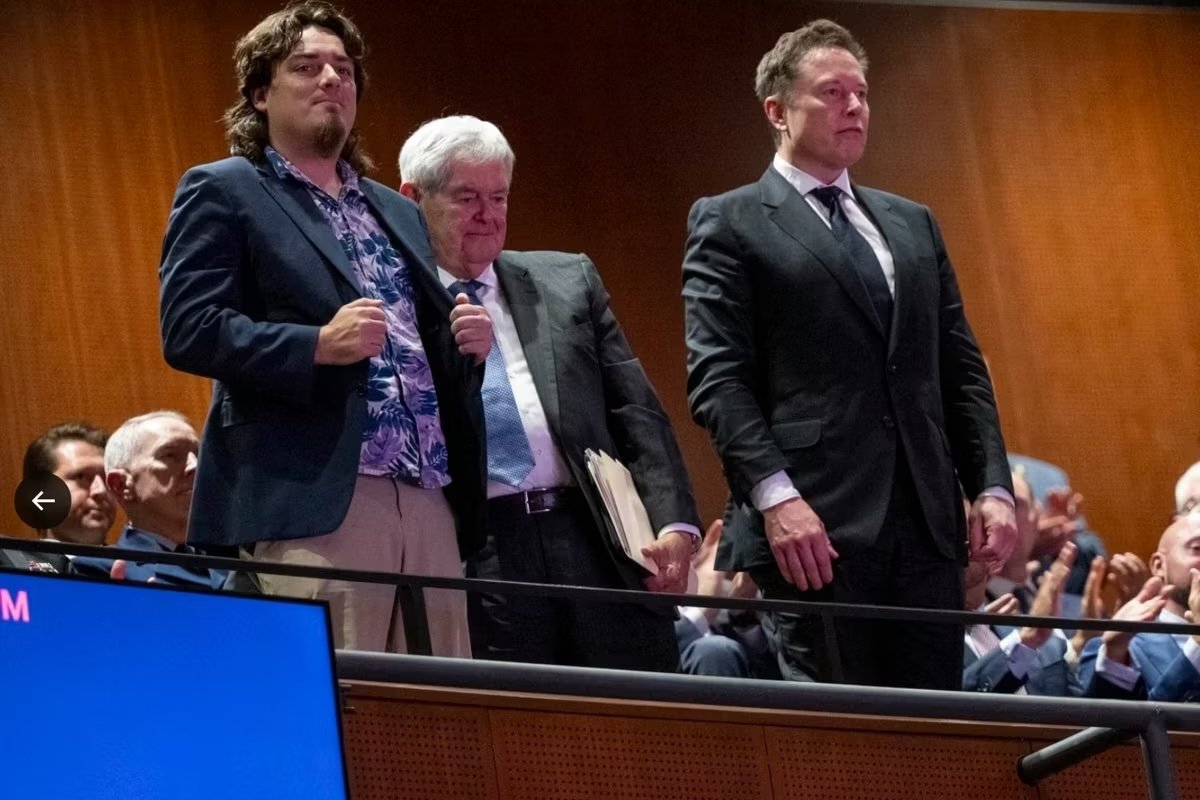
US Defense Secretary Pete Hegseth announced on Wednesday that three prominent figures—Elon Musk, Palmer Luckey, and Newt Gingrich—will co-lead a new Pentagon initiative called Project Meridian, aimed at reshaping the future of warfare. The announcement was made during his “State of the Force” address at Marine Corps Base Quantico in Virginia.
Project Meridian is a 120-day effort that will examine emerging technologies deemed critical for future conflicts. Hegseth said the initiative would bring together “America’s best minds” to “reimagine what warfare will look like in the future.” The three co-leaders, he added, will be joined by a team of senior leaders, private-sector experts, and academics from across the nation’s innovation and policy ecosystems.
Key figures and their backgrounds
Elon Musk, the world’s wealthiest individual, already has deep ties to US national security through SpaceX, which holds billions of dollars in Pentagon contracts. He previously served as the de facto head of the Department of Government Efficiency in the Trump administration.
Palmer Luckey, co-founder of defense technology company Anduril Industries, is a major donor to President Donald Trump. Last year, Luckey said Anduril planned to produce “large numbers” of cruise missiles, fighter jets, and other AI-powered weapons systems. He has been vocal about the need for increased arms production, warning that “if we have to fight Iran, and China, and Russia all at the same time, we are screwed.”
Newt Gingrich, a former Republican Speaker of the House, has advocated for military action against Iran since at least 2005. Both Gingrich and Trump have faced accusations of avoiding the Vietnam War draft through deferments—Trump for bone spurs, and Gingrich as a student and father.
Autonomous Warfare Command and military cuts
In addition to Project Meridian, Hegseth announced the creation of an Autonomous Warfare Command, or Autowarcom, described as “a new four-star combatant command with service-like authorities built to scale autonomous and robotic capabilities across the joint force.”
These moves come as Hegseth pursues a significant reduction in the military’s senior leadership. He announced that the Pentagon would eliminate 20% of its roughly 800 general and admiral positions by January, doubling a previously announced 10% cut. Hegseth described the reductions as necessary to remove “redundant force structure” and “unnecessary bureaucratic layers.”
Since taking office, Hegseth has overseen the removal or early departure of more than two dozen senior military and civilian defense officials. The contrast between these cuts and the appointment of technology executives and a former lawmaker to plan future warfare has drawn criticism from lawmakers and military observers.
“Interesting. A board loaded with defense contractors and one draft-dodging war hawk will decide the future of the US military,” said Marty Taylor, executive of NewBlue USA, on social media. “What could possibly go wrong?”
The initiative comes amid broader debates about the future of warfare, particularly in the Indo-Pacific, where China is rapidly advancing its own autonomous and drone capabilities. As the Pentagon looks to modernize, the role of private-sector innovators and political figures in shaping military strategy is likely to remain a contentious issue.