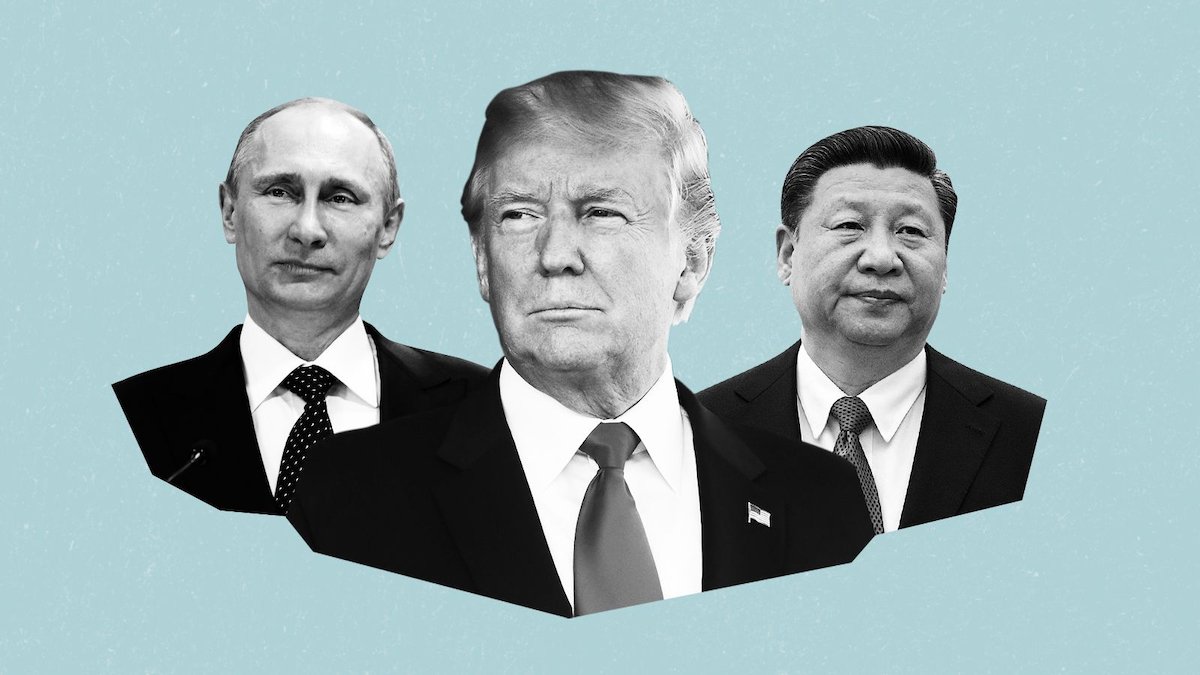
Discussions are reportedly underway for a potential meeting between Donald Trump, Xi Jinping, and Vladimir Putin on the sidelines of the Asia-Pacific Economic Cooperation summit in November. The prospect has already drawn comparisons to the Yalta Conference of February 1945, where the leaders of the United States, Britain, and the Soviet Union redrew the map of Europe and set the stage for the Cold War.
But the analogy, while tempting, is deeply flawed. The world of 2025 is not the world of 1945. The three leaders may each command formidable military and economic power, but they preside over nations that are far more constrained by global public opinion, economic interdependence, and the sheer complexity of modern governance. The idea that they could simply carve up spheres of influence like their predecessors did is a dangerous anachronism.
The allure of a modern-day Yalta
Trump, Xi, and Putin each harbor ambitions of reshaping the international order to suit their interests. Trump has shown a consistent disdain for multilateral institutions and a preference for bilateral strongman diplomacy. Xi has made no secret of his desire to restore China's regional dominance, including over Taiwan, and to expand its influence across Southeast Asia and the South China Sea. Putin, for his part, continues to pursue the restoration of Russian control over Ukraine and the former Soviet space, using a mix of military force, economic coercion, and subversion.
For these leaders, the appeal of a Yalta-style arrangement is obvious: it would legitimize their respective spheres of influence and allow them to bypass the messy, rule-based order that has governed international relations since 1945. The US national security strategy has already signaled a willingness to treat the Western Hemisphere as an American preserve, while Russia and China have similarly staked claims to their own neighborhoods.
Yet the historical record is clear: the Yalta system did not bring lasting peace. It led to a bipolar standoff that fueled proxy wars, nuclear brinkmanship, and decades of instability. The post-war order, for all its flaws, at least recognized the principle of national self-determination and established mechanisms for resolving disputes—however imperfectly.
Why the world has changed
The most significant difference between 1945 and today is the rise of nationalism and the diffusion of power. In 1945, most of Asia and Africa were still under colonial rule. Today, there are nearly 200 sovereign states, many of them fiercely protective of their independence. The people of Greenland, Iran, Ukraine, and Taiwan have all demonstrated a willingness to resist being traded like pawns in a great-power game.
Economic interdependence is another game-changer. World trade has grown by roughly 4,500% since 1950, and no major economy can afford to isolate itself from global supply chains. Even authoritarian leaders depend on economic growth to maintain domestic legitimacy. A carve-up of the world would disrupt the very systems that keep their economies afloat.
Technology has also transformed the nature of power. The internet has connected people across borders, making it harder for any single state to control information. And the proliferation of advanced military technology—drones, cyber weapons, precision-guided munitions—has given weaker states and non-state actors the ability to inflict disproportionate damage on stronger adversaries. As we have seen in Ukraine, Iran, and Gaza, overwhelming military force no longer guarantees victory; it often leads to prolonged, unwinnable conflicts.
The EU as a model, not an obstacle
For Trump, Xi, and Putin, the European Union represents a fundamental challenge to their worldview. The EU demonstrates that nations can achieve stability and prosperity by pooling sovereignty and adhering to common rules, rather than by dominating their neighbors. It is a living refutation of the idea that great powers must control their spheres of influence through coercion.
That is why both Washington and Moscow have sought to undermine the EU by supporting populist and nationalist movements that promise to weaken it from within. But the EU's success—and the broader trend toward regional integration in Asia, Africa, and Latin America—suggests that the future belongs to cooperative frameworks, not imperial hierarchies.
A world that resists carve-ups
The Yalta analogy also ignores the fundamental shift in how power is exercised. In the 19th and early 20th centuries, empire was a common and accepted form of governance. But the rise of nationalism made it unsustainable, and the two world wars demonstrated the catastrophic consequences of great-power competition. The post-war order, despite its imperfections, was a conscious attempt to move beyond the balance-of-power politics that had led to disaster.
Today, the so-called liberal international order is under strain, and many in the Global South view it as a form of neocolonialism. But the answer is not to return to a world of great-power fiefdoms. It is to reform the existing institutions to be more inclusive and responsive to the needs of all nations.
The leaders meeting in November would do well to remember that the world has moved on. The people of Asia, Africa, and Latin America are no longer willing to be treated as pawns in a great-power chess game. They have their own voices, their own aspirations, and their own agency. Any attempt to carve up the world will be met with resistance—not just from rival powers, but from the very people whose futures are at stake.
As Western allies prepare for a post-Trump world, they should also prepare for a world in which the old certainties no longer hold. The Yalta model is obsolete. The future belongs to those who can adapt to a multipolar, interconnected, and increasingly unpredictable global landscape.