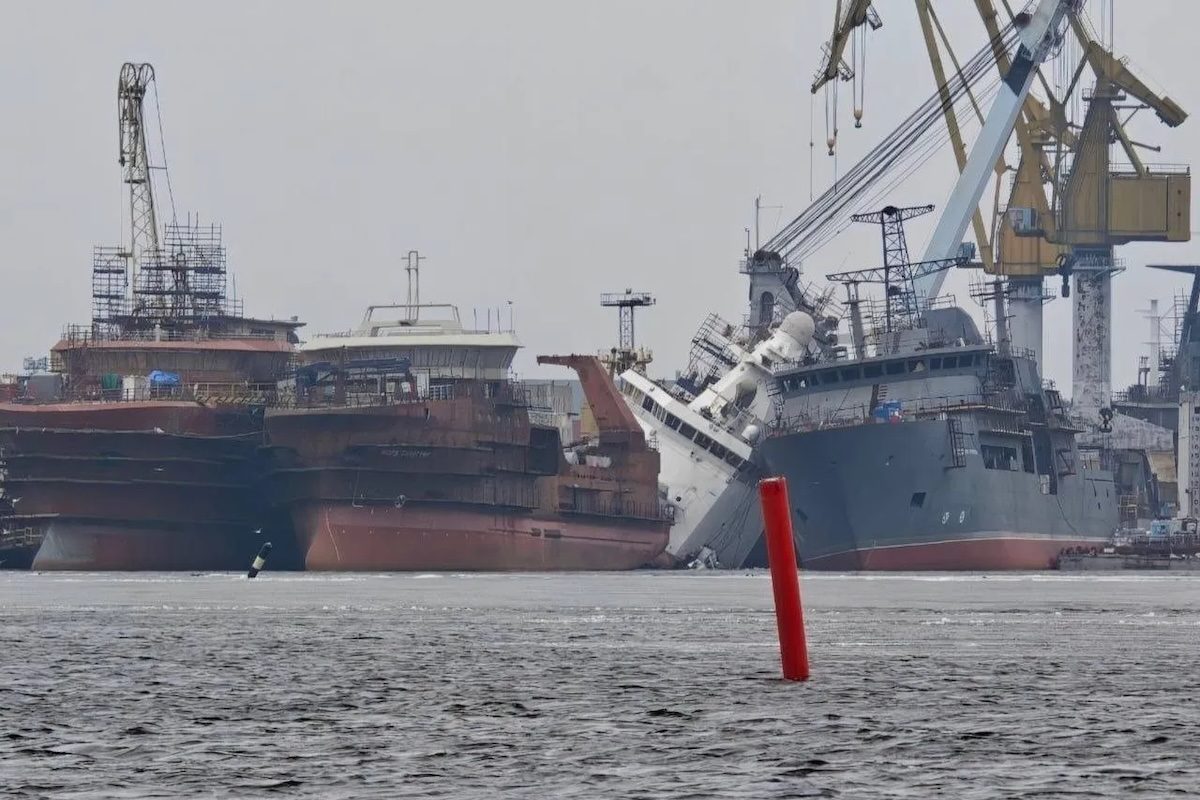
On March 25, a coordinated drone strike on the Vyborg shipyard in Leningrad Oblast inflicted what Ukrainian officials describe as a major blow to Russian naval capabilities. The Ukrainian General Staff claimed responsibility, stating that its “joint forces” damaged the facility. The attack, which occurred during a broader wave of drone incursions, has left the Russian Federal Security Service (FSB) scrambling for answers.
The primary target appears to have been the Purga (Blizzard), a Project 22120 icebreaking patrol ship built for the FSB Coast Guard. Designed for Arctic surveillance, icebreaking, and sovereignty protection, the Purga was a cornerstone of Russia’s strategy to secure the Northern Sea Route and exploit hydrocarbon deposits in the region. Reports indicate the vessel is listing at 40 degrees and leaning against the nearby spy ship Vice-Admiral Burilichev, which also sustained significant damage. Analysts suggest the Purga is likely unsalvageable, given the lack of suitable heavy-lift equipment at the yard.
A Strategic Setback for Moscow
The destruction of the Purga is more than a tactical loss; it undermines Russia’s long-term Arctic ambitions. The Arctic is a core priority for Russian sovereign identity and economic future, and the Purga was specifically built to police the opening polar shipping lanes. Damaging a vessel dedicated to this environment directly challenges Russia’s ability to militarize the region. The attack also highlights the vulnerability of Russian shipyards, which are increasingly exposed to Ukrainian long-range drone operations.
The Vice-Admiral Burilichev, a Project 22011 oceanographic research vessel, is an even more sensitive asset. Officially a scientific ship, it plays a central role in Russia’s “seabed warfare” strategy, deploying deep-diving autonomous underwater vehicles (AUVs) such as the Rus and Consul, capable of operating at depths over 6,000 meters. These submersibles, originally built with Finnish technology, are used to monitor and potentially disrupt NATO’s undersea infrastructure. The damage to the Burilichev—including crushed cranes and sensitive topside instrumentation—represents a significant intelligence setback.
Moscow has imposed a near-total news blackout on the incident. The FSB has established a “special filtration zone” at the shipyard, interrogating all night-shift workers and confiscating mobile phones. Investigators are focusing on the Purga’s ballast control systems and hull fittings, with a working theory that Kingston valves (seawater intakes) may have been sabotaged. Diver protection patrols in Vyborg Bay have been stepped up, with anti-sabotage boats hunting for underwater divers and unmanned underwater vehicles (UUVs).
The method of attack remains unclear. Ukrainian officials initially claimed drones caused the damage, but the Purga was struck near the waterline, suggesting a UUV, limpet mines, or an internal explosion. The use of a modified sport aircraft carrying a 500kg bomb has been dismissed as implausible. The precision of the strike points to either a sophisticated underwater drone or insider sabotage.
This incident has broader geopolitical implications. The United States, along with Finland and Canada under the ICE Pact, is racing to expand its icebreaker fleet. The first vessel, USCGC Polar Sentinel, is expected by May 2030, while Bollinger and Davie Defense plan to build seven medium icebreakers domestically. The attack on the Purga underscores the strategic importance of Arctic capabilities and the vulnerability of Russian infrastructure.
For Ukraine, the strike is a demonstration of its ability to project power deep into Russian territory, targeting not just military assets but also the economic and strategic pillars of the Kremlin’s Arctic agenda. As Russia’s domestic information space faces increasing strain—exacerbated by its own crackdown on platforms like Telegram—the Vyborg attack adds to the pressure on Moscow’s security apparatus.



