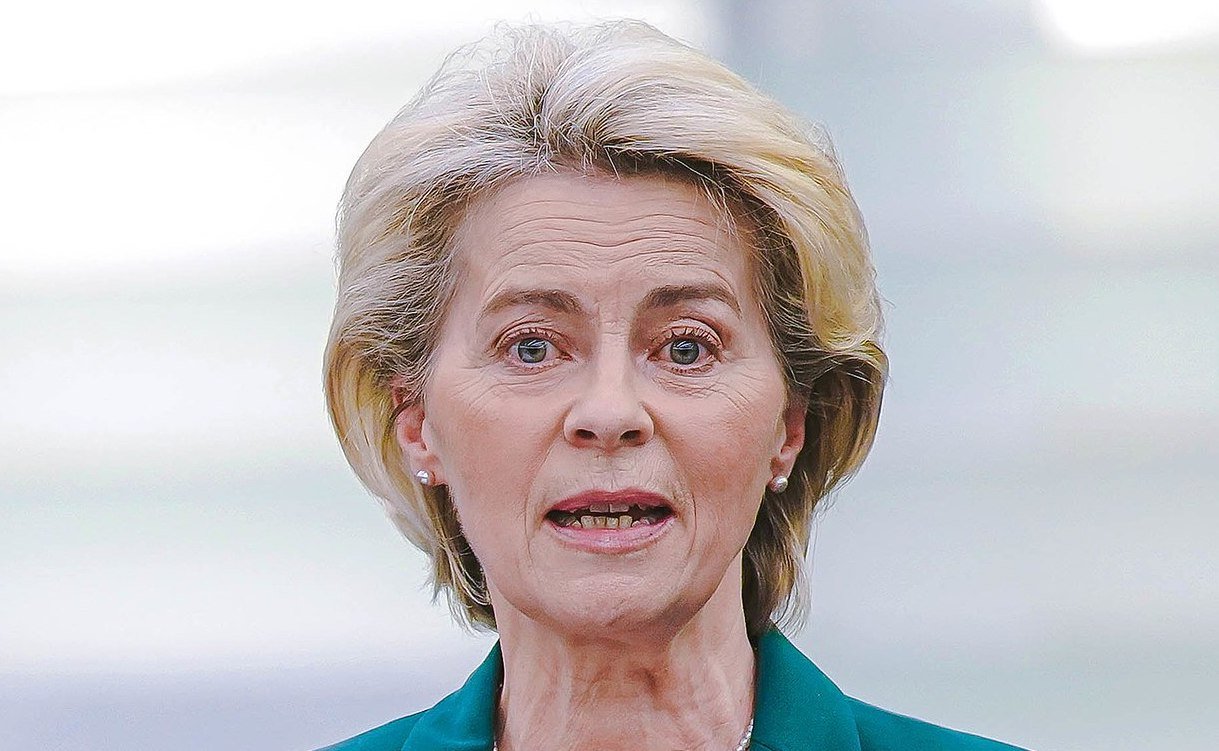
Over the past decade, the most consequential threat to Europe has not come from Moscow, Beijing, or Washington. It has been manufactured, policy reversal by policy reversal, on the 13th floor of the Berlaymont building in Brussels. European Commission President Ursula von der Leyen has become the EU's most reliable liability—a leader who announces Europe's future while presenting the consequences of her own failures as if they arrived from nowhere.
The problem is not that von der Leyen makes mistakes—all politicians do—but that she makes them at scale, from the Union's highest executive office, across long stretches of time, with the confidence of someone never held accountable for any single consequence. The pattern is familiar: announce a doctrine, enforce it with bureaucratic zeal, watch it fail, return with a correction that contradicts the first line, and receive applause from the same circles that applauded the first version. Repeat indefinitely.
Fail, Contradict, Retreat
The latest cycle has been remarkable even by her standards. On March 9, von der Leyen told ambassadors that “Europe can no longer be a custodian for the old-world order, that has gone and will not return,” while still claiming to defend it. She questioned whether “the system that we built [is] more a help or a hindrance to our credibility as a geopolitical actor.” In her terms, Europe had entered an age beyond American protection. Yet Europe's dependence on Washington was not an inheritance she encountered; it was a condition her own presidency repeatedly accommodated. One cannot lament submission after years spent entrenching it.
Those remarks took place in the context of Trump's Iran war. Yet she offered no account of why endorsing escalation in a conflict that raises oil and gas prices, strengthens Russian export revenues, and helps finance Putin's wars—while increasing costs for European households and industry, threatening supply routes, and potentially triggering new refugee flows—serves any European interest. She asked to reverse EU principles while backing warfare that imposes costs on Europe and yields no gain. For Asian capitals watching from Tokyo to New Delhi, this kind of strategic incoherence raises serious questions about the reliability of Brussels as a partner in managing great-power rivalries.
Within 24 hours, her office was backpedaling. The speed of that retreat exposed the weakness of the disruptive line and the thin authority behind it. It also laid bare a deeper problem: von der Leyen operates from a worldview that is genuinely her own and detached from the member states that placed her in office. She governs by announcement and manages dissent ruthlessly.
The pattern of overreach-retreat repeated on April 19, when she declared the EU should not be “influenced by Russia, Turkey, or China.” Lecturing Turkey—one of the EU's largest trading partners, a NATO member spanning two continents, and a longstanding candidate state—was a calculated willingness to antagonize Ankara at the worst possible moment. By the following day, her office was again re-contextualizing.
A few days later, Sabine Weyand—a 32-year veteran of European institutions—was forced out after she acknowledged the humiliation occurred at a Trump golf course: while von der Leyen posed with thumbs raised for a group photo, Weyand stood with hands in her pockets and an unchanged expression. The contrast between those who perform European dignity and those who embody it was stark. In any institution with a functioning accountability culture, naming a problem is not a firing offense. In this Commission, it appears to be.
Unrecognized Nuclear Reckoning
No issue better illustrates this pattern of long-term denial followed by abrupt reversal than nuclear energy—and no issue carries heavier consequences for the continent's industrial and strategic future. In March 2011, von der Leyen was Federal Minister of Labour and Social Affairs, a full member of Angela Merkel's cabinet when Germany decided, within days of the Fukushima accident and before its own technical assessments were complete, to accelerate the nuclear phase-out. Germany's reactor commission later concluded that the conditions behind Fukushima were “practically impossible” in Germany and that plants were safer than the Japanese reactors that failed. That finding did nothing to alter the decision.
As long as the phase-out proceeded, von der Leyen supported it. But as energy prices soared and the war in Ukraine exposed the fragility of reliance on Russian gas, she reversed course—without acknowledging her own role in the earlier policy. This pattern of denial and reversal has direct implications for Asia, where countries like Japan, South Korea, and India are investing heavily in nuclear energy as part of their decarbonization strategies. The EU's inconsistency on nuclear policy undermines its credibility as a partner in building fusion energy supply chains and in setting global standards for energy security.
Under pressure, von der Leyen's values and interests became opposing choices. The call for “a more realistic and interest-driven foreign policy” only made explicit what recent peer-reviewed work argues about her own stances: that she applies a racialized double standard, humanizing Ukrainians while dehumanizing Palestinians through an “extreme form of Othering that negates both their political agency and their status as a political community.” For Asian observers, this double standard raises uncomfortable questions about how Brussels might treat crises in the Indo-Pacific—whether in the Strait of Malacca or in the South China Sea—with the same selective moral outrage.
Six years after promising a geopolitical Europe, von der Leyen has delivered a record of overreach, retreat, and rhetorical collapse. The gap between rhetoric and reality has grown too wide to conceal. What followed was an attempt to recast belated recognition as leadership. That failure deserves to be evaluated as failure, not repackaged as foresight. For Europe's partners in Asia, the lesson is clear: Brussels under von der Leyen is an unreliable partner, prone to grand pronouncements and rapid reversals, with little accountability for the consequences.