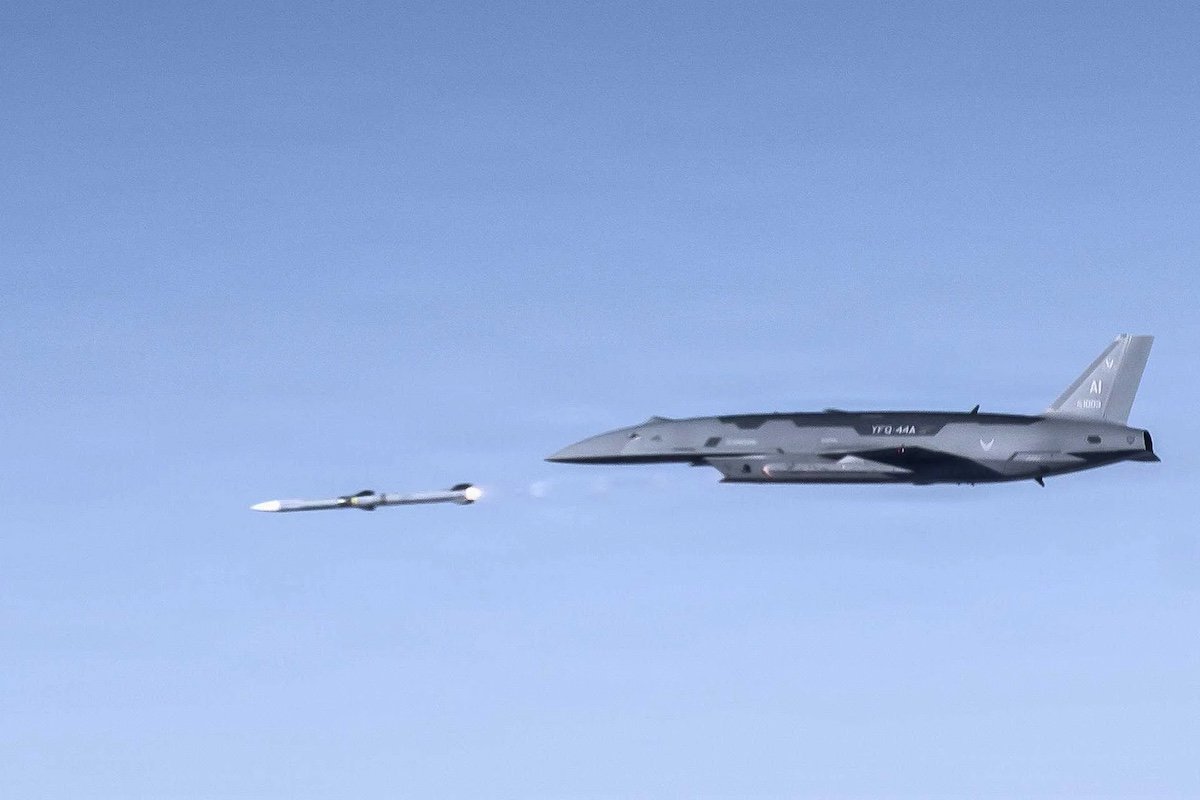
In a significant step toward integrating autonomous aircraft into frontline combat, a US Air Force F-22 Raptor pilot recently controlled an uncrewed YFQ-44A Fury fighter drone from the cockpit for the first time. The test, conducted at Edwards Air Force Base in California, saw the F-22 and the drone meet midair, with the pilot transmitting updated mission plans and tactical directives via data link. The drone's onboard autonomy software then translated those commands into real-time flight maneuvers and simulated combat tasks.
The exercise, coordinated with the 412th Test Wing and the Nellis-based Experimental Operations Unit, marks a milestone in the service's Collaborative Combat Aircraft (CCA) program. Under this initiative, F-22s are designated as the initial tactical coordinators for semi-autonomous wingmen, with large-force integration trials scheduled for Exercise Emerald Flag in December.
Building combat mass on a budget
The CCA program is a cornerstone of the US Air Force's strategy to rebuild its fighter fleet, which has fallen below congressionally mandated levels. According to a September 2026 Congressional Research Service report, the service had only 1,098 combat-coded aircraft in 2026, short of the statutory minimum of 1,145. The shortfall stems from decades of post-Cold War drawdowns, lagging procurement, and an aging fleet averaging 27.4 years, compounded by industrial bottlenecks, spare parts shortages, and a 1,900-pilot deficit.
To address this, the Air Force plans to field 1,558 crewed fighters by 2035, but it also sees CCAs as a cost-effective way to expand combat mass. Mark Gunzinger and other analysts at the Mitchell Institute note that CCAs can carry mission-tailorable payloads—radar, infrared sensors, electronic warfare jammers, decoys, and air-to-air missiles—at a fraction of the cost of crewed aircraft. They describe CCAs as expendable, attritable lead forces that can disrupt enemy air defenses, absorb missile salvos, and launch distributed sorties from forward bases across the Pacific.
Teaming CCAs with fifth-generation fighters like the F-22 creates an advanced outer screen of distributed sensors and shooters, according to Gunzinger. In this construct, CCAs project forward to generate intercept-quality tracks and launch weapons via secure datalinks, enabling trailing F-22 pilots to coordinate long-range strikes from standoff ranges, preserve their low observability, and reduce attrition of crewed aircraft.
China's layered air defenses
The urgency of the CCA program is driven by China's expanding anti-access/area-denial (A2/AD) capabilities in the Western Pacific. Olli Suorsa of the Pacific Forum notes that China's dense, layered anti-aircraft network in the South China Sea combines ground-, sea-, and air-based interceptors under an integrated sensor umbrella. The People's Liberation Army fields advanced Russian S-300 and S-400 batteries alongside indigenous HQ-9 air-defense missiles, extending hundreds of kilometers seaward. This ground umbrella is reinforced by naval surface combatants with 1,900 vertical launch cells and modern J-16 and stealth J-20 fighters carrying long-range PL-15 missiles, cued by KJ-500 radar planes.
In response, the US Air Force aims to field an initial operational fleet of at least 500 Increment 1 CCAs by 2032. The program also advances digital cockpit architectures to reduce single-pilot workload, a key factor as the service grapples with a pilot shortage.
Wargames and technical hurdles
Despite the promise, recent wargames have cast doubt on the effectiveness of CCAs in a US-China conflict over Taiwan. Bryan Clark, a senior fellow at the Hudson Institute, said in an August 2026 interview that war games with senior US Navy leaders at the Naval War College revealed severe operational flaws in manned-unmanned teaming (MUM-T). Clark warned that uncrewed drones are more detectable than stealth fighters like the F-35, drawing hostile fire and endangering human pilots. Speed and range mismatches also hinder joint flight, while equipping CCAs with equivalent stealth and sensors inflates costs to near-crewed fighter levels, negating their intended affordability and combat mass advantage.
Technical challenges extend to the AI that would control these drones. In an August 2025 article in Aether journal, S. Tucker Browne and co-authors note that integrating tactical AI into CCAs is undermined by perception failures, data scarcity, and adversarial brittleness. Autonomous systems struggle to build battlespace situational awareness in chaotic environments and routinely fail at sense-making. AI models cannot generalize beyond flawed peacetime or synthetic training datasets, leaving them unable to handle unexpected combat tactics. The authors also warn that combat AI remains dangerously brittle under electronic warfare conditions.
These concerns echo broader debates about the reliability of autonomous systems in high-stakes military operations. As the US Air Force pushes forward with its CCA program, it must balance the operational imperative to close the fighter gap with China against the technical realities that could undermine the very advantages these drones are meant to provide. The outcome will shape the future of air combat in the Indo-Pacific, where the US and its allies face a rapidly modernizing Chinese military.