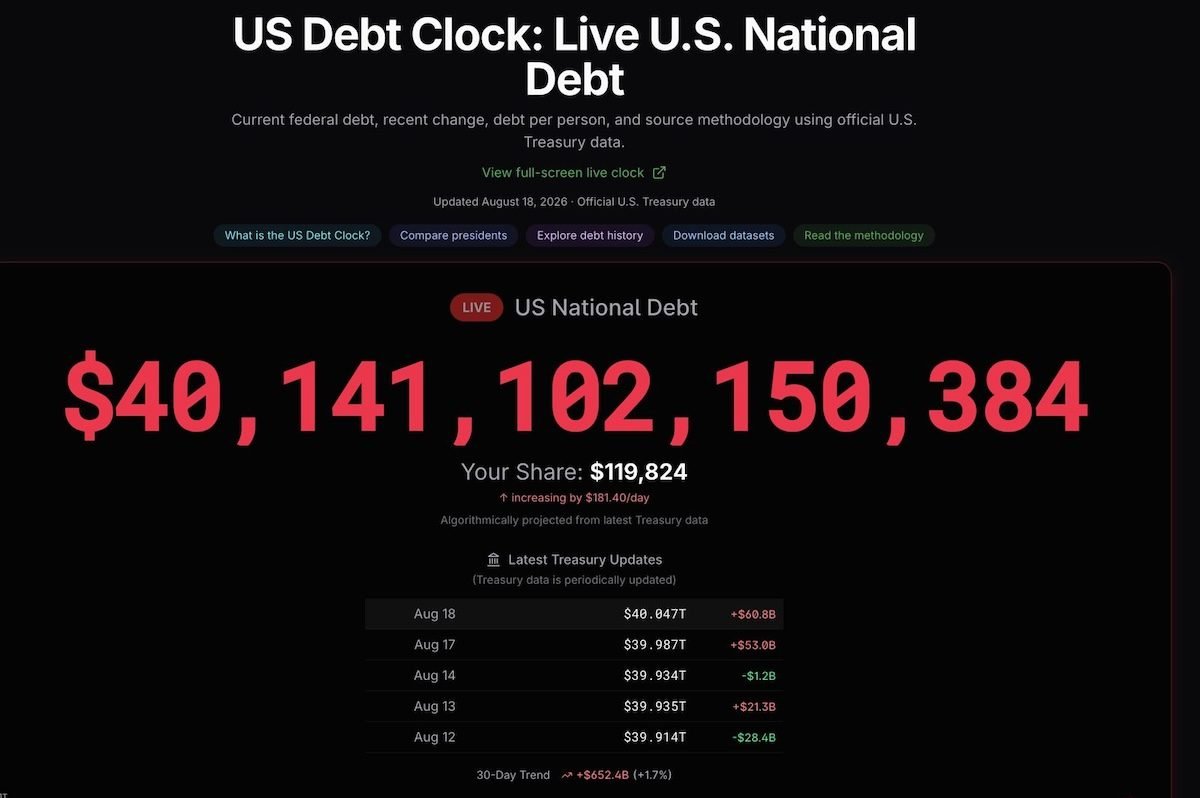
The United States national debt has crossed the $40 trillion mark, a milestone that has sparked a fresh round of political blame games in Washington. Congressional Republicans have seized on the figure to attack what they call "unaffordable socialist policies" and runaway government spending. But economists and policy analysts argue that the real drivers of the debt surge are Republican-backed tax cuts and costly military engagements, not social programs.
President Donald Trump, who has repeatedly vowed to eliminate the national debt, has overseen an $11.6 trillion increase across his two terms. This latest milestone arrived months earlier than forecasters had predicted, partly due to lost federal revenue from Trump's tariffs, which were struck down by courts.
Economists Point to Tax Cuts and Wars
Dean Baker, senior economist at the Center for Economic and Policy Research, was blunt in his assessment: "I have never been a deficit hawk, and I'm not about to change my religious affiliation now. But whatever we think of debt and deficits, there is one point that should be very clear: It has been run up almost entirely due to Republican tax cuts and their inept management of the economy."
Nobel laureate Paul Krugman echoed that view, writing that while the $40 trillion figure "has no special significance," it underscores "the incredible irresponsibility of the Trump administration, with its unfunded tax cuts that overwhelmingly benefit the wealthy, billions in wasteful military spending – redesigning aircraft carriers because Trump doesn't like the way they look!—and more."
Jared Bernstein and Bobby Kogan have shown that the deficit would be far more manageable if not for the tax cuts pushed through by George W. Bush and then Trump, which heavily favored high-income Americans. Kogan, senior director of federal budget policy at the Center for American Progress, estimated in 2023 that these tax cuts were "responsible for 57% of the increase in the debt ratio since 2001, and more than 90% of the increase in the debt ratio if the one-time costs of bills responding to Covid-19 and the Great Recession are excluded."
Last summer, Trump signed another massive tax cut package that disproportionately benefits the wealthy and large corporations, adding trillions more to the debt over the next decade. This pattern has led former Labor Secretary Robert Reich to advise: "From now on, whenever you hear someone fret about how huge, horrible, and out-of-control the national debt is, explain to them that it's largely because of tax cuts to the wealthy – who are also the major recipients of interest on that debt."
Interest Payments Now Exceed Military and Medicare
The consequences are already visible. Interest payments on the debt now consume more public money than the military or Medicare, a point highlighted by Rep. Chris Deluzio (D-Pa.): "Before his second term is even over, Donald Trump is responsible for more than $10 trillion of this. Just INTEREST on this debt is now sucking up more of our public money than even the military and Medicare. DC Republicans are leaving our kids a colossal mess to clean up."
This fiscal trajectory has implications beyond US borders. As the world's largest economy, the US debt burden affects global markets, interest rates, and the dollar's value, which in turn impacts trade and investment flows across the Indo-Pacific. For Asian economies that hold significant US Treasury reserves, such as China and Japan, the stability of US fiscal policy is a matter of direct concern. The intersection of national security and market logic is becoming increasingly evident as Washington's fiscal choices ripple through the region.
The debate over the debt also comes at a time when global inequality is rising, with the first trillionaire predicted to emerge within a decade. Critics argue that tax cuts for the wealthy exacerbate this divide, while the interest on the debt flows back to the same affluent bondholders.
As the US heads into another election cycle, the debt is likely to remain a central issue. But the evidence suggests that the Republican narrative of "socialism" is a misdirection. The real story is one of tax policy and military spending, choices that have been made in Washington, not in any socialist utopia.