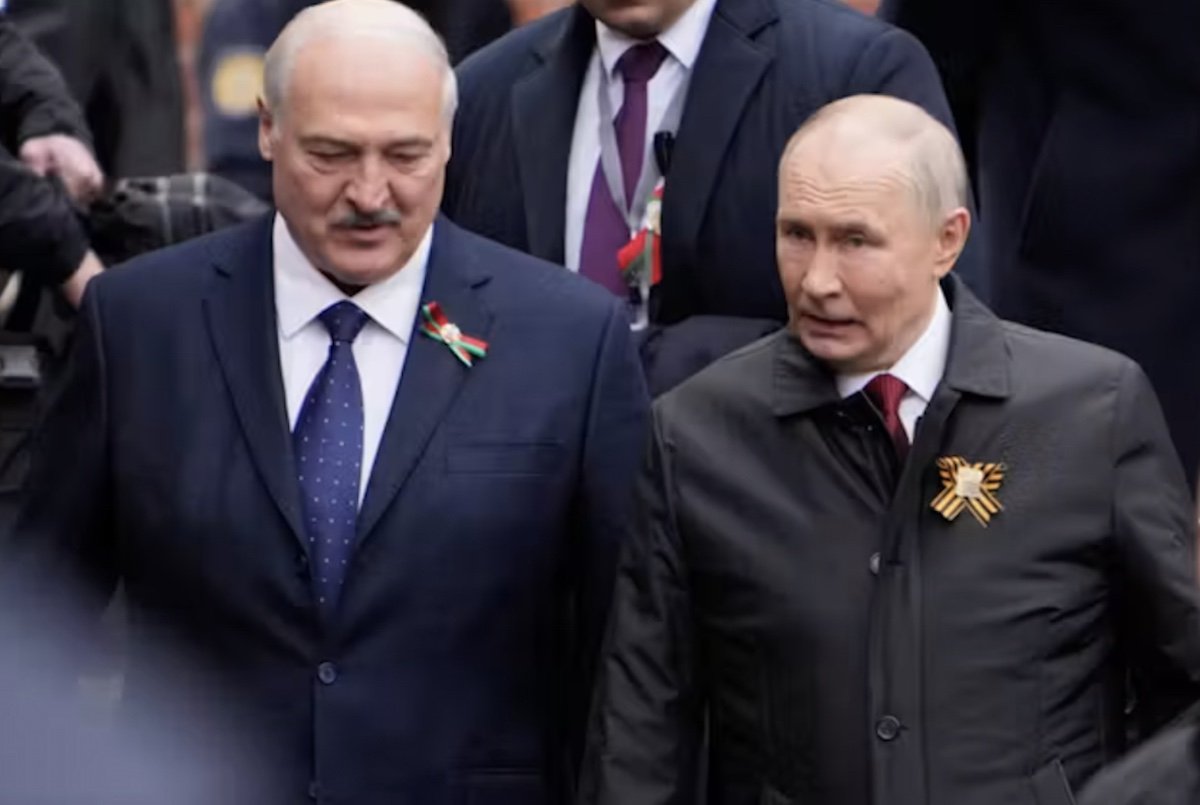
The Trump administration's mixed signals toward Belarus—renewing a national emergency while simultaneously easing sanctions—have created a widening gap with European allies, a divide that analysts say plays directly into the hands of Russian President Vladimir Putin.
In May 2026, President Donald Trump renewed the US national emergency on Belarus, first imposed by George W. Bush in 2006 after a widely condemned election. The emergency underpins targeted sanctions on the former Soviet republic. Yet weeks earlier, Washington lifted restrictions on Belarus's financial and fertilizer sectors in exchange for the release of 250 political prisoners—a bargaining tactic that echoes Lukashenko's past use of detainees as leverage with both Europe and the US, notably in 2008 and 2015.
This dual approach—keeping legal sanctions in place while pursuing transactional deals—stands in stark contrast to the European Union's strategy. In April 2026, the EU adopted a sanctions package targeting Belarus and its ally Russia, focusing on evasion, financial channels, trade restrictions, and cryptocurrencies. For Brussels, Belarus is not a separate issue but an extension of the threat emanating from Moscow, especially since Russia's full-scale invasion of Ukraine in 2022.
Europe's Security Calculus
For EU member states bordering Belarus, the stakes are immediate. Lithuania, Estonia, Latvia, and Poland have ramped up defense programs along NATO's eastern flank. Poland's East Shield program commits $2.7 billion to fortifications, while the Baltic states are developing the Baltic Defense Line with bunkers and obstacles near Russia and Belarus. In May 2026, Lithuanian leaders were moved to bunkers after a suspected drone incursion linked to Russia's war in Ukraine triggered an airspace alert—a reminder that border security is now a daily governance issue.
Lithuania also took Belarus to the International Court of Justice in 2025, accusing the Lukashenko government of orchestrating large-scale migrant smuggling. The EU's April package continued aligning Belarus-related measures with Russia sanctions, particularly on enforcement and circumvention.
The US request in May for Lithuania, Poland, and Ukraine to allow transit of Belarusian potash fertilizer—produced by state-owned Belaruskali—was seen as pressure to carve out exceptions to the sanctions regime. For these countries, reopening export corridors would revive a revenue stream for Lukashenko at a time when they are already worried about border security.
Washington's Transactional Logic
For the Trump administration, Belarus is part of a broader problem: the risk that the country becomes so dependent on Russia or China that Western influence evaporates. The White House wants sanctions flexible enough to produce visible deals, such as prisoner releases, rather than maintaining a rigid pressure campaign.
This marks a shift from the Biden era, which aligned more closely with the EU's sanctions-first approach. The Trump administration's flexibility is driven partly by the reality that years of pressure have pushed Belarus further toward non-Western partners. Belarusian trade with Russia doubled from $29.5 billion in 2020 to $62 billion in 2025, while trade with China rose from $4.6 billion to over $8.8 billion in the same period.
As one scholar of Eastern Europe noted, the difference between US and European views is tactical in form but strategic in effect. Europe wants sanctions to constrain Belarus as part of the Russian threat; the US wants them as bargaining chips. That mismatch gives Lukashenko room to maneuver and tests how much common ground remains between Washington and Brussels on Russia.
The transatlantic rift is not limited to Belarus. Similar tensions have emerged over Iran, where the US has escalated military strikes while the EU pursues diplomacy—a dynamic explored in Iran Accuses EU of Appeasement as Trump Escalates Military Strikes. The broader pattern suggests that under Trump, the US is willing to diverge from European allies on key security issues, a shift that benefits adversaries like Putin who can exploit the gaps.
For Asia, the implications are indirect but significant. A divided West weakens the collective posture toward Russia, potentially emboldening Beijing as well. As the Quad alliance faces its own tests under Trump's second term—detailed in Quad's Structural Resilience: Why Trump's Second Term Won't Kill the Alliance—the Belarus episode serves as a warning that transatlantic cohesion cannot be taken for granted.