Wars often begin with a belief in distance—precision strikes, remote control, minimal personnel exposure. That American instinct, visible from the Gulf War to the campaign against ISIS, is resurfacing in the current US confrontation with Iran. Airstrikes have killed political leaders and degraded elements of Tehran's missile and drone infrastructure, but they have not defeated the regime. Iran has built a decentralized strategic posture specifically to withstand such campaigns.
This is the moment when policymakers in Washington begin asking the question they hoped to avoid: if bombing does not achieve regime change, what will? The answer, suggested by Donald Trump and visible in recent troop movements, is as old as war itself: boots on the ground. Not necessarily divisions marching on Tehran, but perhaps an invasion of Kharg Island, an offshore terminal 25 kilometers from Iran's coast through which 90% of its crude oil exports pass.
The Allure and Danger of Special Operations
The first step down the boots-on-the-ground path is almost always framed as a limited operation or surgical mission. Navy SEALs, Delta Force, Green Berets—these specialized units offer a seductive middle ground for policymakers. They are militarily more flexible and politically more palatable than full-blown conventional deployments. Mission failures, when they occur, can be more easily contained—at least in theory.
But theory collides with ground reality. The shadow of Operation Eagle Claw—the 1980 US mission that catastrophically failed to rescue 53 embassy staff held by revolutionary Iran—still lingers in American strategic thinking. The lesson was not just about operational risk; it was about political fragility, as the failed operation contributed to President Jimmy Carter's electoral defeat. Iran today presents an even more complex target set. Its nuclear program, a key target of Trump's Operation Epic Fury, is dispersed, hardened, and well-hidden. A raid to seize enriched uranium would risk a repeat of that multi-staged, fatally flawed mission.
Other special operation options include sabotage of key facilities, including on Kharg Island, top commander assassinations, and providing material support to underground dissident networks. If escalation continues, the next phase—employing troops on the ground—will be far harder to contain. Limited territorial operations, particularly along Iran's coastline, are a plausible next step.
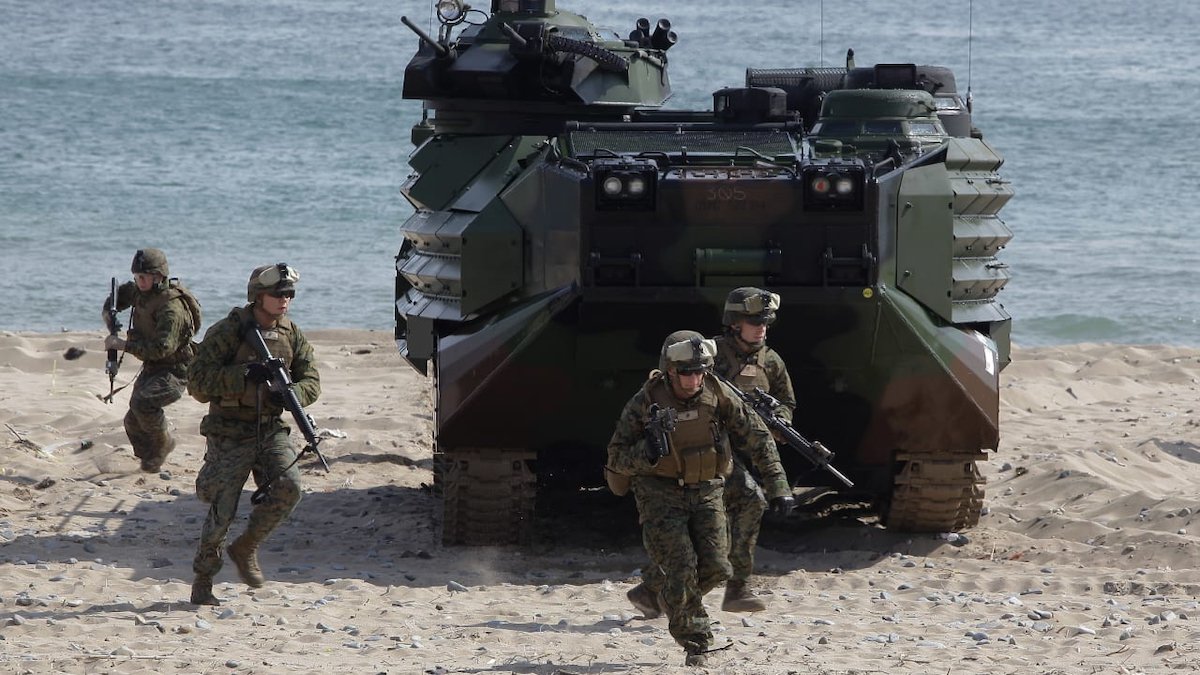
This week's deployment of Marine Expeditionary Units to the Persian Gulf is not yet a declaration of intent to invade. Rather, it is a signaling of capability while talks are supposedly ongoing behind the scenes. The MEU's roughly 2,500 troops, amphibious ships, and rapid-insertion forces are tools designed for controlled escalation.
The Strait of Hormuz and the Risk of Quagmire
Iran's blockade of the Strait of Hormuz is another possible boots-on-the-ground target. Controlling nearby islands—Qeshm, Kish, and Abu Musa—could potentially loosen or break Iran's hold on the crucial waterway. Yet geography cuts both ways. Iran's coastline is layered with radar systems, mobile missile batteries, and naval assets designed for asymmetric warfare. The US would bring superior technology; Iran would benefit from proximity. War-time supply lines almost always favor the defender.
Even a successful US landing would not be a victory. Holding the island territory would be a different exercise entirely. The US learned this painfully in the Iraq War, where rapid victory gave way to prolonged occupation and strategic exhaustion under insurgent fire. There is little reason to believe Iranian territory would be any easier to hold. Its terrain is harsher, its population larger, and its political structure is already proving more cohesive under external fire than Iraq's. A US coastal foothold could quickly become a difficult-to-exit liability.
Beyond limited operations lies the option few openly advocate but many quietly analyze: a full-scale invasion. It is often the logical endpoint of escalation for military planners. The comparison with Iraq is unavoidable yet misleading. If the 2003 invasion of Iraq required roughly 200,000 troops, Iran would demand far more—perhaps multiples of that number. Logistics alone would be daunting. Regional allies, now under Iranian missile fire, would need to provide secure basing and supply corridors. Political consent will inevitably become more uncertain as the war grinds on. US domestic support, fragile even in the early stages, would erode as costs in American lives mounted.
Moreover, a long, grinding war in Iran would inevitably shift American attention away from other regions, such as Europe, where deterrence is weak, and Asia, where competition with China will determine America's long-term standing and prosperity. As the US Navy's drone swarm strategy illustrates, Washington is already betting heavily on technological superiority in the Indo-Pacific. A ground war in Iran would drain resources and focus from that critical theater.
Even in the unlikely event of battlefield success in Iran, the aftermath would be the true test. Regime collapse would not equal stability—Afghanistan and Iraq offer sufficient evidence of that. Iran's complex ethnic, political, and religious dimensions would complicate any US-led reconstruction. The path from limited strikes to ground invasion is a slippery slope, and the history of such escalations suggests that the costs far outweigh the gains.