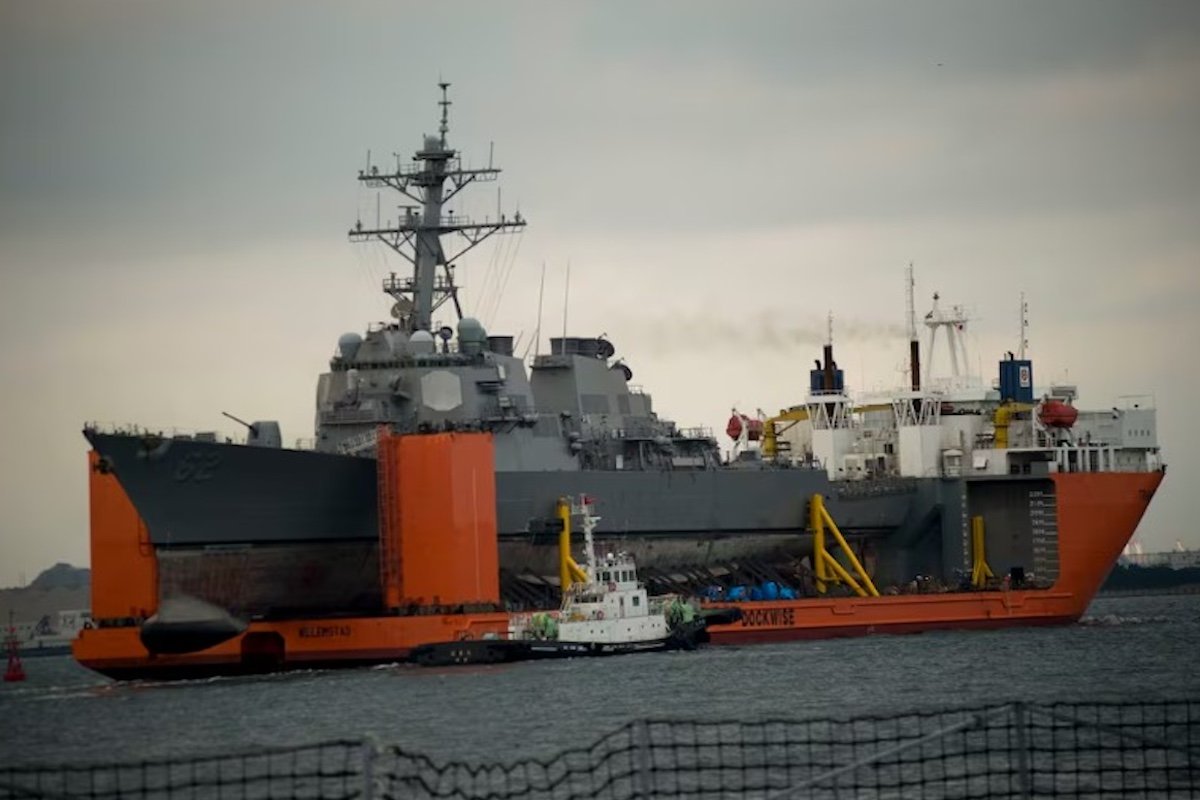
The US Navy's most dangerous vulnerability in a conflict with China may not be losing ships to enemy fire, but failing to get damaged vessels back into action quickly enough. A recent report from the RAND Corporation, based on a two-day wargaming exercise held in August 2025 with participants from the United States, Japan, South Korea, and Australia, warns that repairing battle-damaged Arleigh Burke-class destroyers in a hostile Indo-Pacific theater is far more complex than current military plans account for.
The exercise, sponsored by the US Joint Staff, simulated conflict scenarios against China to evaluate strategic ship-salvage and force-regeneration capabilities. The findings reveal critical bottlenecks in industrial ship repair: the US Navy's organic capabilities are insufficient for major repairs and can only stabilize ships enough for them to transit back to the United States. This leaves damaged warships vulnerable during an active campaign, potentially handing China a decisive advantage.
Technician Shortages and Regulatory Hurdles
Repairs are further crippled by a severe shortage of specialized technicians and a rigid peacetime regulatory framework that stalls emergency wartime operations. The report notes that the US Navy lacks an established wartime doctrine, with fragmented planning over which authority oversees repair and maintenance efforts. A June 2021 Government Accountability Office (GAO) report corroborates this, stating the Navy is still in the early stages of developing the capabilities needed to repair battle damage in great-power conflicts.
Additionally, tech-sharing hurdles and the non-standardized, "snowflake" configurations of individual Aegis combat systems make it nearly impossible to substitute or cannibalize parts. This lack of specialized spare parts is compounded by the extreme physical vulnerability of allied shipyards to enemy attacks and commercial constraints at regional hubs such as Singapore.
Japan's recent push to sell frigates to regional navies, as covered in Japan's Frigate Sales: A Strategic Bid to Reshape Indo-Pacific Security, highlights the broader effort to strengthen allied naval capabilities, but the repair gap remains a glaring weakness.
Strategic Implications for the Indo-Pacific
The US Navy's battle damage repair capabilities may not be limited to just the Arleigh Burke destroyer class. The GAO report emphasizes that the Navy has not had to repair damaged warships on a scale not seen since World War II, leaving it unprepared for a major conflict. This vulnerability is particularly acute given China's growing naval power and its investments in anti-access/area denial (A2/AD) systems, including sea-skimming hypersonic missiles, as explored in China's Sea-Skimming Hypersonic Missile: Ambition Meets Physics.
Without a robust repair network in the Indo-Pacific, the US Navy risks losing the ability to sustain a prolonged campaign. Allied shipyards in Japan, South Korea, and Australia are potential assets, but their vulnerability to attack and the lack of standardized parts make them unreliable. The RAND report underscores that the US must urgently address these gaps or risk ceding the Pacific to China.
As the US and its allies navigate this challenge, the broader context of Asia's Space Race: China, Japan, India Challenge US Dominance and other technological competitions shows that the region's strategic landscape is shifting rapidly. The repair gap is not just a logistical problem—it is a fundamental threat to US deterrence in the Indo-Pacific.