In August 2026, a fatal traffic accident from the previous year became one of the biggest trending topics on Vietnamese social media. Nguyen Sy Cuong, a former National Assembly deputy whose wife now serves as Minister of Culture, Sports and Tourism, had driven his BMW into an oncoming motorbike in Hanoi in May 2025, killing an 18-year-old girl, who died of her injuries only days later.
More than 14 months passed with no prosecution announced, despite the 2015 Criminal Procedure Code requiring a formal decision within months. When an unrelated act of censorship against a rapper drew attention to the culture ministry's willingness to act swiftly on minor cultural offenses while no action had been taken on the crash involving the minister's husband, younger Vietnamese on Meta's Threads platform turned the case into an online mobilization of striking scale.
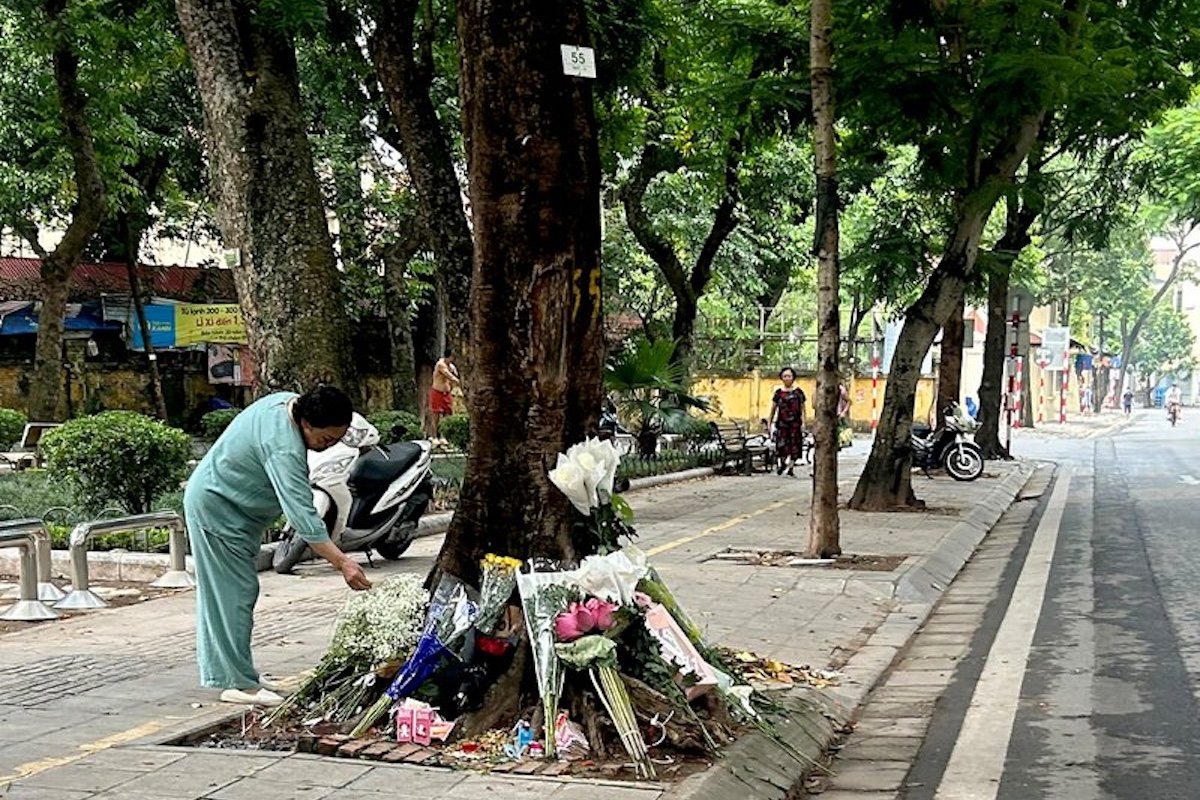
By mid-August, more than one million posts had mentioned Cuong, the crash site tree had been renamed the “justice tree,” marked on Google Maps, and turned into a makeshift memorial. On August 17, state broadcaster VTV devoted a six-minute segment to the case, featuring the victim's father confirming the family had no complaints and a prosecutor declaring that Cuong met the criteria for exemption from criminal liability.
A narrow grievance, a broad principle
The specifics of the case matter in their own right. But the episode also reveals something broader about the changing dynamics of online activism and state response in Vietnam, and across the region. The “justice tree” campaign is not challenging the political system or calling for reform. Its demand is rooted in a single case and directed at a single individual.
But the question it raises – whether everyone is truly equal before the law – resonates well beyond the road accident. That combination of a narrow, case-specific grievance and a broader principle of equal justice is what makes the mobilization so difficult for the state to manage. Whether this amounts to civic disobedience or quiet dissent is a question the state cannot easily settle, and the answer determines what kind of response is available to it.
The state's response cycle
Vietnam's handling of the Cuong affair followed a recognizable sequence, and at each stage the authorities appear to have misjudged what they were dealing with. For over a year, the approach was silence: no formal decision, no public acknowledgment, no media coverage beyond initial reports that identified the driver only by initials. This was the response to quiet dissent, something that could be waited out.
When the case resurfaced on Threads, the response shifted to suppression. Flowers at the crash site were removed under police supervision. Posts were taken down. Users reported that their content was restricted at the request of the Ministry of Culture and subsequently the Ministry of Public Security, though Meta did not respond to AFP questions about the takedowns. This was the response to civic disobedience as something to be contained. When suppression failed, the state moved to narrative management through the VTV broadcast.
Each stage carried costs. The silence allowed grievance to accumulate. The suppression generated documentation of itself, as users screenshotted restriction notices and shared them as evidence. The VTV broadcast was, in one sense, a form of responsiveness: the state could have continued to ignore the case, and instead chose to address it publicly on its flagship program.
But the broadcast's framing, with the victim's father appearing to confirm the family had no grievance and a prosecutor presenting a closed case, left many users unconvinced. When flowers were confiscated, users called for white bows on backpacks instead. The movement stayed almost entirely online, and its tone remained measured. There were no protests, no political demands, no confrontation with authorities. Yet it kept adapting faster than the state could contain it.
Researchers have characterized the Vietnamese state's approach to online dissent as more nuanced than straightforward repression: a calculated blend of tolerance, selective responsiveness and coercion in which authorities use social media as a gauge of public grievance while working to ensure criticism does not spill over into organized opposition. Unlike China, Vietnam has not blocked major international platforms such as Facebook, YouTube or Threads. This leaves users in a more open information environment where censorship is visible and can itself become a rallying point.
The state maintains Force 47, a reported 10,000-strong military cyber unit, and the 2018 Cybersecurity Law gives authorities a legal basis to require foreign platforms to localize data and comply with government takedown requests. The state has previously used this framework to pressure Facebook, YouTube and TikTok. But the Cuong case suggests these tools work better against isolated dissidents than against broad mobilizations that avoid explicitly political framing.
Regional parallels
The pattern is recognizable elsewhere in the region. India's Cockroach Movement, born in May 2026 from a chief justice's contempt for unemployed youth, used similarly creative and satirical tactics to force the resignation of India's education minister. That episode showed how online satire can translate into political accountability in a competitive democracy.
Malaysia's Bersih movement sustained digitally networked pressure across electoral cycles, contributing to the fall of the Barisan Nasional government in 2018. Indonesia's student and labour protests have shown that online mobilisation and street action can reinforce each other, though Indonesian experience also suggests that states can respond with selective concessions and issue fragmentation rather than structural reform. Jakarta's balancing act in foreign affairs mirrors its domestic approach to managing dissent.
These comparisons highlight both the possibilities and the constraints of Vietnam's case. India's movement could extract a ministerial resignation because India's competitive democratic system, however imperfect, creates mechanisms for protest pressure to translate into political consequences. Vietnam lacks such mechanisms, yet the “justice tree” campaign has already forced a public response from the state, something that would have been unthinkable a decade ago.
The question now is whether the state's narrative management will hold, or whether the campaign will evolve into a broader test of legal equality. Vietnam's institutional gaps are not limited to the justice system, and the “justice tree” may become a symbol of deeper frustrations. For now, the tree stands as a reminder that even in a tightly controlled information environment, a single case can resonate far beyond its immediate facts.