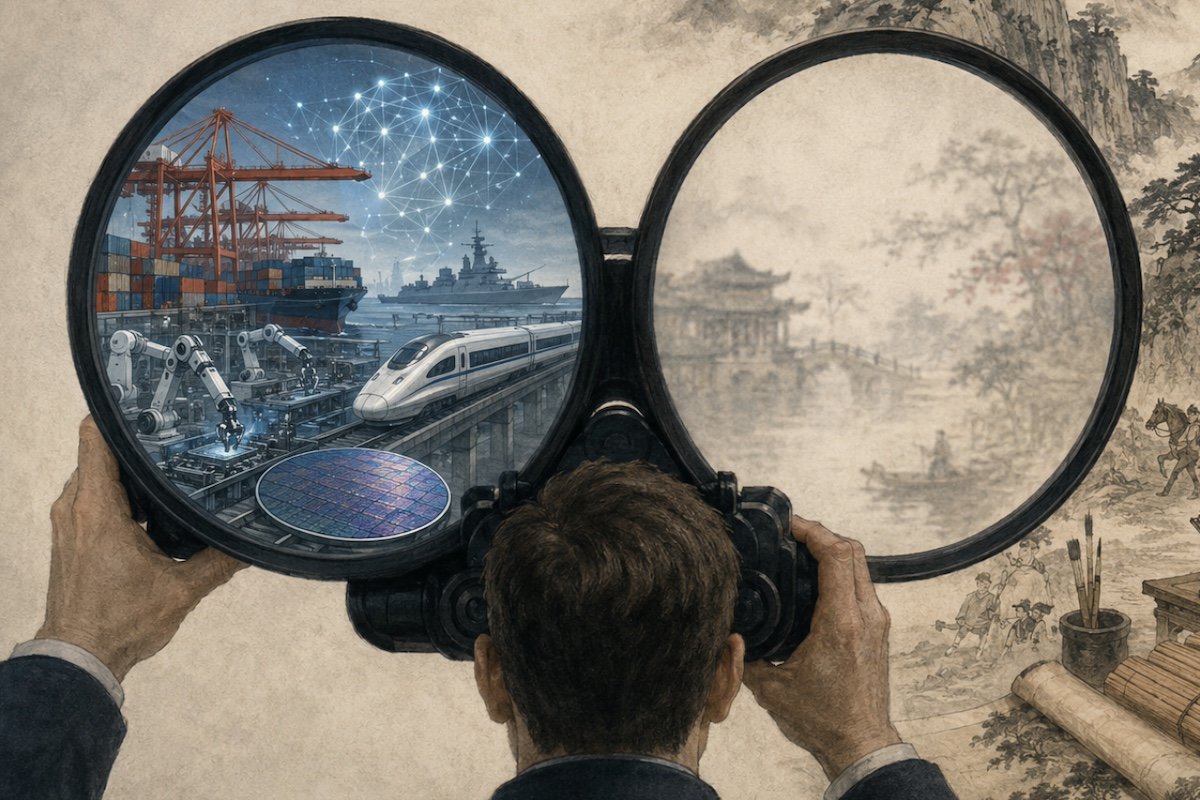
When Xi Jinping met Donald Trump in Beijing on May 14, 2026, the Chinese president raised the "Thucydides Trap" — the idea that a rising power and an established one are destined for conflict. He also warned that mishandling Taiwan could push the two countries toward war. The exchange captured the strategic anxiety of the moment.
China's rise is measured in factories, patents, AI models, naval vessels, and trade flows. Governments and corporations study its industrial policy, automated manufacturing, and technological capabilities. Competitors want to replicate its success; countries in the Global South want to adapt what seems useful. Yet the study of Chinese language, history, philosophy, and culture has not kept pace with China's growing importance. That imbalance is dangerous.
Learning how China competes, not how it thinks
The world is learning how China produces, finances, and competes without understanding the historical and cultural frameworks through which questions of order, humiliation, obligation, authority, and national renewal are debated. The trend is visible in education. According to the Modern Language Association's 2021 enrollment survey, Chinese language enrollments at US colleges fell by 14.3% between 2016 and 2021. Graduate enrollments dropped from 1,266 to 892. Academic exchange has also contracted as geopolitical tension, security concerns, travel restrictions, and political controls make sustained engagement harder. At the moment China expertise is most needed, the channels that produce it are narrowing.
Cultural literacy does not mean accepting Beijing's claims. It means recognizing that policies and statements are interpreted through different historical memories and moral vocabularies. American political discourse emphasizes individual rights and limits on government. Chinese discourse often stresses social order, collective welfare, and relational obligation. Neither society speaks with one voice, but the difference helps explain recurring arguments over human rights, governance, and stability. In diplomacy and business, Chinese counterparts may also place greater weight on personal relationships, indirect speech, and saving face than Americans accustomed to explicit disagreement.
Historical memory matters just as much. Western and Japanese imperialism caused immense suffering in China during the nineteenth and early twentieth centuries. That history is emphasized in Chinese education and official narratives, while many Western publics know little about the Opium Wars, the unequal treaties, or the Japanese invasion. What one side sees as contemporary policy, the other may interpret through a longer history of national vulnerability and foreign intrusion.
China also remembers centuries when it was one of the world's most sophisticated civilizations. It developed a durable bureaucratic tradition and, during the Song dynasty, achieved remarkable advances in commerce, education, printing, technology, philosophy, and the arts. That history does not justify modern territorial claims or policy, but it helps explain why many Chinese see national rejuvenation not as the birth of a new power but as recovery from a historical interruption.
Henry Kissinger contrasted American and Chinese forms of exceptionalism. Each country carries a story about its place in world history. Diplomacy conducted without understanding those stories is prone to mistake symbolism for substance, defensive behavior for aggression, or compromise for humiliation.
China is more than the Chinese state
Understanding China also requires resisting the temptation to reduce it to a single essence. Chinese society and civilization cannot be reduced to the Communist Party, nor to Confucianism. China has been shaped by Confucian, Daoist, Buddhist, and Legalist traditions, as well as popular religion, Marxism, nationalism, capitalism, and global modernity. These inheritances overlap and compete.
New Confucianism offers a revealing example. The movement took shape as Chinese thinkers confronted Western power and modern institutions. Philosophers including Mou Zongsan, Tang Junyi, and Xu Fuguan defended the Confucian tradition against those who blamed it for China's weakness, while also asking how it might respond to science, democracy, and individual freedom. After 1949, much of this work continued in Hong Kong and Taiwan, while Confucianism was officially repudiated and, especially during the Cultural Revolution, violently suppressed on the mainland.
New Confucians distinguished technical knowledge from wisdom. Science and reason could reveal and transform the natural world, they argued, but could not by themselves settle questions of meaning, moral cultivation, or the proper ends of power. Their thought remains relevant to societies that possess extraordinary technical capabilities but are less certain about the purposes those capabilities should serve.
Some mainland thinkers have since promoted nationalist, authoritarian, or patriarchal versions of Confucianism. Others across mainland China, Taiwan, South Korea, and North America have explored its compatibility with democracy, meritocratic government, reciprocity, and human dignity. Confucianism is therefore not a fixed political doctrine but a contested living tradition.
Tu Weiming has done more than most to bring that tradition into global conversation. His idea of "cultural China" extends beyond the Chinese state to include people connected to Chinese civilization through language, memory, and intellectual engagement. He criticizes the political use of Confucianism to enforce obedience, but ...
As Washington and Beijing navigate a fraught relationship, the gap in cultural knowledge is not merely academic. It affects how each side interprets the other's moves — from space weapons programs to supply-chain diplomacy. Without deeper engagement with China's civilizational roots, the world will continue to study its power while missing the ideas that shape it.