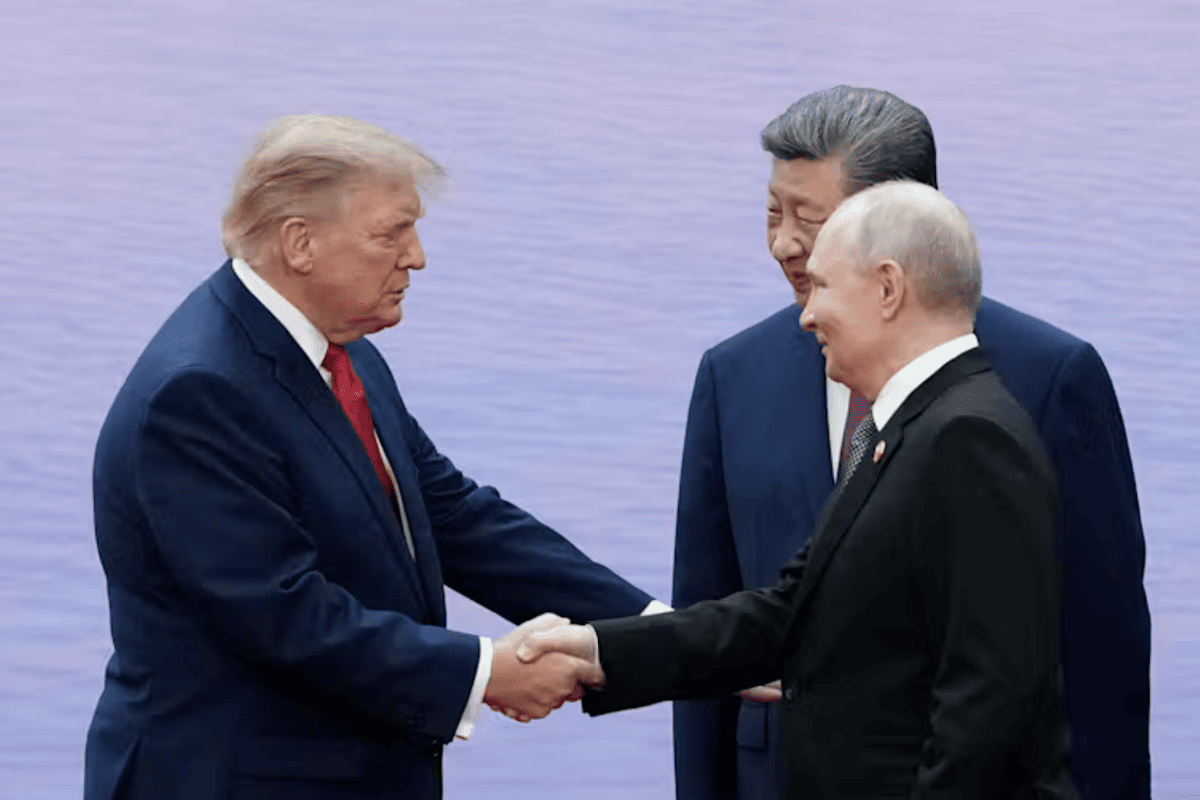
On November 19, 2026, the leaders of China, Russia, and the United States convened in Shenzhen for a trilateral summit that was billed as a potential turning point in global affairs. The meeting, held on the sidelines of the Asia-Pacific Economic Cooperation (APEC) forum, brought together Chinese President Xi Jinping, Russian President Vladimir Putin, and U.S. President Donald Trump for the first time in this format. Yet, after 90 minutes of discussion, the event delivered more in terms of imagery than in concrete policy outcomes.
A stage set for symbolism
The choreography began even before the talks started. Trump's arrival in Shenzhen was marked by an unusual gesture: Xi personally greeted him at the airport, an honor rarely extended to foreign leaders. The subsequent embrace between the two presidents was unprecedented for Xi, who is not known for such displays of warmth. This carefully staged interaction set the tone for a summit that seemed designed to project an image of unity and mutual respect among the three powers.
The seating arrangement at the main table reinforced this narrative. Xi sat at the center, flanked by Trump and Putin, a positioning that underscored China's self-perception as the 'Middle Kingdom'—a stabilizing force in a turbulent world. While this may not reflect Beijing's actual global standing, it certainly signals how Xi wishes China to be perceived.
Limited policy outcomes
Despite the grand setting, the substantive achievements were modest. The three leaders discussed reforming the United Nations, a topic on which they share some common ground—China seeks greater influence within the organization, while Trump has grown increasingly skeptical of its effectiveness. However, no concrete proposals were put forward.
On nuclear weapons, the trio signed a joint statement echoing the 1985 Reagan-Gorbachev declaration that 'nuclear war cannot be won, must never be fought.' While symbolically significant, the statement lacked specific commitments or mechanisms for implementation. With key arms control treaties having lapsed, and China's nuclear arsenal still smaller than those of the U.S. and Russia, the practical implications remain unclear.
What was left off the table
Notably absent from the discussions were the ongoing conflicts in Ukraine and Iran. The war in Ukraine was not mentioned by name, likely because the three leaders are on opposing sides and European allies were not present. Similarly, the situation in Iran, where the U.S. has been engaged for nine months, was not addressed in any meaningful way. Neither Russia nor China appeared willing to offer assistance to Washington on this front, preferring to keep their leverage intact.
Also missing from the agenda were artificial intelligence regulation and critical mineral supply chains—issues central to the U.S.-China economic rivalry. These topics may have been raised in bilateral sideline meetings, but they were not part of the trilateral conversation.
Yalta II or a new reality?
Some observers have drawn parallels to the Yalta Conference of 1945, where Churchill, Stalin, and Roosevelt shaped the post-war order. But the comparison is superficial. In 1945, the three leaders were allies fighting a common enemy; today, the U.S., China, and Russia are strategic competitors with divergent interests. Moreover, Britain was a key participant at Yalta, whereas China was absent—a reflection of how much the global balance of power has shifted over eight decades.
The Shenzhen summit may have opened a door to great power dialogue, as some analysts suggest, but it also exposed the hollow core of multipolar diplomacy. The leaders left with a photo opportunity and a vague statement, but the world's most pressing challenges remain unresolved. As the hollow core of multipolar diplomacy becomes more evident, the question is whether future summits will produce more than symbolism.
For now, the meeting in Shenzhen will be remembered more for its optics than its outcomes. The embrace between Xi and Trump, the seating arrangement, and the carefully crafted statements all pointed to a desire to project stability. But as the door to great power peace dialogue creaks open, the lack of concrete progress suggests that the road ahead remains fraught with challenges.