In the world of generative AI, a common belief holds that the window for building frontier models has closed. The prevailing view is that only those who started years ago—with established labs, deep research cultures, and insurmountable head starts—can compete. Yet a counterexample from Beijing-based Xiaomi is challenging that narrative.
In March 2025, an anonymous model appeared on a developer platform under a codename. It quickly climbed usage charts, serving over one trillion tokens before its maker was identified. The developer community initially assumed it was an unreleased version of DeepSeek, the Hangzhou-based AI lab. It was not. It was Xiaomi's MiMo series, a fact that surprised many who associate the company primarily with smartphones, rice cookers, and electric vehicles.
Xiaomi's first serious reasoning model, a seven-billion-parameter system, arrived on April 30, 2025—barely a year ago. It was deliberately small, optimized for math and code. By December 2025, the company had scaled to a 309-billion-parameter model, and by March 2026, a trillion-parameter mixture-of-experts model that matched or exceeded many peers on benchmarks. The model, MiMo-V2.5-Pro, now handles text, image, and video natively, with a one-million-token context window.
From Standing Start to Frontier Contender
Xiaomi's AI journey began earlier, with a voice assistant called Xiao Ai launched in 2017, but that was narrow AI. The company formed a large-model team inside its AI Lab in early 2023 and released the MiLM series for edge devices. But those were tiny. The leap to frontier-scale models came only in 2025.
The speed of progress is striking. Within eight months of its first model, Xiaomi had a 309-billion-parameter version; within eleven months, a trillion-parameter one. The model went open-source and multimodal. Independent rankings now place it consistently in the middle of major leaderboards, often ahead of models from companies with higher market capitalizations, such as Zhipu AI.
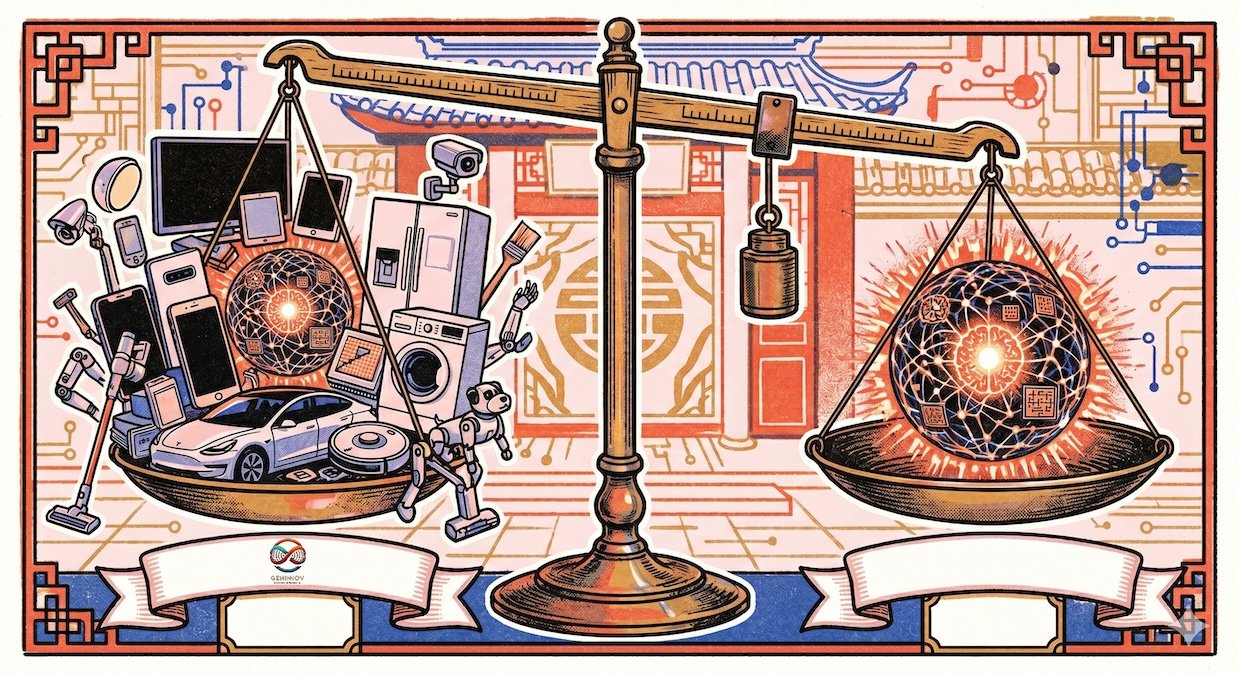
Xiaomi's market cap is currently lower than Zhipu AI's, a fact that seems anomalous given Xiaomi's vastly larger revenue and diversified product lines. The company's model is arguably more exciting than many pure-play AI labs, yet the market has not fully priced this in.
Part of the reason is that reputation in AI builds slowly, through developer trust and ecosystem accumulation. Xiaomi has only recently given developers a reason to adopt its models. The ecosystem of adapters, fine-tunes, and deployment tooling is still nascent, but each capable release lowers the cost of the next, and each developer adoption compounds the network effect.
Late in 2025, Xiaomi hired a senior researcher who had helped build DeepSeek's models to lead its AI effort. The inflection in model quality lines up with her arrival, suggesting the best may be yet to come.
Early users noted that MiMo models were verbose and prone to math errors. A year later, independent measurements show the flagship is concise and efficient, hitting comparable quality at lower token counts than peers. On agentic tasks—staying faithful to instructions over long runs—it holds together across thousands of tool calls without drifting. Xiaomi's demonstrations include a compiler written autonomously over several hours, passing every hidden test.
Some observers have called MiMo-V2.5-Pro superior to Claude Code in certain contexts. While that claim is limited, it underscores the rapid rise.
The implications extend beyond Xiaomi. For governments and corporations drafting national or corporate AI strategies, the assumption that it takes a decade and a fortune to compete may need revision. Xiaomi's example shows that a latecomer with strong engineering, a clear product focus, and strategic hiring can catch up faster than expected.
As the US-China tech rivalry intensifies, with implications for supply chains and security, Xiaomi's AI push adds a new dimension. The company's model is now a contender in a field dominated by DeepSeek, Alibaba's Qwen, and Baidu's Ernie. Whether it can sustain momentum depends on continued investment and ecosystem growth, but the early signs are promising.
For investors and policymakers watching the region, Xiaomi's AI story is a reminder that the map of AI leadership is not fixed. The door may not be as closed as it seems.