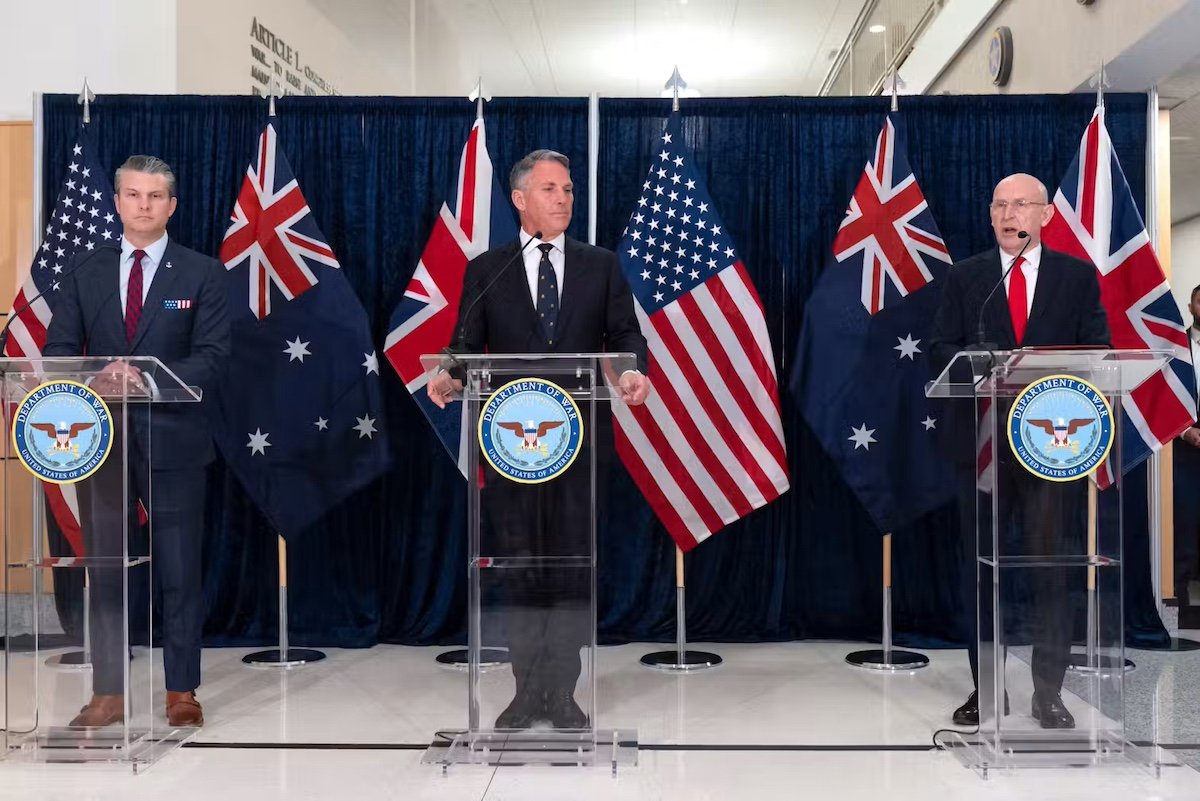
At the Shangri-La Dialogue in Singapore last weekend, the three AUKUS partners—the United States, the United Kingdom, and Australia—announced a revision to their submarine-sharing arrangement that has stirred considerable debate in Canberra. Under the new terms, Australia will receive three second-hand Virginia-class, nuclear-powered submarines in the coming years, replacing the original plan of two used vessels and one brand-new boat.
Australian Defence Minister Richard Marles presented the change as a welcome simplification of the fleet, arguing it would streamline supply chains, management, and sustainment of these complex warships. Yet what Marles appears to have overlooked is that not all Virginia-class submarines are created equal.
The new submarine the US had promised would have been from Block 6, the most advanced design currently in production. Instead, all of Australia's submarines will now likely come from Block 4, which carries a significantly smaller weapon payload. Firepower is a fundamental measure of a fighting ship's utility, and having the largest possible weapon capacity is critical for battle success. Australia, it seems, has been a willing—if not eager—victim of what amounts to a classic bait-and-switch.
A Deal Built on Unequal Terms
The unilateral change of plans should not have surprised anyone in the Australian government. AUKUS has always been a lopsided arrangement in which the United States reaps the strategic benefits while Australia shoulders the risks. The agreement Canberra signed provides Washington with numerous opportunities to cancel or modify the deal, and the US simply acted on what was permitted.
Moreover, the AUKUS framework allows the US president to cancel the submarine transfer at his or her discretion, with Australia having no right to challenge or lobby against the decision. Current President Donald Trump is not known for loyalty to allies, and the fact that the deal was signed by his predecessor, Joe Biden, likely further reduces Trump's commitment.
To make matters worse, Australia has already contributed at least US$2 billion (A$2.8 billion) to the American submarine manufacturing pipeline. The US is not building enough submarines to meet its own requirements, let alone the additional boats it promised to Australia. Canberra's cash injection was meant to boost US production rates so that Australia could secure one or two of the latest boats. That investment has turned out to be a poor one, and there are no refunds.
The Australian government has also misread what Washington hopes to gain from the arrangement. For the Americans, selling any submarines to Australia makes little strategic sense in the contest with China for supremacy in the Western Pacific—it merely reduces America's own military capability. The key element of AUKUS for the US has always been the submarine base Australia is building at HMAS Stirling in Western Australia. This is where the US Navy plans to operate its submarines, and Washington has already announced the establishment of support elements to administer and sustain these warships.
As events have shown, Australia has virtually no leverage to make the submarine deal more equitable. The Americans know that Australian strategic policy, since before the Vietnam War, has been to demonstrate relevance to the US. Canberra has not hesitated to rush into US-led wars—even those of dubious legality—in order to prove its loyalty. If this were a poker game, the Australians would be playing with most of their cards face-up.
What Can Australia Do?
Unfortunately, not much. The US holds all the important cards. Australia will likely continue to be a dutiful ally in the hope that Washington delivers what it has promised, but there are no guarantees. The only vulnerability the US has is its desire to base its submarines at Stirling. If Australia were to halt construction or restrict US access to the base, it would be seen as tantamount to canceling the deal. The price Canberra would pay for such temerity would be an enormous loss of respect and favor in Washington—the very thing a long succession of Australian governments has sought to boost.
Australia's defense policy has ensnared the country in a trap of its own making. There are lessons its political leaders can learn. The first is to accept the wisdom of former UK Prime Minister Lord Palmerston's adage that countries have no eternal allies, only eternal interests. The second is to recognize that an unbalanced alliance leads to servility, not partnership. The final lesson is to develop faith in Australia's ability to protect itself rather than turning to an ally of increasingly dubious reliability.
For deeper context on how Australia's strategic posture is evolving, see our analysis on how Pacific Islands can benefit from deepening Australia-Japan ties. The broader implications of the AUKUS submarine shift are also explored in our piece on US access to Australian bases.