Bangladesh's rulers have long resorted to renaming institutions when they become politically toxic. Roads are renamed after coups, laws after public outrage. The practice is usually futile.
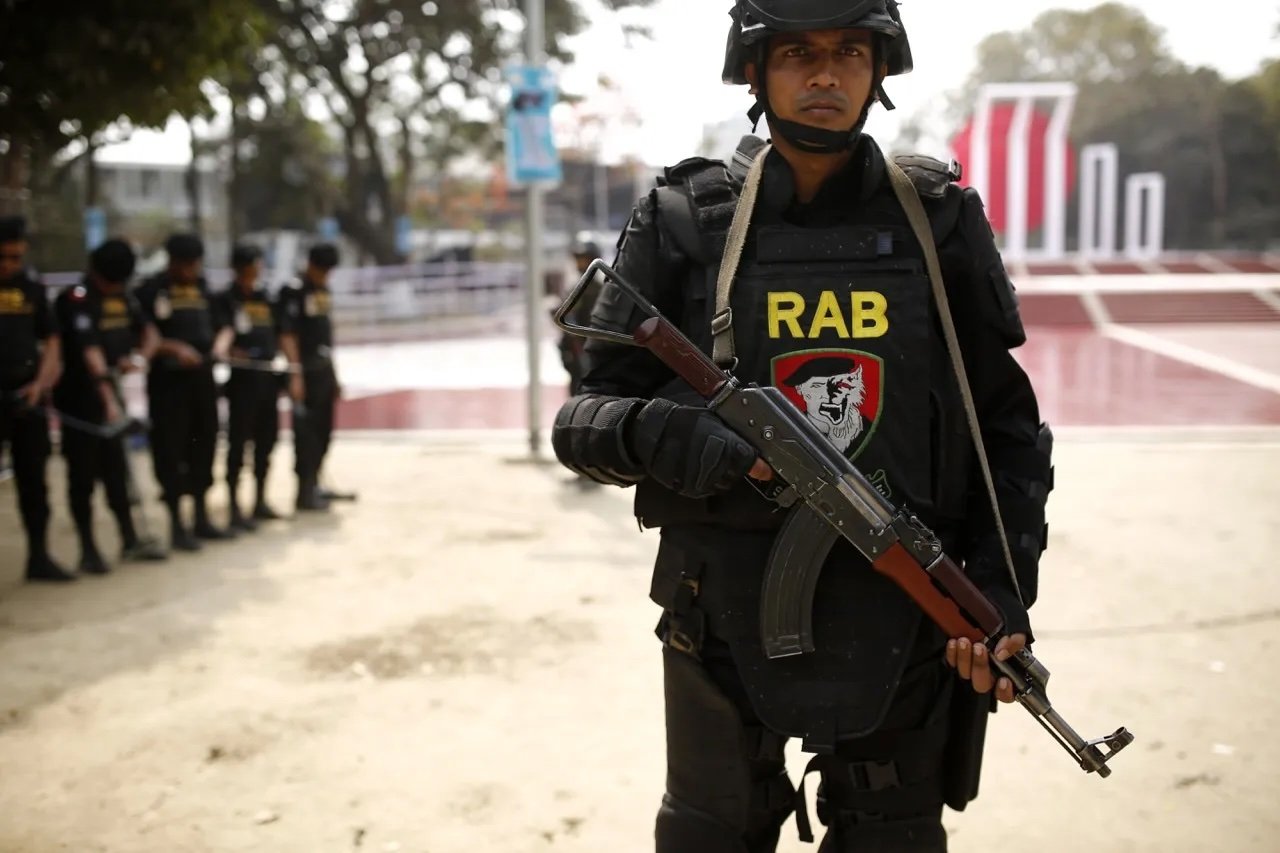
Now, the same instinct is being applied to the Rapid Action Battalion (RAB), the paramilitary force that for two decades served as the primary enforcement arm of authoritarian rule in Dhaka. Officials insist a new legal framework and a fresh signboard can rehabilitate the force. They are mistaken. The problem with RAB was never its name. It was the state philosophy that weaponized it.
RAB was created in 2004 under a Bangladesh Nationalist Party (BNP) coalition government led by then-Prime Minister Khaleda Zia. Born out of public panic over a wave of violent crime and nascent Islamist militancy, it was sold as a necessary tool for a weak state. In narrow tactical terms, it worked. Operations against the militant group Jama'atul Mujahideen Bangladesh (JMB) won praise at home and abroad. Yet Zia's government made a Faustian bargain: efficiency for accountability. Under her watch, RAB's "crossfires" — a transparent euphemism for extrajudicial executions — became normalized. Human rights monitors documented more than 350 people killed in these staged gunfights during the BNP's tenure up to 2006.
Like many elite units born in panic, RAB quickly evolved from a counterterrorism squad into a parallel coercive structure operating in the grey zone between military power and civilian life. That ambiguity was by design. Although nominally placed under the Ministry of Home Affairs, RAB was built by amending the Armed Police Battalion Act to allow the secondment of personnel from the army, navy, and air force. Soldiers entered civilian law enforcement without shedding their martial culture. This was the original sin. Armies are trained to neutralize enemies; police are trained to manage citizens under constitutional restraint.
The Hasina Era: From Anti-Crime to Political Repression
When Sheikh Hasina and her Awami League took power in 2009, they perfected the machinery. Over her 15-year rule, RAB ceased to be an anti-crime unit and became a sophisticated apparatus for political survival. Under the guise of a "war on drugs" and counterterrorism, the force systematically targeted the political opposition, journalists, dissenters, and even ordinary civil society members. The statistics of the Hasina era are grimly precise. Between 2009 and her ouster in August 2024, human rights groups documented over 600 enforced disappearances and more than 2,500 extrajudicial killings by security forces. RAB was the primary executioner.
A terrifying new vocabulary entered the Bangladeshi lexicon. Foremost was Aynaghar (the "House of Mirrors"), a network of clandestine military and paramilitary-run black sites where dissidents were subjected to prolonged isolation and waterboarding, sometimes for years, completely cut off from the legal system. The force operated with absolute impunity until December 2021, when the United States imposed Global Magnitsky sanctions on RAB and six of its top commanders, including Benazir Ahmed, the former RAB chief and later Inspector General of Police. The subsequent shift exposed the central myth of Dhaka's security discourse: that such abuses were tragic necessities of national security. Following the sanctions, extrajudicial killings and disappearances dropped precipitously overnight. The state had always possessed the capacity to restrain the force. It simply chose not to until external pressure altered the cost-benefit calculation.
This is why cosmetic reforms inspire little confidence. Bangladesh's current BNP-led interim government again approaches the issue administratively rather than structurally, debating new ordinances while avoiding the fundamental question: Should a military-trained institution be embedded in civilian governance at all? The danger is amplified because Bangladesh's military establishment is a sprawling corporate conglomerate. Military-linked enterprises dominate banking, insurance, construction, and telecommunications. This fusion of coercive authority and economic interest creates a combustible political economy. When security-linked networks become entrenched across civilian sectors, the temptation to influence civilian politics grows irresistible. RAB became the blunt instrument through which this institutional creep occurred.
The collapse of Sheikh Hasina's autocratic regime in 2024 exposed the ultimate failure of security-heavy governance. The combined terror of the police, RAB, and military intelligence could successfully suppress peaceful dissent, but proved incapable of managing mass popular uprisings without escalating violence to a catastrophic, and ultimately fatal, degree. Such systems excel at intimidation, not legitimacy. They mistake fear for stability until the moment both collapse together.
Bangladesh now faces a choice familiar to many post-authoritarian states. It can continue refining instruments of coercion while pretending they are compatible with democratic accountability, or it can rebuild civilian policing around transparency and genuine legal restraint. The first option is easier. It also guarantees recurrence. A renamed RAB may temporarily soothe foreign diplomats, but institutions do not change because governments repaint their logos. Until Bangladesh confronts the militarization of its domestic governance, the culture of the black site will survive any rebranding exercise intact.
For more on Bangladesh's diplomatic challenges, see Tarique Rahman's First Overseas Trip Will Define Bangladesh's Diplomatic Path. The country's strained ties with India are explored in India and Bangladesh Weigh Political Fix for Strained Ties.