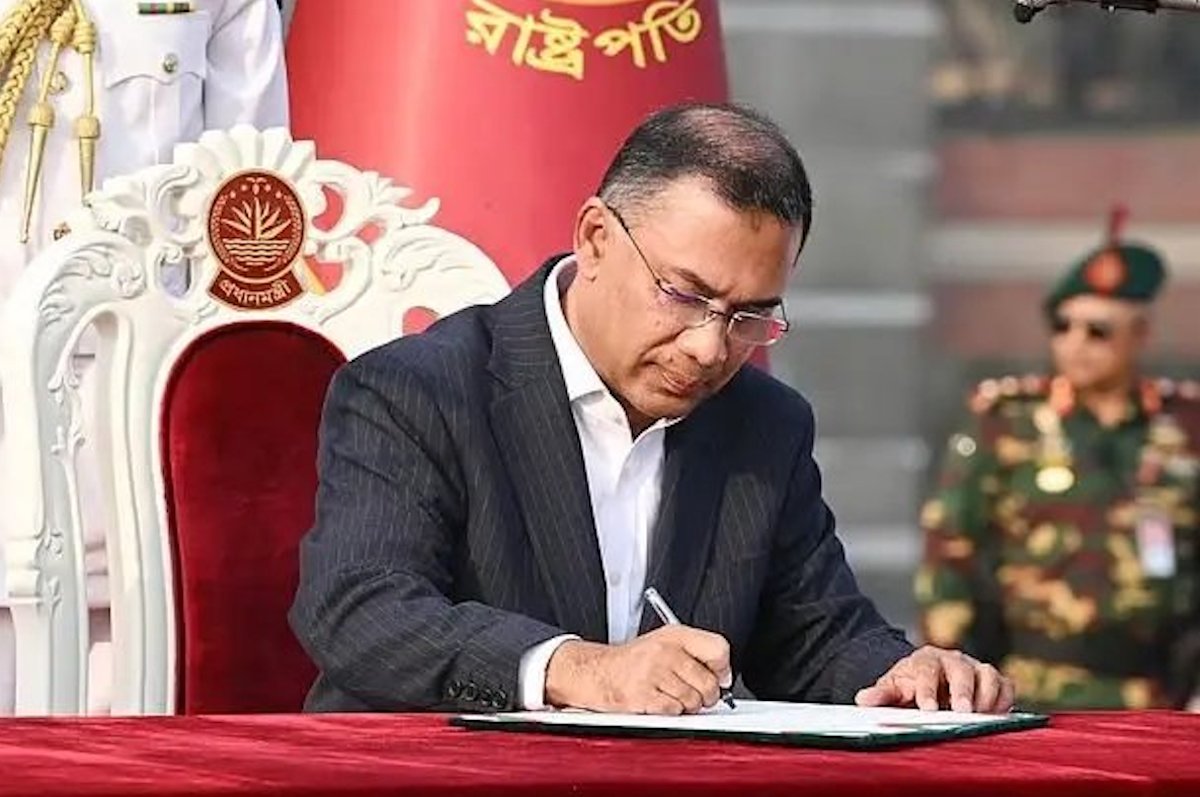
When Ashik Chowdhury, executive chairman of the Bangladesh Investment Development Authority, was asked about Prime Minister Tarique Rahman's upcoming trip to China, his answer surprised many in the room. “Many issues will come up,” Chowdhury said, “starting with defense.” For a visit officially framed around trade and investment, it was a blunt admission of the full scope of the agenda.
Rahman is scheduled to land in China on June 23 for a four-day official visit, preceded by a two-day stop in Malaysia. The newly elected government has promoted the tour under its “Bangladesh First” foreign policy doctrine, but the reality awaiting Dhaka in Beijing extends well beyond balance sheets.
Economic Stakes and Pending Proposals
The trip opens with an economic veneer. Rahman will first attend the World Economic Forum's Summer Davos in Dalian — formally the 17th Annual Meeting of the New Champions, running from June 23-25. He is expected to meet WEF Interim President and CEO Alois Zwinggi before heading to Beijing for talks with Chinese President Xi Jinping. By starting at a multilateral economic forum, Dhaka can frame the visit through a commercial lens before addressing the high-stakes strategic negotiations waiting in the wings.
The economic stakes are genuinely massive. Bangladesh currently has financing proposals worth over $9 billion pending with the Chinese government, the Asian Infrastructure Investment Bank, and the New Development Bank. Dhaka is directly seeking $4.34 billion from Beijing to back several critical, long-delayed initiatives — among them the contested Teesta River Comprehensive Management and Restoration Project, the expansion and modernization of Mongla Port, and the Chinese Economic and Industrial Zone in Anwara, Chattogram.
Groundwork on Anwara is moving fast. On June 16, the Executive Committee of the National Economic Council cleared a 41.89 billion taka project to develop the zone's supporting infrastructure: a four-lane road, a multipurpose jetty capable of handling 20,000 deadweight-tonne vessels, a central effluent treatment plant, and gas, power, and water systems across the 800-acre site. China Road and Bridge Corporation has been nominated to carry out construction. Officials expect around a dozen memoranda of understanding to be signed during the trip, spanning electric vehicle technology transfers, renewable energy, banking cooperation, and a potential currency swap. Rahman will also serve as chief guest at a Beijing investment conference aimed at drawing Chinese capital directly.
Defense at the Forefront
But commerce alone does not explain why BIDA's chairman put defense at the absolute top of the list. Bangladesh is quietly finalizing a $2.2 billion deal to buy 20 Chinese-made J-10CE multirole fighter jets. The package allocates roughly $60 million per aircraft — $1.2 billion for the 20-jet fleet — with the remaining $820 million covering training, logistics, spare parts, transport, insurance, and infrastructure. The acquisition would make Bangladesh only the second country in South Asia, after Pakistan, to operate the J-10CE, and would represent the most significant expansion of Chinese military hardware in the region in years.
The previous interim administration had already cleared the deal in principle following extensive military reviews, and the current government is now driving it across the finish line. Air Chief Marshal Hasan Mahmood Khan heads an 11-member inter-ministerial committee tasked with finalizing government-to-government terms, payment schedules, and delivery timelines. Internal momentum for the Chinese jets surged after Operation Sindoor, the four-day India-Pakistan border conflict of May 2025. While New Delhi disputed many of Islamabad's claims, Pakistan's accounts of the J-10CE's radar performance against Indian Rafales likely shifted calculations in Dhaka, convincing military planners that the aircraft offered the best available combination of combat capability and cost, particularly after sticker shock from French alternatives.
It is not an isolated defense procurement from China. In January this year, the Bangladesh Air Force signed a government-to-government agreement with CETC International — the export arm of China Electronics Technology Group Corporation — to establish a domestic unmanned aerial vehicle manufacturing and assembly facility in Dhaka, with full technology transfer. It stands as the most consequential transfer of Chinese military technology to Bangladesh to date.
Washington's Countermove
Washington is no doubt watching all of this carefully. US Ambassador to Bangladesh Brent Christensen has explicitly flagged the long-term risks of strategic over-reliance on Beijing. To provide an alternative, Washington has put an aggressive military package on the table, including F/A-18 Super Hornets, Apache attack helicopters, NASAMS air defense systems, and MQ-9 Reaper drones — a line-up calibrated to match what China is offering in both capability and signal. Simultaneously, long-stalled talks over the GSOMIA and ACSA defense frameworks have suddenly accelerated. The catalyst was a congratulatory letter dated February 18 from President Donald Trump to Prime Minister Rahman — a letter that went well beyond pleasantries. “I hope you will take decisive action to complete the routine defense agreements that would finally give your military access to high-end, American-made equipment,” Trump wrote, pressing Dhaka to sign both pacts. Rahman's government has insisted that no security agreement will be concluded unless it protects core national interests, but the pressure is unmistakable.
The deeper problem for Bangladesh is that Washington has begun tying trade access directly to security compliance. A reciprocal trade agreement signed on February 9 by the outgoing interim government embedded significant conditionalities alongside its tariff concessions. The deal reportedly links continued preferential access to progress on defense pacts, creating a dilemma for Dhaka. For a deeper look at how India's own actions have complicated relations with Bangladesh, see our analysis: India's Border and Airport Snubs Undermine Its Own Bangladesh Reset.
As Rahman prepares to land in Dalian, the balancing act between Beijing's checkbook and Washington's security demands will define not just this visit, but Bangladesh's strategic trajectory for years to come. The outcome will also resonate across the broader Indo-Pacific, where smaller powers are increasingly forced to choose sides in the intensifying US-China rivalry. For context on how the Pentagon is refocusing its priorities, read: Why Dropping 'Indo-Pacific' Sharpens the Pentagon's China Focus.