China has established itself as a credible alternative supplier of conventional arms across the Indo-Pacific, but a more consequential shift is underway. Beijing is beginning to export weapons that incorporate artificial intelligence and autonomous capabilities, a development that extends far beyond traditional arms sales and raises fresh questions about technological dependence and crisis stability in the region.
This transition is still in its early stages. Most Chinese arms exports remain conventional platforms. Yet China's dominance in commercial drone manufacturing, its established market for armed unmanned aerial vehicles (UAVs), and the growing sophistication of its domestic defense industry are laying the groundwork for a significant next phase in its defense-export strategy.
The AI dimension of Chinese exports
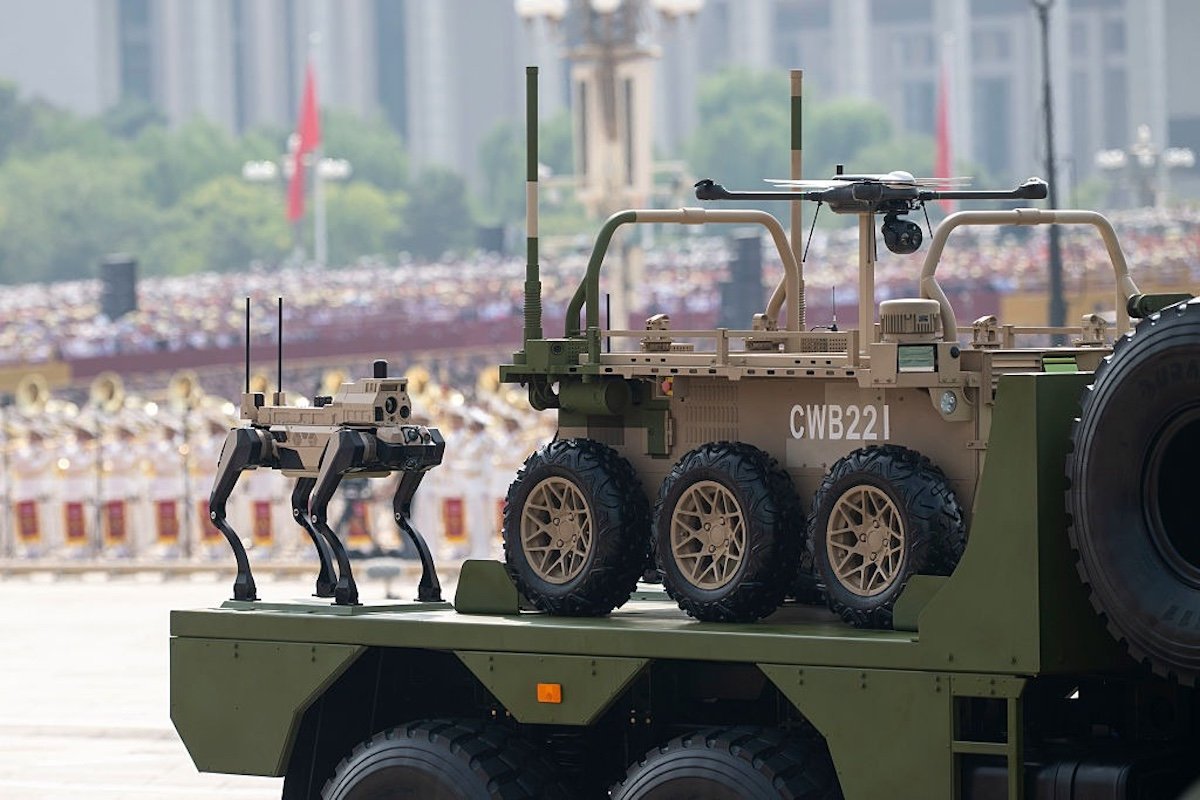
China's military modernization is built around the concept of "intelligentized warfare," which places AI, autonomous systems, and data-driven operations at the center of future conflict. This doctrinal priority drives sustained investment in unmanned platforms, swarm technologies, and intelligent command systems within the People's Liberation Army (PLA).
In parallel, a combination of capability and affordability has already made China one of the world's leading exporters of armed drones and drone components. Platforms such as the Wing Loong II, the Ziyan Blowfish A2, and the CH-4 have found markets across the Middle East, Africa, and parts of Asia. While China has not yet exported fully autonomous drones, these platforms already incorporate autonomous functions in navigation, target tracking, and flight control.
In practical terms, these systems can perform basic on-board processing of sensor feeds—stabilizing imagery, maintaining a designated track on a moving object, and cueing operators to potential targets—reducing continuous manual workload and reliance on high-bandwidth data links. Newer generations are expected to feature more advanced AI integration and greater autonomy.
The PLA has tested AI-coordinated drone swarms and human-machine teaming concepts, including systems capable of operating with reduced direct human control. In August 2026, it was revealed that the PLA Air Force is using an AI-enabled strike planning system to prioritize targets, coordinate attack waves, and allocate tasks across large formations. Once a subset of these swarm-management tools, automated target-recognition algorithms, or collaborative autonomy features becomes incorporated into export variants, it will significantly enhance the capabilities of smaller Indo-Pacific states in surveillance, strike coordination, and area denial, potentially narrowing longstanding gaps with larger regional powers.
China's Military-Civilian Fusion (MCF) strategy has played a central role in Beijing's push to develop AI capabilities. The policy is designed to integrate civilian technology with military requirements, allowing the PLA to draw on rapid advances of commercial companies in AI, data analytics, and unmanned systems. Once a technology matures, the same MCF approach that accelerates domestic AI development also positions Chinese defense firms to incorporate such technologies into weapons offered abroad.
How quickly and in what form these capabilities will appear in export models depends equally on technical progress and Beijing's export control decisions. On October 19, Beijing announced revised controls on specified UAVs and related technologies, including autopilots, flight- and cluster-control, autonomous-navigation, and obstacle-avoidance technologies. These controls shape not only which systems Chinese firms can offer abroad, but also the capabilities and supporting technologies available to foreign buyers.
For recipient militaries, acquiring AI-enabled platforms does not only involve importing physical platforms, but also adopting the associated software, data formats, and updating cycles that sustain AI-enabled functions, such as diagnostic tools or decision-support displays. Over time, this will create forms of dependence that hinge less on spare parts and more on continued access to Chinese software support, training data, and integration services. In a crisis, the ability—or refusal—of Chinese firms to provide software patches, threat-library updates, or troubleshooting support could therefore become powerful leverage, one that operates below the threshold of formal sanctions but still shapes partners' operational readiness.
Implications for Indo-Pacific security
Chinese arms transfers are beginning to alter capability balances across multiple Indo-Pacific subregions, from the Korean Peninsula to the South China Sea and the eastern Indian Ocean. The emerging AI trajectory in Chinese systems adds a further layer of complexity. When future Chinese exports incorporate more advanced AI-assisted sensing and targeting tools, they may shorten the time between detection, classification, and engagement at the tactical level, leaving commanders and political leaders with less time to interpret events and respond.
This raises serious concerns for regional security. In tightly contested airspace or maritime zones, the shrinking window between detection and engagement could increase the risk of inadvertent escalation. Smaller states that acquire these systems may gain new capabilities, but they also become enmeshed in a web of technological dependence that Beijing can exploit. As China's arms exports reshape defense choices across the region, the AI dimension adds a strategic layer that goes beyond mere hardware sales.
The broader context of US-China technological competition, as highlighted by recent summit discussions, underscores the stakes. While the United States and its allies have imposed export controls on advanced AI chips, China's drone exports offer a workaround for regional buyers seeking capable systems without Western restrictions. This dynamic could further fragment the Indo-Pacific security architecture, with countries increasingly choosing sides based on access to cutting-edge military technology.
For now, the full extent of China's AI-enabled arms exports remains uncertain. But the trajectory is clear: Beijing is leveraging its technological prowess to expand its influence, and the Indo-Pacific's smaller powers are watching closely. The question is not whether AI will feature in Chinese arms sales, but how quickly it will arrive—and what it will mean for regional stability.