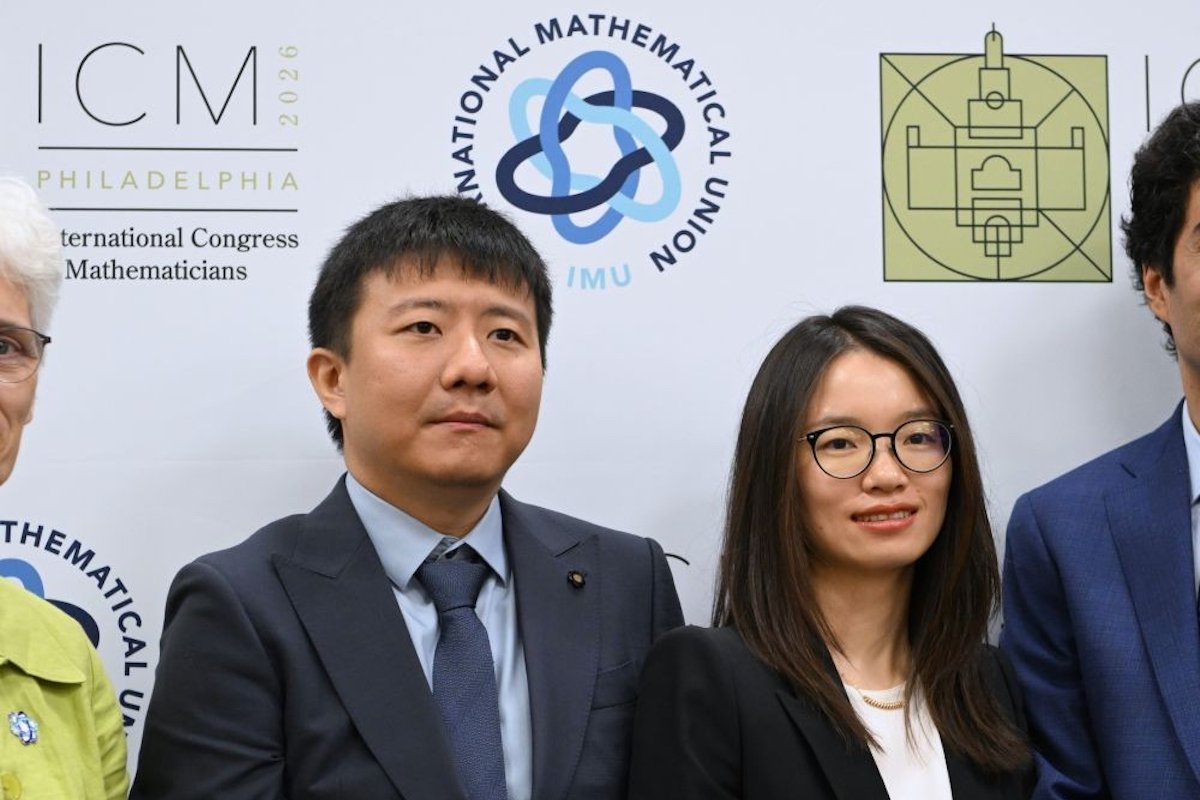
When Hong Wang and Yu Deng received the Fields Medal at the International Congress of Mathematicians in Philadelphia on July 23, they became the first citizens of the People's Republic of China to claim the highest honor in mathematics in its 90-year history. Wang is also only the third woman ever to win, after Maryam Mirzakhani and Maryna Viazovska.
Both achievements deserve unreserved celebration. But the medals also raise a question that neither triumphalism nor skepticism answers well: what exactly does a Fields Medal measure?
Not the present, for a start. Prizes in fundamental science are like light from distant stars: by the time the signal reaches us, the source has changed. Any government reading this year's medals as a real-time report card on its current science policy is reading the wrong instrument.
Careers that defy national scoreboards
The reflexive framing is a national scoreboard. Yet the biographies resist it. Wang and Deng entered Peking University in the same 2007 cohort; Wang then studied in France before earning her doctorate at MIT, and Deng transferred to MIT in 2009 before completing a PhD at Princeton.
Wang now holds positions at New York University and France's Institut des Hautes Études Scientifiques; Deng is at the University of Chicago. French President Emmanuel Macron called Wang to congratulate her and later invoked her career while promoting France as a destination for scientific talent. Three or four national flags could plausibly be planted on the same pair of careers.
This is not a contradiction to be explained away. It is the actual structure of elite scientific production.
Talent formation — the schooling, the competition circuit, the undergraduate rigor that produces someone capable of attacking the Kakeya conjecture — is largely national and takes about two decades. Talent flourishing — the mentors, the seminar culture, the tolerance for a decade of apparent failure — is institutional and increasingly transnational.
China supplied the first with evident success. The second was supplied by a handful of research centers spread across three countries. Neither half produces medals alone.
Lessons beyond China
There is a more interesting lesson buried here, and it applies well beyond China. For years China dominated the International Mathematical Olympiad without producing a Fields Medalist, and the gap was instructive.
Olympiad excellence rewards speed on problems known to be solvable within four hours. Research rewards the opposite disposition: choosing a problem that may consume a decade and may not yield at all.
Wang and Joshua Zahl resolved a question Soichi Kakeya posed in 1917; Deng and his collaborators Zaher Hani and Xiao Ma closed a formulation of a problem Hilbert set out in 1900. Few research metrics are designed to reward work on that timeline.
That is the transferable insight, and it indicts more systems than it flatters. Research bureaucracies across Asia, Europe and North America have converged on short evaluation cycles, publication counts and deliverables. Many of these systems struggle to protect the long horizons that such work requires.
The Fields Medals are, among other things, an argument for patient capital in the sciences — the kind that most funders have been steadily withdrawing. This pattern echoes broader trends in agricultural research funding, where China's surge contrasts with US decline.
Anxiety on both sides of the Pacific
Two competing anxieties surfaced within hours of the announcement, and both deserve tempering. On Chinese social media, users asked why their best students leave after undergraduate study. In Washington, the same news reads as evidence of American decline. Each reading treats mathematicians as national assets in a zero-sum ledger.
They aren't, and the proofs themselves show why. Wang's result was joint with a collaborator at the University of British Columbia; Deng's with colleagues at Michigan.
A theorem, once published, becomes a permanent global public good — non-rival, non-excludable, available to a graduate student in Lagos or Lahore the day it appears on arXiv. Kakeya sets bear on harmonic analysis, wave propagation, signal analysis and imaging. That downstream value accrues to whoever builds on it, not to whoever issued the passport.
If there is a policy story worth watching, it is not who won but whether the pipeline that produced these winners still exists. That pipeline depended on unimpeded movement: Chinese undergraduates admitted to American doctoral programs, French institutes hiring globally, collaborations formed across borders.
As governments increasingly sort researchers by nationality and security risk, however, that cross-border pipeline is becoming harder to sustain. Circulation is being replaced, incrementally, by sorting. This dynamic is visible in other domains, such as US innovation models that struggle to grasp China's state-led tech ascent.
That would be a costly trade. The 2026 medals were produced by an open system, and one can reasonably ask whether a more closed one would produce the same result in 2030.
The medals also arrive amid debate over AI in mathematical discovery, underscoring that greater computational power does not eliminate the need for human judgment about which questions merit years of attention. Meanwhile, China's launch of a global AI body signals a different approach to international scientific cooperation.
The honest reading of Philadelphia, then, is neither ascendance nor decline. It is that mathematics remains one of the few genuinely borderless human enterprises, and that its greatest results still emerge from systems willing to fund a question for a century and wait.