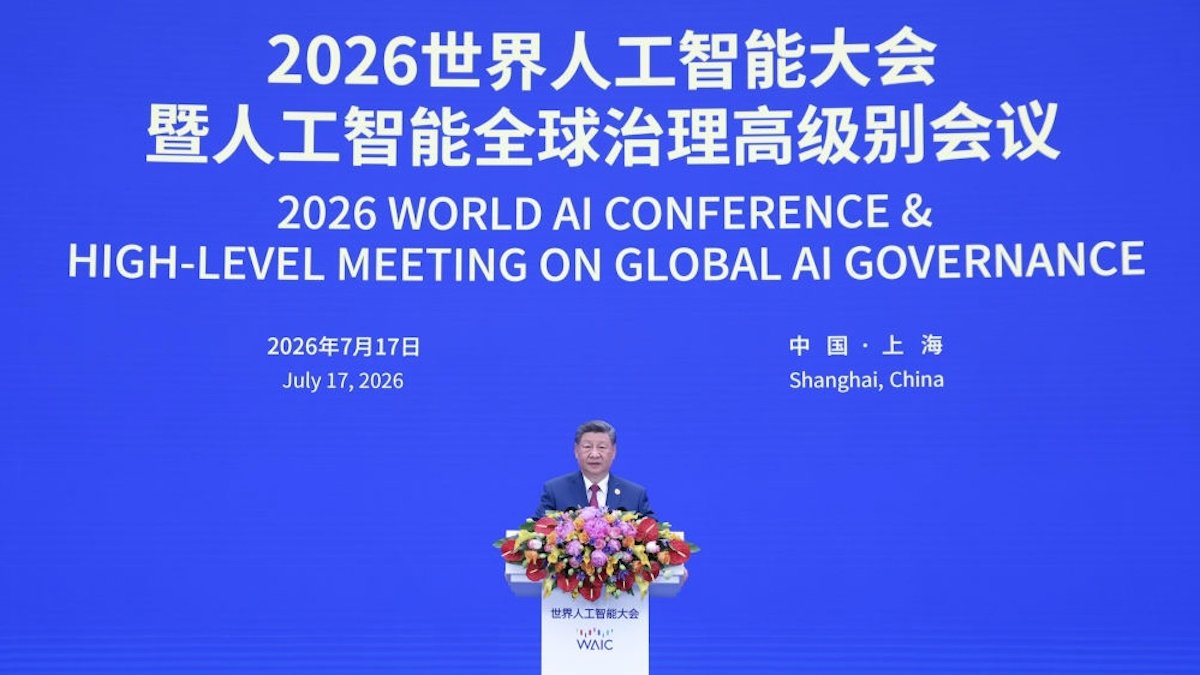
Chinese President Xi Jinping opened the 2026 World AI Conference and High-Level Meeting on Global AI Governance in Shanghai on July 17 with a carefully crafted metaphor: artificial intelligence should not be a solo performance by one country, but a symphony of international cooperation. It was his first in-person appearance at the event, and the line resonated with an audience that included representatives from 29 nations.
The following day, those countries—among them Kazakhstan, Laos, Pakistan, Russia, and Indonesia—signed the agreement establishing the World Artificial Intelligence Cooperation Organization, a new intergovernmental body with its headquarters in Shanghai. Xi called the creation a milestone, and Beijing committed to providing 5,000 AI training and research opportunities for developing countries over the next five years, alongside cooperation centers targeting ASEAN, the Arab League, the African Union, the Shanghai Cooperation Organisation, and BRICS members.
From Vague Proposal to Signed Treaty
This is not China’s first attempt at a global AI governance initiative. At last year’s WAIC, Beijing floated the idea of a cooperation body, but the proposal lacked detail. This year, the organization has legal form, a headquarters, 29 founding signatories, and the presence of UN Secretary-General Antonio Guterres at the signing ceremony—a stamp of international legitimacy that a purely Chinese program would not carry.
Xi’s appeal to the Global South is genuine and well-timed. Many developing economies have watched the AI race unfold as a contest between a handful of American and Chinese firms with the compute, capital, and chips to compete. They have found few avenues to shape the rules rather than simply receive them. A body that promises training, seminars, and application-focused cooperation centers—rather than investment tied to political conditions—addresses a real gap. Officials in Southeast Asia and the Arab world have reason to take the offer seriously.
But the framing deserves scrutiny alongside the welcome. WAICO arrives explicitly as a counterweight to what Chinese officials and state media describe as Western dominance of AI governance, and it launches amid intensifying competition between Washington and Beijing over the future of the global AI ecosystem. That does not make the initiative insincere, but it does mean the “symphony” metaphor sits alongside a fairly conventional exercise in great-power technology diplomacy—one in which Beijing is building influence and standard-setting power in exactly the arenas where Washington has historically led.
The notable absence of major US technology firms from the Shanghai summit underscores how far the two governance tracks have already diverged. Meanwhile, China's anti-stealth radar network faces integration and combat reality checks, highlighting the broader technological competition that frames this initiative.
Delivery Remains the Test
There is also a track record to weigh. Last year’s WAIC produced a Global AI Governance Action Plan and a proposal for the same cooperation organization now being formally launched, but independent trackers noted at the time that public details were thin and implementation unclear. A year on, WAICO has gone from proposal to signed agreement, which is real progress, but the harder test—whether the training slots, cooperation centers, and technology transfers materialize at the scale promised—is still ahead.
Member governments and observers will want to see delivery, not just declarations, before crediting Beijing with having solved the access gap it describes. The initiative also sits alongside other Chinese efforts to build influence, such as deepening tech and halal ties with Indonesia's top Islamic body, which similarly blends technology cooperation with diplomatic outreach.
None of this should obscure what is genuinely new here. The world’s first intergovernmental organization built specifically around AI cooperation is a notable institutional fact, whatever one thinks of its sponsor or its politics. For countries long accustomed to being AI rule-takers rather than rule-makers, an invitation to help write the rules—even one issued by Beijing and shaped by its interests—is worth engaging with rather than dismissing.
The test now shifts from speeches to delivery. Xi has offered the Global South a seat in the AI conversation. Whether WAICO becomes a genuine platform for shared benefit, or another venue in which a rising power sets terms that smaller states must accept, will depend on what happens in Shanghai’s cooperation centers over the next five years, not on what was said at the podium this week.