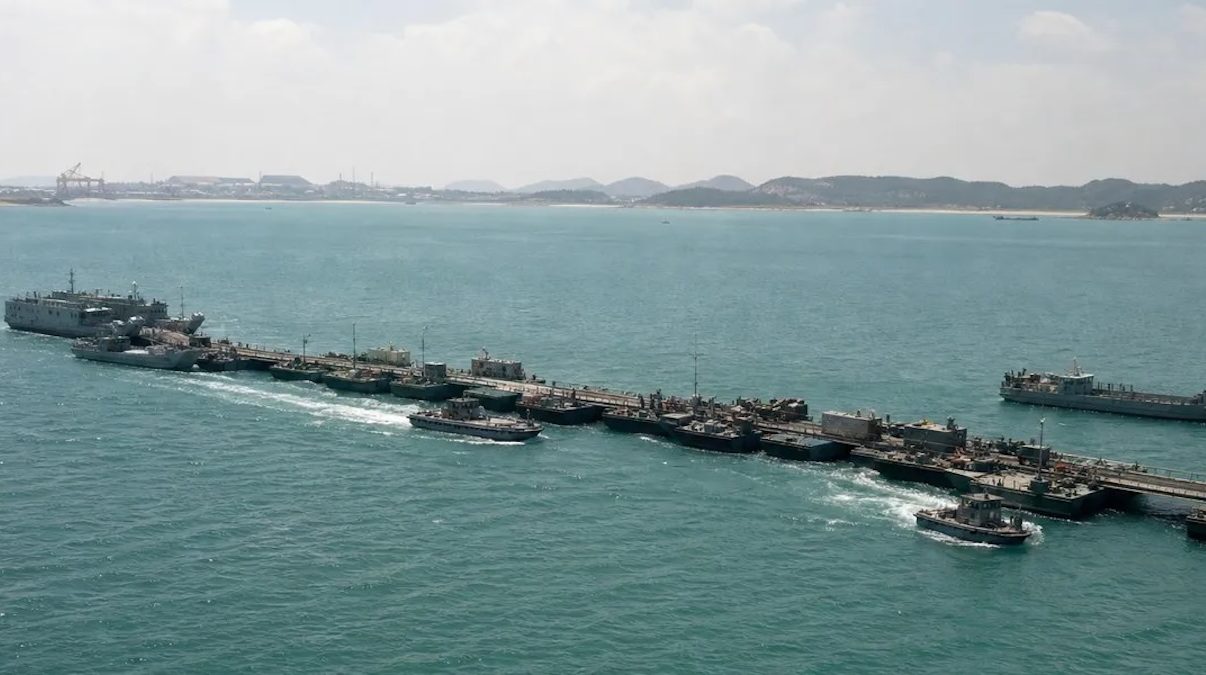
China's ongoing amphibious exercises in Dacheng Bay, Fujian province, have drawn attention for their use of civilian vessels to assemble an 800-meter floating bridge. But military analysts say the drill reflects a narrower operational goal: seizing small, lightly defended islands and supporting blockade coercion, not preparing for a full-scale invasion of Taiwan.
The exercise, first identified by geospatial firm ingeniSPACE and confirmed by an unnamed security official, involves eight civilian ships—four barges, two semi-submersible vessels, and two powered craft—alongside four landing craft and smaller support boats. The makeshift causeway is repeatedly assembled and dismantled without purpose-built bridging equipment, a technique that could compress warning times and expand landing options against isolated targets.
Rehearsing for the First Island Chain
Jason Wang, chief operating officer of ingeniSPACE, said the PLA was rehearsing low-signature logistics for contingencies along the First Island Chain and expanding potential landing sites. He noted radar jamming in the area, suggesting an effort to mask the exercise. The security official said the drill focused on quickly seizing small islands ahead of Taiwan's local elections, though he did not directly link it to the vote. He also warned that civilian barges would be "live targets" in wartime.
China has called the training legitimate and reasonable, while Taiwan said it was assessing security implications as Beijing refines coastal landing tactics, builds dual-use ships, and expands naval and coast guard deployments across the Taiwan Strait.
The improvised floating causeways solve a far narrower problem than an all-out invasion. They could be used to neutralize Taiwan's outlying islands—Kinmen, Matsu, and Dongyin—which host forward observation posts and missile batteries that could strike staging areas around Xiamen and Fuzhou. Eliminating those outposts would deprive Taiwan of early warning and long-range strike capabilities, while offering China a calibrated escalation step during a maritime blockade.
Beyond the Taiwan Strait, similar low-signature bridging could support rapid lodgments on islands astride critical chokepoints, such as Japan's Southwestern Islands near the Miyako Strait or the Philippines' Batanes Islands in the Bashi Channel. Seizing those positions could help the People's Liberation Army Navy break into the Pacific to deter US and allied intervention or mount a two-pronged flanking maneuver against Taiwan.
Even on Taiwan's main island, makeshift causeways fit secondary supporting thrusts better than decisive main-force landings. Defense planners generally divide potential landing sites between primary beaches—like Baodoucuo and Haihu near Taipei or Jianan and Xishu on the west coast—and smaller, secondary sites such as Fulong, Toucheng, or Jialutang, which offer tighter maneuver space for flanking operations. As Ashton Cho and co-authors noted in the Korean Journal of Defense Analysis (December 2023), while improvised bridges could widen offshore options, narrow spans and rugged terrain still constrain inland breakout.
However, relying on civilian landing craft in a contested Taiwan campaign introduces major operational friction. In a January 2026 report from the China Maritime Studies Institute (CMSI), Thomas Shugart and J. Michael Dahm noted that civilian hulls could boost over-the-shore assault capacity but face severe risks from guided missiles, artillery, mortars, and small drones. A precision drone strike on a ramp or bow vehicle could trap onboard armor, and Taiwan's scarce, confined beaches risk severe traffic congestion. Narrow high-tide windows could strand grounded hulls as stationary targets and physical obstacles for follow-on forces.
China's modular bridge concept faces similar single-point failures and sea-state limits. In an earlier March 2025 CMSI report, Shugart and Dahm argued that China's Shuiqiao specialized jack-up landing barges face steep operational hurdles, starting with narrow six-meter widths that restrict vehicles to a single column and cap offload rates. Because the system links modular units into a continuous pier, damaging or destroying a single barge could disable the entire causeway.
The drills underscore a strategic reality: while China is investing in dual-use vessels and coastal infrastructure, a full-scale Taiwan assault remains a high-risk, attritional gamble. Instead, Beijing appears to be building a toolkit for limited, deniable operations—seizing outlying islands, imposing blockades, and pressuring Taipei without triggering a massive conventional war. This approach aligns with broader regional dynamics, as seen in US Marine missile range boost faces reality check on Taiwan and North Korea's missile advances expose South Korea's industrial vulnerability.
For now, the floating-bridge drills are a reminder that China's military modernization is not just about mass—it is about flexibility and coercion. The question is whether Taiwan and its allies can adapt to a threat that is less about storming beaches and more about chipping away at the edges.