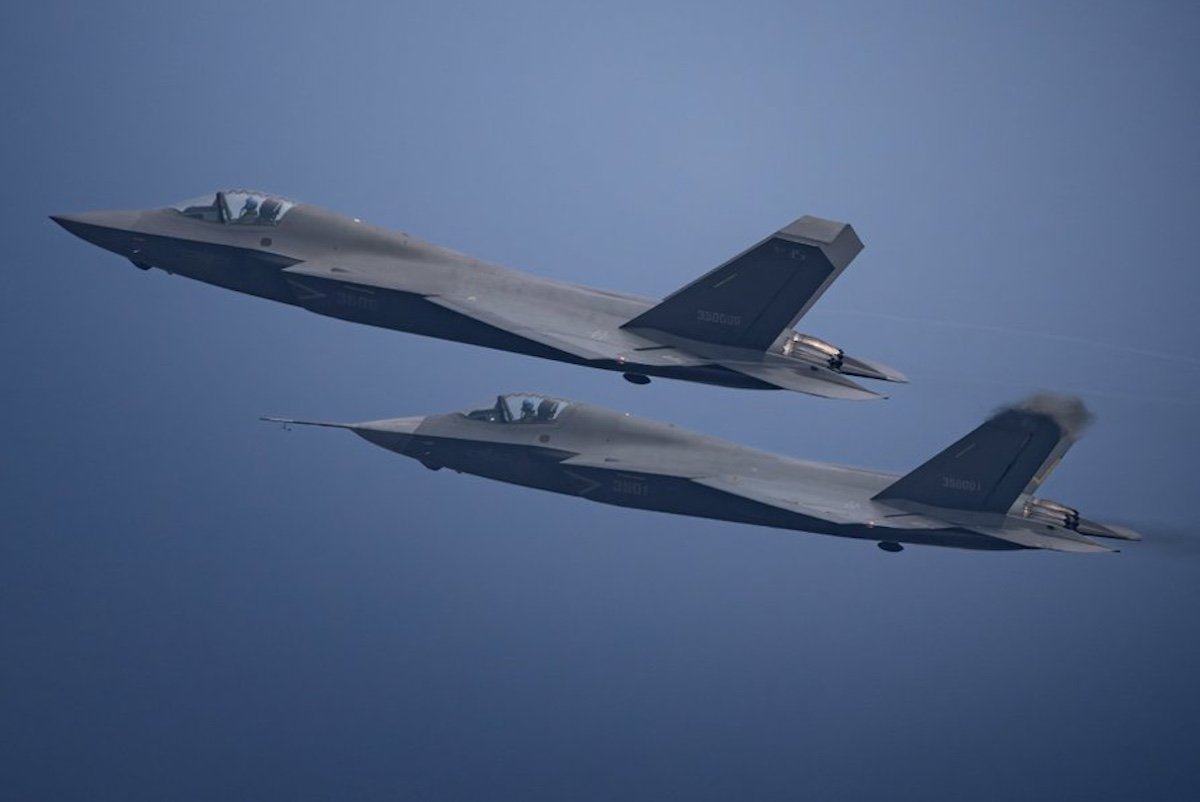
China appears poised to export its J-35AE fifth-generation stealth fighter to Pakistan, a move that could give Islamabad a new capability to strike deep into Indian territory and potentially destabilize the already fragile nuclear balance between the two rivals.
State broadcaster CCTV recently aired footage of the J-35AE rolling out of a hangar with markings from the Aviation Industry Corporation of China (AVIC), rather than the People's Liberation Army Air Force (PLAAF). The aircraft features an internally integrated electro-optical targeting system (EOTS), indicating a mature, combat-ready platform suitable for foreign sales. Reports suggest Pakistan may acquire around 40 units as part of a broader defense package, making it the primary initial customer.
Stealth Fighter Could Reshape Air Combat Dynamics
The J-35AE's potential deployment comes amid heightened tensions between India and Pakistan, which saw clashes in May 2025. While Pakistan's J-10C fighters drew attention for reportedly downing an Indian Rafale, those engagements also exposed the limits of fourth-generation aircraft. India's S-400 long-range air defense systems reportedly downed one Pakistani aircraft, highlighting the need for stealth capabilities.
Christopher Clary, in a May 2025 Stimson Center article, noted that India attempted surface-to-air intercepts from within its territory during the clashes. The limitations of current platforms underscore why both sides are seeking advanced fighters.
The operational template for stealth fighters was demonstrated during Israel's Operation Rising Lion in 2025, as detailed by Alexander Palmer and Kendall Ward in an October 2025 report. Israel's F-35Is were used in integrated strike packages, flying ahead in intelligence, surveillance, and reconnaissance (ISR) roles to guide targeting and support coordinated attacks against Iranian air defenses. These operations decimated Iran's integrated air defense system (IADS) and enabled Israel to achieve air superiority within four days, allowing aircraft to operate freely over Iran without losses.
That model—using stealth aircraft to suppress air defenses and enable follow-on strikes—offers a template Pakistan could seek to replicate with the J-35AE. Seen through that lens, the J-35AE could give Pakistan a credible conventional counterforce option against India's nuclear infrastructure.
Escalation Risks and Nuclear Thresholds
The introduction of such capabilities risks pushing future crises up the escalation ladder. Rakesh Sood, in a February 2026 report for the Carnegie Endowment for International Peace (CEIP), warns that India-Pakistan crises typically begin with sub-conventional or conventional actions—terrorist attacks or limited strikes—followed by calibrated military responses and counter-mobilization, as seen in 2001–02 and later crises. Sood notes that Pakistan's nuclear posture, including ambiguity and lower thresholds, introduces risks of escalation, while India anticipates possible nuclear threats if it crosses key thresholds.
During the May 2025 hostilities, India used supersonic BrahMos cruise missiles to attack Pakistani airbases, notably Nur Khan airbase, located just over 1.6 kilometers from the headquarters of Pakistan's Strategic Plans Division, which manages the country's nuclear arsenal. Mhairi McClafferty, in a March 2026 BASIC report, suggests India may have chosen to strike Nur Khan to signal that it can decapitate Pakistan's nuclear command and control. Mansoor Ahmed, in an April 2025 interview with the International Institute of Strategic Studies (IISS), states that Pakistan is responding with its own conventional counterforce options, comprising long-range precision and standoff capabilities.
China's role extends beyond the fighter itself. Ashok Kumar, in a June 2025 Defense Security Asia report, notes that China may have provided critical space-based ISR for Pakistan during the May 2025 hostilities, helping Pakistan redeploy its air defense radars to monitor Indian aerial activity effectively. Combined with Chinese ISR, J-35AEs could be used to exploit gaps in India's air defenses to strike deep, including against nuclear-linked targets.
However, China's arms export footprint remains modest. Data from the Stockholm International Peace Research Institute (SIPRI) show that from 2021 to 2025, China was the fifth-largest arms exporter, accounting for 5.6% of global arms sales. In comparison, the US holds the top spot over the same period, accounting for 42% of global arms sales. Ghulam Ali, in an April 2026 Think China article, notes that China refrains from entering into formal military alliances, which discourages potential buyers wary of developing military dependence on Beijing.
The J-35AE export to Pakistan, if confirmed, would mark a significant step in China's push to compete with the US in high-end arms exports, particularly in stealth fighters comparable to the F-35. But the strategic implications for South Asia's nuclear balance are profound. As Pakistan's deepening military ties with China continue to challenge India's regional dominance, the introduction of stealth fighters could further complicate an already volatile security environment.