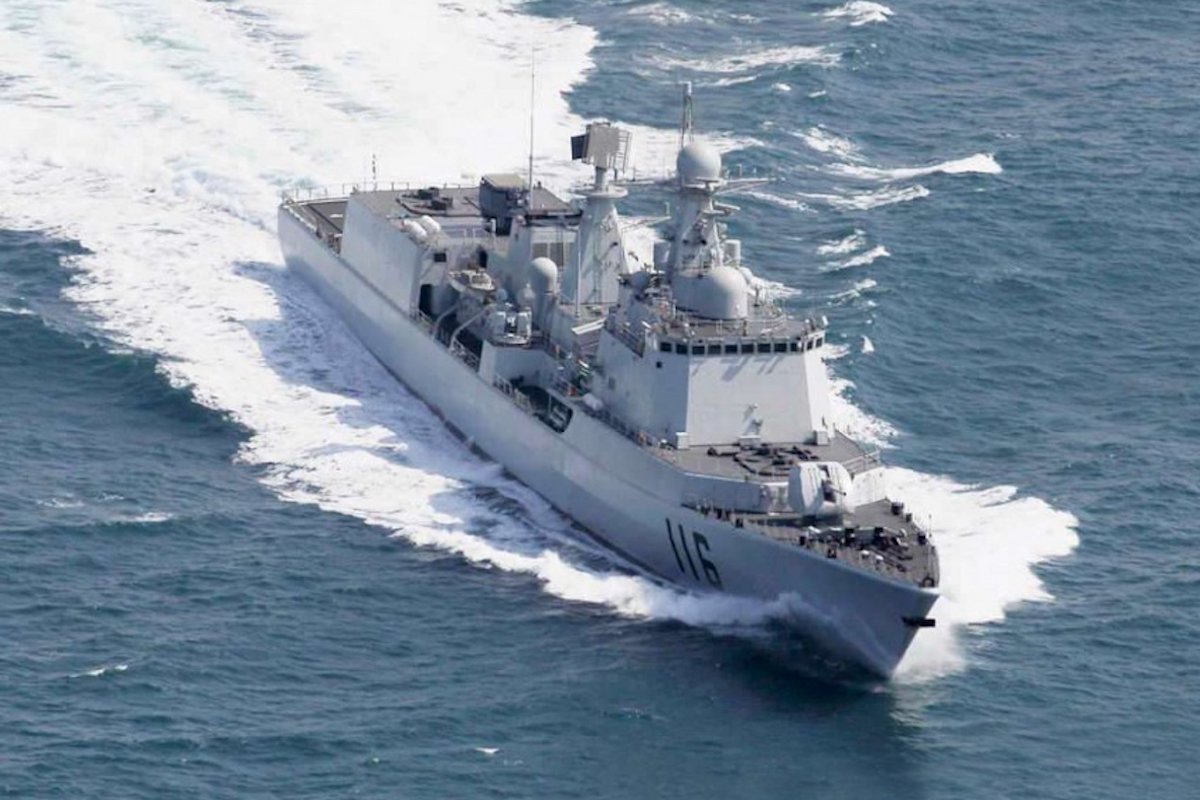
China's decision to give its older destroyers a new lease on life reveals a strategic bet: that in a naval race with the United States, sheer numbers can offset technological gaps. Recent midlife upgrades to the People's Liberation Army Navy's (PLAN) legacy Type 051C guided-missile destroyer, as reported by the South China Morning Post, show Beijing is willing to invest in older hulls to keep its fleet size competitive.
The Luzhou-class warship, commissioned in the mid-2000s as a stopgap for fleet air defense, originally relied on Russian S-300FM Rif-M vertical launch systems and heavy rotating radars. Now, as it nears the end of its service life, the vessel has undergone an extensive overhaul at northern shipyards, swapping out the dated Russian components for indigenous universal vertical launch cells and advanced phased-array radars. The goal is to streamline maintenance, eliminate dependence on foreign parts, and improve interoperability with newer Type 052D and Type 055 destroyers in digitally integrated battle groups.
Why preserve older hulls?
The PLAN's approach contrasts with the US Navy's focus on building fewer, more advanced ships. According to a June 2024 report by the Center for Strategic and International Studies (CSIS), about 70% of active Chinese warships were launched after 2010, compared with just 25% of the US Navy. The disparity is even starker among surface combatants: China has deployed 23 destroyers in the past decade, versus 11 for the US, and has launched eight cruisers since 2017, while the US has launched none of a similar size.
Given China's massive shipbuilding capacity—estimated by the US Office of Naval Intelligence to be roughly 232 times that of the US—one might ask why Beijing bothers preserving older hulls at all. The answer lies in the strategic value of fleet mass. As Sam Tangredi wrote in a January 2023 Proceedings article, numerical superiority often overcomes technological advantages in peer conflicts. Larger fleets can absorb damage, exhaust enemy munitions, and mass decisive firepower through multi-axis saturation attacks.
Tangredi argues that while initial technological leads erode over time, a larger fleet retains striking power after absorbing first salvos and can overwhelm defensive systems. It also enables broad-area scouting, depletes an opponent's finite stockpiles of precision munitions, and provides resilience to replace catastrophic wartime losses.
The US Department of Defense's 2020 China Military Power Report recognized the PLAN as the world's largest maritime force by hull count, with about 350 ships and submarines, including more than 130 major surface combatants. In contrast, a Congressional Research Service report from October 2020 recorded an active US Navy inventory of 301 battle force ships.
The costs of keeping old ships
But preserving older warships is not without challenges. Brent Sadler of the Heritage Foundation noted in a March 2026 report that ships over 20 years old pose severe operational, structural, and budgetary problems. Deferred maintenance leads to compounding structural degradation, making life extensions costly and draining shipyard capacity from new construction. Legacy platforms also suffer obsolescence, requiring extensive retrofits for modern radar, electronic warfare suites, and missile cells.
Keeping older vessels risks fleet-wide firepower losses upon retirement and strains maintenance crews already dealing with spare-part shortages. However, the PLAN may be better positioned than the US Navy to handle these issues, given its younger fleet and dual-use industrial base. Chinese state-backed yards leverage a vast commercial shipbuilding sector to absorb naval construction, allowing rapid output, attrition replacement, and high-volume battle-damage repairs during a protracted conflict—echoing Allied manufacturing advantages in World War II.
Alex Luck, a naval analyst, notes that China has overtaken Russia in sensors and electronics, thanks to its larger domestic electronics and semiconductor industries. He suggests that comprehensive modernization of aging destroyers reflects the PLAN's desire not to compromise on the number of its large surface combatants, maintaining front-line combat mass as it transitions to advanced domestic designs.
The debate over fleet mass versus qualitative superiority is not new, but China's approach suggests a pragmatic answer: keep the numbers up while gradually upgrading. As the PLAN integrates its refitted destroyers with newer vessels, it aims to present a credible challenge to US naval dominance in the Indo-Pacific. Whether this strategy pays off will depend on how well Beijing balances the costs of maintaining older hulls with the need for cutting-edge capabilities.
For more on China's naval ambitions, see China's new drone mothership and the US Air Force's drone wingman program.