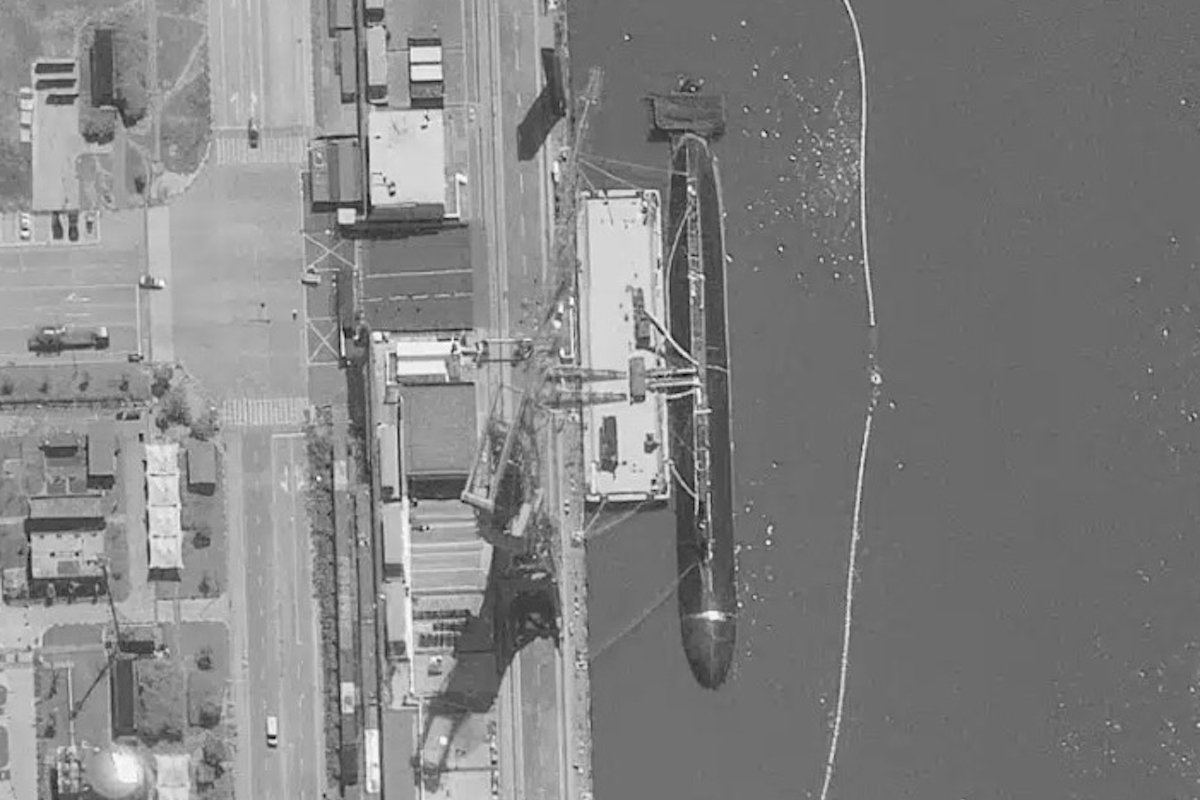
China has quietly launched a new class of sailless submarine from the Jiangnan Shipyard in Shanghai, according to satellite imagery reported by Naval News this month. The approximately 120-meter-long vessel, with a streamlined hull and X-form rudders, represents a significant technological leap in the People's Liberation Army Navy's (PLAN) rapid expansion. Two additional vessels may have been built at the Huludao shipyard in the Bohai Sea, a facility known for nuclear-powered submarine construction.
The submarine's design omits the traditional sail—the tower-like structure atop the hull that houses periscopes, sensors, and antennas. Joseph Trevithick, writing for The War Zone, notes that removing the sail reduces underwater drag, boosting speed, maneuverability, and quietness while submerged. This makes the submarine harder to detect even at high speeds, a critical advantage for penetrating US and allied anti-submarine defenses in the First Island Chain.
Seabed Warfare and Undersea Infrastructure
The sailless design may be optimized for seabed operations, where mast deployment is less critical, or for transit speed during blue-water missions. Its large size and apparent nuclear propulsion suggest the endurance needed for extended missions on the ocean floor. This aligns with a growing focus among major powers on undersea infrastructure competition, including the ability to monitor, tap, or sever critical communications cables.
Niklas Swanstrom, in a January 2025 policy brief for the Institute for Security and Development Policy, highlights that undersea internet cables carry up to 99% of international internet traffic, making them highly vulnerable to state-sponsored sabotage. The US and Russia already operate special mission nuclear-powered submarines, such as the USS Jimmy Carter and Losharik, capable of such operations. If optimized for seabed warfare, China's new submarine would place it among a small group of powers with this capability.
Jason Hsu, in a March 2026 testimony before the US-China Economic and Security Review Commission, warned that Taiwan's heavy reliance on undersea cables makes it particularly vulnerable. A sailless submarine could threaten these cables, adding a new dimension to cross-strait tensions.
Stealth Challenges and Fleet Dynamics
Despite the technological advance, Chinese military journals cited by Ryan Martinson in a June 2025 article for the Center for International Maritime Security (CIMSEC) acknowledge that the PLAN cannot guarantee submarine stealth. The US military's network of satellites, fixed seabed sonar arrays, and maritime patrol aircraft has made China's Near Seas—the First Island Chain—highly transparent. Chinese submarines face an extremely high probability of detection immediately upon leaving port, undermining their operational utility and China's sea-based nuclear deterrent.
China could attempt a mass breakout using its 32 nuclear submarines as of January 2026, but such an effort may create predictable fatal funnels at chokepoints like the Miyako Strait and the Bashi Channel. Meanwhile, the US submarine fleet, all-nuclear with 71 boats in January 2026, is projected to hit a low of 46 units in 2030 as Los Angeles-class retirements outpace Virginia-class deliveries, according to Roy Wood in a February 2026 Proceedings article. Recovery to the low-50s is expected by 2040, but the long-term goal of 66 hulls will not be achieved until the mid-2050s.
China's submarine production has outpaced Western navies, with roughly 15 to 20 submarines across eight classes built in the past five years. James Eanell, in a May 2026 Proceedings article, estimates China may have up to 70 submarines by 2027 and 80 by 2035, half of them nuclear-powered. This rapid buildup complicates intelligence assessments and disrupts assumptions about China's next-generation Type-095 attack submarine program.
If China's nuclear submarines penetrate the First Island Chain, they could serve as a forward screen for intelligence, surveillance, and reconnaissance (ISR) of US and allied vessels, escort carrier strike groups toward the open Pacific, or attack high-value targets like aircraft carriers. The sailless submarine's enhanced stealth makes it particularly suited for such missions.
The emergence of this submarine class underscores the intensifying undersea competition in the Indo-Pacific. As China expands its naval capabilities, the balance of power beneath the waves is shifting, with implications for regional security and the protection of critical infrastructure. For more on China's strategic posture, see our analysis of Xi Jinping's new US-China formula and the Shangri-La Dialogue 2026.