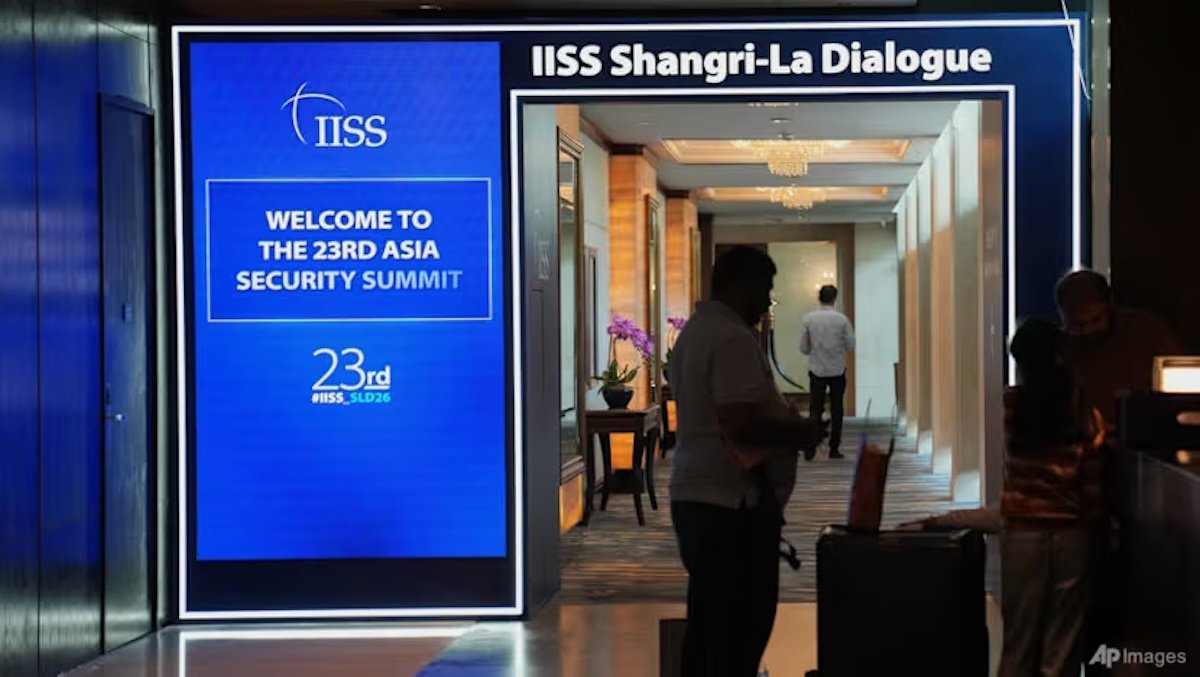
Every June, the Shangri-La Dialogue in Singapore offers a rare, unscripted stage where the Indo-Pacific's strategic order is publicly tested. It is not about signing communiqués, but about who shows up, at what rank, and what they dare say before an audience of defense ministers, military chiefs, and strategists from over forty nations. The 2026 edition, now underway, tells the story of an unequal triangle: the United States at its apex, China in reluctant retreat, and India finally stepping into its own.
The American Constant
Since 2002, nearly every sitting US defense secretary has delivered a plenary address at Shangri-La. Pete Hegseth returns for his second consecutive appearance, continuing a tradition that signals Washington's enduring commitment to the Indo-Pacific as its primary strategic theater. This is not routine multilateralism; it is an institutional expression of hegemonic presence. Even as domestic politics convulse and trade policies shift, the US invests political capital to show up, make its case, and take open questions. This sustained presence creates the gravitational field in which other powers must choreograph their own engagement.
The forum's credibility test is implicitly set by Washington: send your defense minister, deliver a speech, and face the audience. Countries that meet that benchmark signal confidence; those that cannot reveal something about themselves. For a deeper look at how Asia's security realignment is unfolding beyond the US shield, see our analysis: Shangri-La Dialogue 2026: Asia's Security Realignment Beyond the US Shield.
The Chinese Paradox
China's relationship with Shangri-La is anything but simple. By material measures, the People's Liberation Army is the region's pre-eminent military power: the world's largest navy by hull count, the most advanced ballistic missiles, and a modernizing nuclear triad. Yet Beijing cannot comfortably sit in this room. The immediate reason is institutional rot. Dong Jun is the third consecutive serving defense minister to face corruption investigation, following Wei Fenghe and Li Shangfu. In October 2025, Xi Jinping removed General He Weidong, the PLA's second-highest-ranking officer, alongside Admiral Miao Hua. In January 2026, Xi removed Vice Chairman Zhang Youxia. You cannot send a minister under investigation to face unscripted questions from forty nations' military leaders.
The deeper problem is structural. Beijing's elites increasingly see Shangri-La as a forum to highlight and shame China's perceived rule-breaking behavior. The South China Sea, Taiwan, the Quad, AUKUS—none are subjects Beijing can handle in an open Q&A format. Unlike its own Xiangshan Forum, where China controls the agenda and guest list, Shangri-La belongs to no one, making it vulnerable to Washington's agenda. General Meng Xiangqing, a professor at China's National Defense University, leads the delegation for the second straight year. This downgrade from minister-level attendance during 2019–2024 is a calculated retreat: the world's second-largest military power has decided that talking is riskier than silence.
India's Reckoning, Long Overdue
If China's story is a paradox, India's is a prolonged missed opportunity now being corrected at accelerating pace. For most of the forum's history, New Delhi's engagement was desultory. It sent ministers of state or military officials; in 2024, it sent effectively no one of consequence. In the forum's entire 23-year history, only Manohar Parrikar in 2016 appeared as a full defense minister. Prime Minister Narendra Modi's celebrated 2018 Shangri-La keynote—still cited as India's Indo-Pacific manifesto—was a diplomatic one-off, not a sustained institutional commitment.
That changes this year. Defense Minister Rajnath Singh is attending, signaling that New Delhi finally understands the forum's strategic value. India's ascendance as a consequential power demands a presence commensurate with its ambitions. The shift reflects a broader reckoning: after two decades of negligence, India is beginning to grasp that showing up matters. For context on how other regional players are positioning themselves, see Why Vietnam's To Lam Won't Dominate the 2026 Shangri-La Dialogue.
Reading the Triangle
Collectively, these three trajectories reveal much about Indo-Pacific security dynamics. The US remains the defining security provider, its presence creating the forum's gravitational field. China, despite its material power, retreats from terrain that does not favor its narrative. India, long absent, finally steps forward. The unequal triangle is not static; it is evolving, and the 2026 dialogue offers a rare snapshot of where each power stands—and where they are headed.