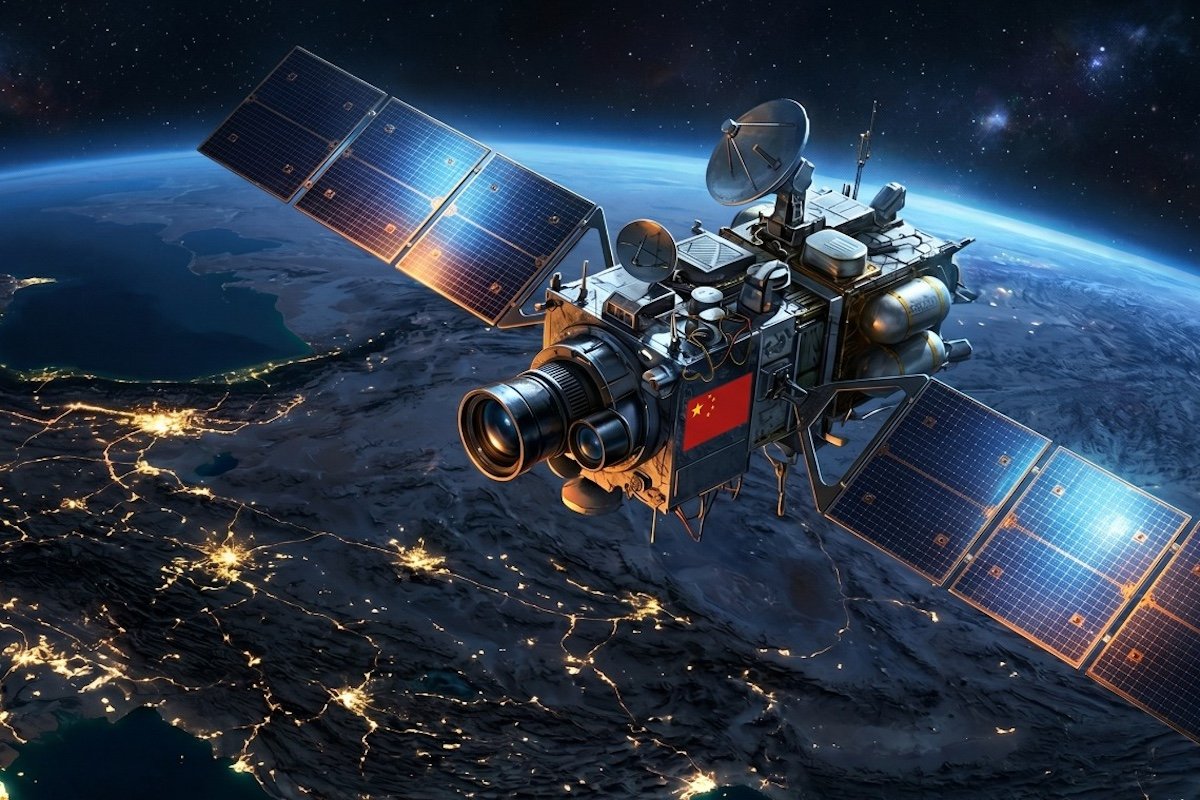
Iran's reported acquisition and use of a Chinese-built satellite, alongside alleged Russian intelligence support, marks a significant evolution in modern warfare. This development suggests that commercially enabled space assets are reshaping how US military forces are monitored and potentially targeted across the Middle East.
According to a Reuters report based on leaked Iranian military documents cited by the Financial Times, Iran covertly obtained the TEE-01B satellite, manufactured by China's Earth Eye Co. The satellite is designed for low Earth orbit (LEO) optical remote sensing, operating at an altitude of 535–545 kilometers. It carries a panchromatic/multispectral camera capable of 0.52–0.53 meter panchromatic resolution and 2.08–2.12 meter multispectral resolution, with a swath width of 14.8 kilometers. Weighing under 112 kilograms, it is part of a constellation aimed at global coverage with a rapid 1.2-hour response time.
The US Department of Defense's 2025 China Military Power Report notes that as of August 2024, Chinese commercial satellite companies had business dealings with Iran's Islamic Revolutionary Guards Corps (IRGC), though it does not detail the extent of these transactions. Iranian commanders reportedly tasked the satellite with surveilling key US installations, using time-stamped coordinates and orbital data captured in March, including imagery before and after drone and missile strikes on those sites.
Targeting US Bases and Regional Implications
Targets reportedly included Prince Sultan Air Base in Saudi Arabia, where US President Donald Trump confirmed aircraft were hit on March 14, as well as Muwaffaq Salti Air Base in Jordan, areas near the US Fifth Fleet headquarters in Bahrain, and Erbil airport in Iraq. Iran also gained access to ground stations operated by Beijing-based Emposat, expanding its satellite control capabilities globally.
If confirmed, the integration of Chinese satellite imagery and alleged Russian targeting assistance could significantly enhance Iran's ability to conduct effective strikes on US and partner forces. This highlights gaps in deterrence, attribution, and defense. Russia, sharing aligned interests against the US, has reportedly provided targeting data to Iran, leveraging its space-based intelligence, surveillance, and reconnaissance (ISR) infrastructure, though its optical reconnaissance capabilities are limited to a handful of dedicated satellites.
China's TEE-01B could provide routine, high-resolution ISR coverage, while Russian state-controlled capabilities contribute selective cueing and targeting intelligence. Russian ISR support is likely strategic and politically sensitive, whereas Chinese commercial satellite imagery offers Iran a broader monitoring capability. The commercial nature of Chinese support provides a veneer of plausible deniability, while Russian involvement could be more escalatory.
A more dangerous scenario involves an ISR mesh, where Chinese-origin commercial satellites operated by Iran, combined with Russian state-controlled space-based ISR and maritime tracking from Iran's coastal radar stations, form a resilient targeting complex. This could enable a kill chain to detect and track Iranian missile and drone attacks against US warships in the Strait of Hormuz.
After more than five weeks of aerial bombardment of Iran, the US has declared a blockade of the Strait of Hormuz, enforced by over a dozen warships. This move could bring US vessels closer to Iranian shores, making them potentially vulnerable. However, even with Russian and Chinese ISR support, Iran faces significant challenges in hitting fast-moving, maneuvering targets with layered defenses. Between November 2023 and February 2025, Houthi forces in Yemen—an Iranian proxy—launched over 100 attacks on commercial and military vessels in the Red Sea but failed to hit a US warship.
China and Russia may also restrict their ISR support to avoid further escalation, as a successful Iranian strike on a US warship could draw the US deeper into conflict. Both powers may benefit from a protracted but controlled US engagement in Iran, diverting strategic attention and resources from Ukraine and the Pacific. For more on China's role in regional dynamics, see China's Role Emerges as Key to Reviving Iran Nuclear Deal and Ending Conflict.
While a US blockade could be enforced by stationing warships farther out in the Gulf of Oman and the Arabian Sea, beyond Iranian attack range, this reduces the chances of a successful strike. The evolving interplay of commercial and state space assets underscores a new era of warfare where non-state actors and proxies gain unprecedented targeting capabilities.



