Every few months, a Chinese artificial intelligence model makes global headlines—closing the gap with American rivals, topping benchmarks, or powering smarter factories and cities. The usual explanations point to China's vast engineering workforce, manufacturing base, state support, and data reserves. While accurate, these miss a deeper pattern.
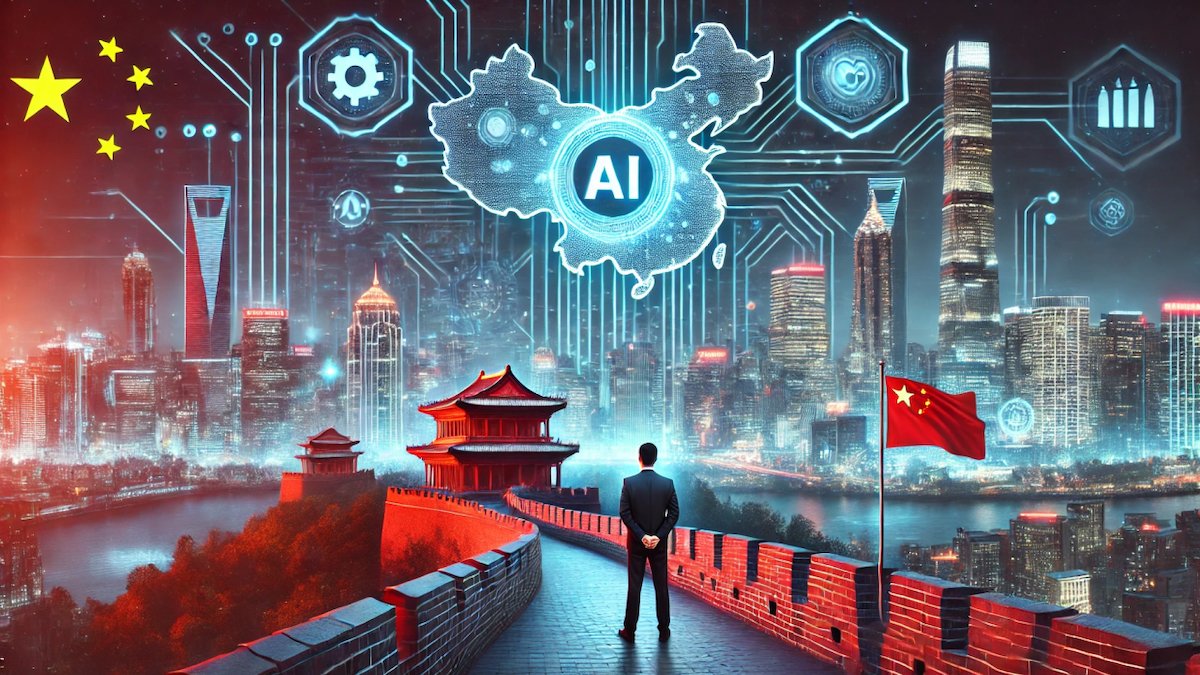
China is not simply building bigger AI systems. From digital twins and predictive logistics to intelligent manufacturing and smart urban management, its AI increasingly serves not to chat or imitate, but to coordinate and manage. This divergence raises a fundamental question: why has China prioritized AI for navigating change, while much of the Western conversation centers on chatbots, productivity tools, and artificial general intelligence?
The answer lies not just in economics or industrial policy, but in an older Chinese way of thinking about intelligence itself—one that values flux, interdependence, and the direction of change over fixed categories.
From Binary to the Book of Changes
In 1701, Gottfried Wilhelm Leibniz sent his binary arithmetic to Joachim Bouvet, a French Jesuit at the court of China's Kangxi Emperor. Leibniz had shown that every number could be expressed using only 0 and 1—a foundation for digital computing. Bouvet's reply surprised him: a diagram of the 64 hexagrams from the I Ching, or Book of Changes, an ancient Chinese classic. Each hexagram consists of six broken or unbroken lines, producing exactly 64 combinations.
Leibniz saw a resemblance to binary, but the I Ching was never a mathematical system. It is a guide to change: when a hexagram is cast, certain lines "move," transforming one pattern into another. What matters is not just what appears, but what it is becoming. The hexagrams hold two dimensions: structure and transformation. Remove the movement, and a hexagram is just a pattern. Restore it, and it becomes a moment inside something larger and ongoing.
This is not to claim the I Ching predicted modern AI. Rather, it exemplifies an intellectual orientation that has persisted across Chinese thought: attention to flux, interdependence, and the direction of change. While modern AI draws on global science, it is striking that China's most prominent applications—digital twins, intelligent infrastructure, predictive urban management—place continuous adaptation at their center.
The Great Split: Discrete vs. Continuous
Mathematicians later formalized these two dimensions as discrete and continuous. Aristotle distinguished them, and 19th-century mathematics built rigorous traditions around the split. Continuous mathematics, shaped by calculus, became the language of flow and motion. Discrete mathematics grew alongside it, concerned with numbers, logic, and symbolic operations.
Computing inherited the discrete tradition. George Boole turned logic into algebra; Claude Shannon showed how Boolean logic could be implemented through electrical circuits; Alan Turing demonstrated how symbolic operations become computation. AI inherited the same representational logic: language becomes tokens, images become pixels, behavior becomes data. A continuous world is rendered into discrete forms machines can manipulate.
That strategy has been extraordinarily successful. But the systems AI increasingly seeks to understand—cities, supply chains, financial markets, ecosystems—are never still. They shift while decisions are being made. A map can become infinitely detailed and still capture only a moment. A compass helps navigate a landscape already moving beneath our feet. The distinction between map and compass is no longer philosophical; it is an engineering problem.
Intelligence as Infrastructure
Most people meet AI today as a chatbot, search tool, or image generator—an app on a screen. Now imagine AI in a different role: adjusting traffic lights as congestion builds, balancing electricity across a grid, or rerouting logistics in real time. This is the direction China is pursuing, embedding AI into physical infrastructure as a coordinating layer. For instance, China's 40 million EVs are becoming a distributed AI computing network, turning vehicles into nodes for data collection and processing.
This approach also has implications for global competition. As China's AI systems manage supply chains and urban systems, they create efficiencies that challenge Western assumptions about productivity. The Plaza Accord 2.0 talk won't solve Europe's China competitiveness problem if the gap lies in how AI is deployed, not just in trade balances.
China's AI strategy is not a simple copy of Western models. It reflects a cultural orientation that treats intelligence as a tool for navigating change, not just mapping static reality. The result is a different kind of AI—one that may reshape how we think about the relationship between technology, infrastructure, and the flow of daily life.