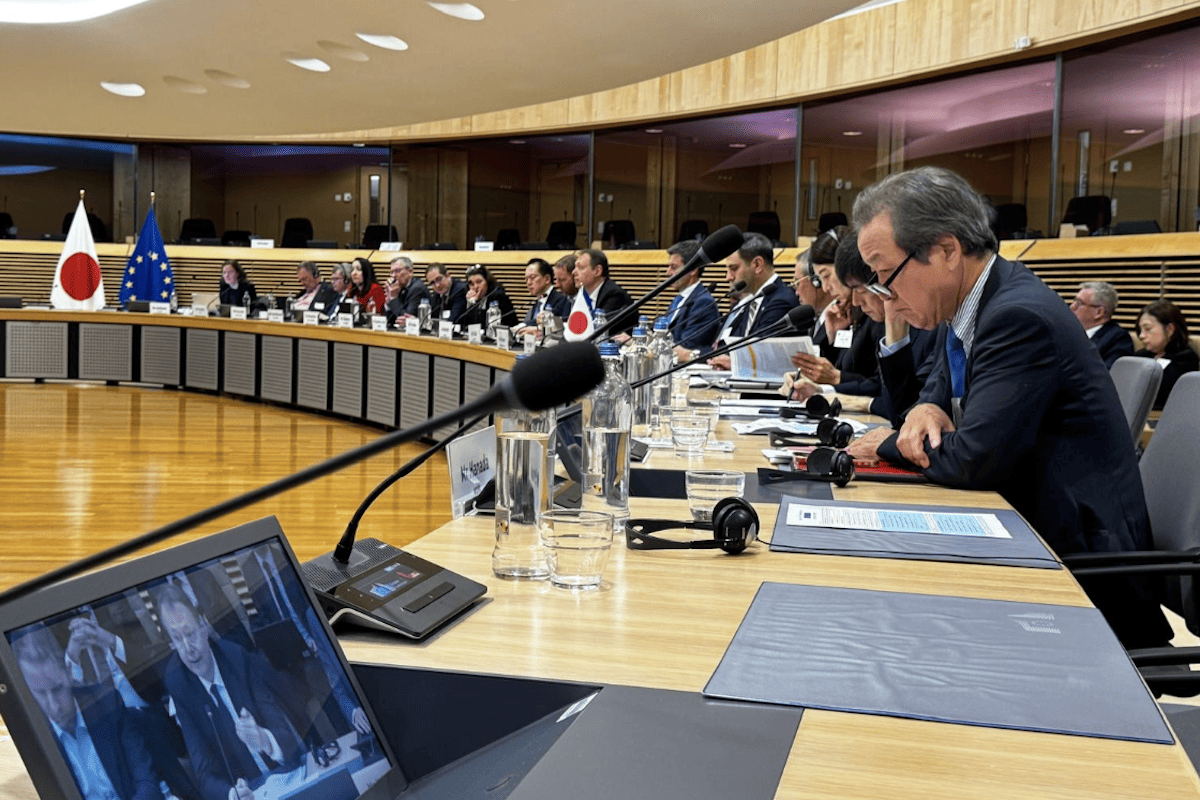
In early May, the European Union and Japan convened the 7th High-Level Economic Dialogue (HLED) in Brussels, signaling a sharpened convergence on economic security. The meeting reflected a notable hardening of language and intent, as officials from both sides focused squarely on vulnerabilities stemming from concentrated supply chains—particularly China's dominance in critical minerals and clean technology manufacturing.
While diplomatic caution ensured that Beijing was not always explicitly named in every formulation, the thrust of the discussions left little ambiguity. The EU and Japan are increasingly coordinating to counter what they see as China's use of non-market policies, export restrictions, and state-backed industrial expansion to distort global competition and create asymmetric strategic dependencies.
From Trade to Geopolitical Alignment
What began over the past decade as a conventional trade and regulatory relationship has evolved into a far more geopolitical alignment centered on economic security, industrial resilience, and technological sovereignty. At the heart of the concern lies China's dominance across the critical mineral supply chain. Beijing controls substantial portions of the global processing and refining capacity for rare earths, graphite, gallium, germanium, lithium compounds, and other indispensable inputs required for semiconductors, batteries, renewable energy systems, robotics, aerospace technologies, and advanced defense manufacturing.
Over the past several years, China has demonstrated a growing willingness to leverage this position through export controls and administrative restrictions. For both Europe and Japan, this has fundamentally altered the risk calculus surrounding economic interdependence. The EU and Japan now increasingly interpret supply chains through the lens of strategic vulnerability rather than pure efficiency. The old assumption that globalization naturally produces stability has given way to the recognition that concentrated dependencies can be transformed into instruments of geopolitical pressure.
This is particularly acute in sectors tied to the green transition and advanced industrial production, where Chinese firms occupy commanding positions built through decades of state subsidies, industrial targeting, and aggressive scaling strategies. Against this backdrop, the Brussels dialogue underscored a shared determination to build resilient, diversified supply chains free of excessive Chinese influence.
Strategic Sectors and the Critical Raw Materials Act
Both sides reaffirmed commitments to cooperate across a broad range of strategic sectors, including critical minerals, batteries, clean technologies, hydrogen, offshore wind, solar energy, steel, robotics, biotechnology, defense industries, and the space sector. This breadth is significant. It illustrates that the EU and Japan no longer regard supply chain resilience as a narrow trade issue but as the foundation of long-term economic and strategic autonomy.
The most consequential aspect of the partnership may lie in critical raw materials cooperation under the EU Critical Raw Materials Act (CRMA). The CRMA was designed precisely to reduce Europe's dangerous reliance on single-country suppliers, particularly China. During the HLED, the EU and Japan highlighted progress on strategic projects linked to the CRMA and reiterated their intention to support additional joint mineral ventures. This signals an important evolution from rhetoric to implementation.
The logic is straightforward. Europe and Japan possess highly complementary capabilities. Japan brings decades of expertise in advanced materials processing, battery chemistry, precision manufacturing, and industrial coordination. The EU contributes financing power, regulatory leverage, and access to one of the world's largest integrated markets. Together, they are attempting to create parallel ecosystems capable of competing with China's vertically integrated industrial dominance.
This effort extends beyond securing raw materials themselves. The deeper objective is to challenge China's chokehold over midstream processing and high-value manufacturing. Mining diversification alone cannot reduce strategic dependence if Chinese entities continue to dominate refining, cathode production, rare earth separation, and advanced component manufacturing. Consequently, EU-Japan cooperation increasingly focuses on the entire industrial chain—from extraction and refining to recycling, advanced manufacturing, and next-generation technologies.
Responding to Chinese Industrial Overcapacity
Importantly, both sides are also responding to what they regard as the corrosive effects of Chinese industrial overcapacity. European and Japanese policymakers have become increasingly alarmed by the scale of subsidized Chinese production in sectors such as steel, solar panels, batteries, and electric vehicles. Their concern is not simply commercial. They fear that persistent market flooding by heavily subsidized Chinese firms could hollow out domestic industrial bases before Europe and Japan have fully established their own strategic production capabilities.
This anxiety is particularly acute in clean technologies. China's overwhelming scale in solar panels, battery components, and electric mobility technologies has enabled it to compress global prices to levels that many competitors struggle to match. While this has accelerated aspects of the global energy transition, it has also intensified fears in Brussels and Tokyo that the transition itself could become structurally dependent on Chinese industrial policy. The EU and Japan increasingly view this dependency as incompatible with long-term economic security.
Yet despite the increasingly assertive rhetoric emerging from Brussels and Tokyo, the practical capacity of the EU and Japan to meaningfully counter China's dominance in critical minerals and strategic manufacturing remains limited. Both economies remain deeply entangled with Chinese supply chains, industrial inputs, and consumer markets, creating structural dependencies that cannot be unwound overnight. For a deeper look at how Japan is navigating its own energy dependencies, see our analysis of Japan's Ammonia Co-Firing Plan Risks Prolonging Indonesia's Coal Dependence.
Moreover, the broader geopolitical context complicates these efforts. Japan's military normalization and its role in regional security are evolving rapidly, as discussed in Japan's Military Normalization: Why It's Time to Scrap Postwar Constitutional Constraints. Meanwhile, the US-Japan alliance is deepening its footprint in Southeast Asia, as seen in US-Japan Missile Drills Turn Philippines Into Forward Base in Pacific Rivalry. These developments underscore that the EU-Japan partnership on supply chains is part of a larger strategic realignment across the Indo-Pacific.