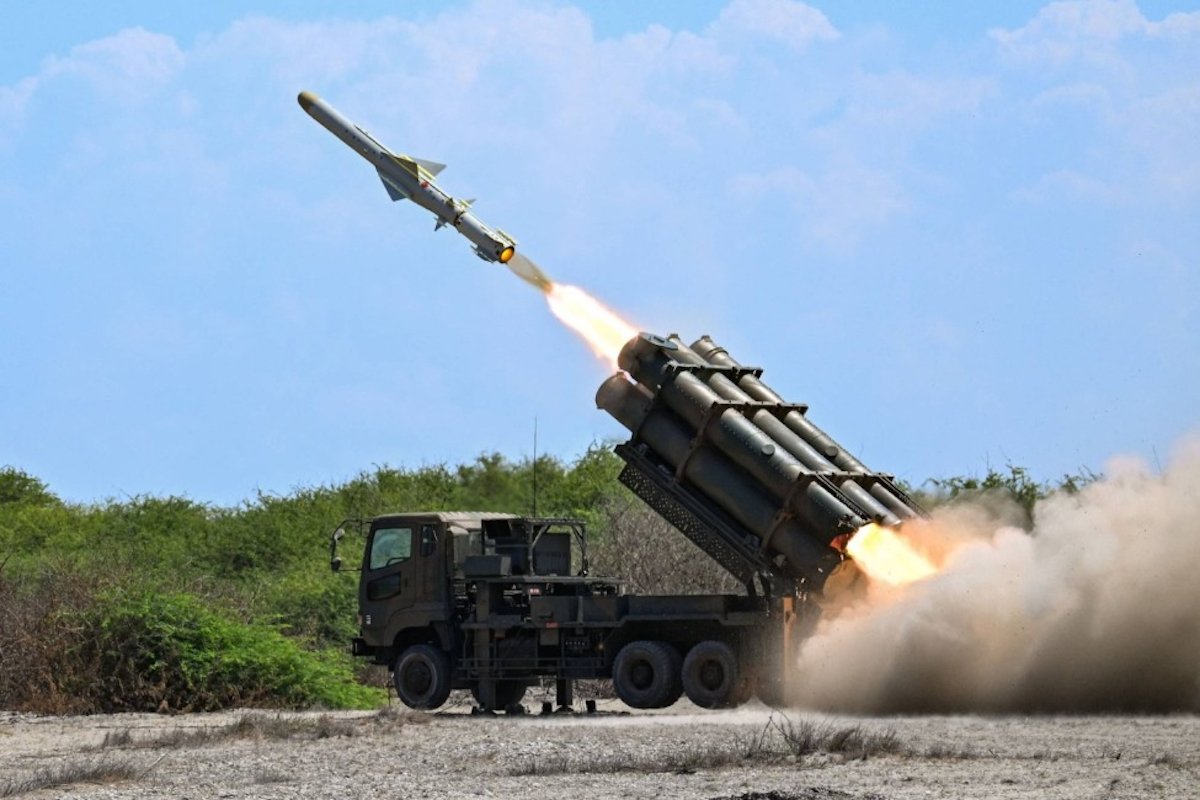
Live-fire missile drills conducted by the United States and Japan on Philippine territory have underscored Manila's growing role as a forward-deployed hub in the intensifying US-China rivalry across the Indo-Pacific. The exercises, part of this year's Balikatan maneuvers, saw the Japanese Ground Self-Defense Force (JGDSF) fire Type 88 surface-to-ship missiles from Paoay, Ilocos Norte, while the US Army launched a Tomahawk cruise missile from its Typhon system in Tacloban City, Leyte.
Approximately 140 Japanese troops participated in the launch of two Type 88 missiles, which sank a decommissioned Philippine Navy vessel roughly 75 kilometers offshore. The drill was observed by Japanese Defense Minister Shinjiro Koizumi and Philippine Defense Secretary Gilberto Teodoro Jr., while Philippine President Ferdinand Marcos Jr. monitored remotely. A day earlier, the US Army Pacific's 1st Multi-Domain Task Force fired a Tomahawk missile that struck a target around 600 kilometers away at Fort Magsaysay in Nueva Ecija, simulating support for ground operations.
Strategic Implications of the Missile Tests
The Balikatan exercises involved approximately 17,000 troops from the Philippines, the United States, Japan, Australia, Canada, France, New Zealand, and the United Kingdom. They highlighted expanding maritime strike and island-defense cooperation among allies. China has criticized the drills as destabilizing and warned against what it calls Japanese “remilitarization.”
The missile firings demonstrate how allied missile deployments could strengthen deterrence against China while simultaneously deepening the Philippines' strategic vulnerabilities. The country is evolving from a treaty ally into a forward missile platform embedded in the US-led First Island Chain strategy. The Tomahawk's range of 1,250 to 2,000 kilometers allows the US to threaten targets in mainland China from Philippine territory, depending on the variant. Japan's Type 88 anti-ship missile, with a range of 180 kilometers, can complement the US Navy-Marine Expeditionary Ship Interdiction System (NMESIS).
These systems could also work alongside the Philippines' BrahMos supersonic missiles, which have an export variant range of 290 kilometers. However, Manila's limited intelligence, surveillance, and reconnaissance (ISR) capabilities could restrict the BrahMos's operational effectiveness. Still, the Philippines could use these missiles to threaten Chinese forces at the disputed Scarborough Shoal, just 220 kilometers off Luzon—a fixed location that would remain relatively easy to target.
If Japan follows the US precedent of deploying missile systems in the Philippines under training arrangements, Tokyo could eventually keep Type 88 batteries in the country on a long-term basis. Such deployments could contribute to a broader First Island Chain “missile wall” featuring layered coverage of mainland China, the South China Sea, and chokepoints such as the Miyako Strait and Bashi Channel. However, these systems may remain vulnerable in the Philippines' small-island geography, where limited roads and sustainment infrastructure could make launchers easier to track and target through satellite ISR, drones, or missile strikes.
Japan's Type 88 missile is a Cold War-era weapon designed in the 1980s with the Soviet Navy in mind. It may be obsolete against modern layered ship defenses of China's carrier strike groups and improved weapons with extended ranges, stealthy designs, and hypersonic speeds. Nevertheless, the messaging behind these firings may be more important. As the US is bogged down against Iran with no clear end in sight, it may need to reassure Pacific allies and partners such as Japan, the Philippines, and Taiwan. The US missile firing may thus be a warning to China not to move on Taiwan while Washington is distracted in the Middle East.
In Japan, the Type 88 firings may reinforce the country's shift away from its long-held pacifist posture toward a more proactive regional security role. The drills may also signal Japan's growing willingness to loosen longstanding restrictions on arms exports and defense cooperation with partners such as the Philippines. They may also serve as a sales pitch ahead of a possible transfer of older Abukuma-class destroyer escorts. While such transfers may face bureaucratic hurdles under Japan's restrictive arms export policies, the Type 88 batteries could still serve as a test case for loosening those restrictions.
For the Philippines, Japan's test firings on its territory could be seen as progress toward engaging alternative defense partners beyond the US. Manila is likely to maintain its longstanding alliance with Washington, owing to its proximity to the South China Sea and Taiwan, its generally weak military, and reliance on US security guarantees via a mutual defense treaty. However, the unpredictability and transactional nature of the US Trump administration, along with its preoccupation with the Iran war, may have driven the Philippines' urgency to diversify its defense partnerships. In terms of optics, Japan's missile launch from its territory underscored that point by bringing in a capable potential partner aside from the US to help counterbalance China.
Still, it is debatable just how much agency the Philippines has in hosting these missile systems. While the US and Japan frame the drills as defensive, they place Manila squarely in Beijing's crosshairs. As the US Army accelerates anti-ship missile development for Pacific deterrence, the Philippines finds itself at the center of a strategic competition that may offer security guarantees but also invites escalation risks. The broader context of potential US-China summitry and China's dual role in the Iran conflict further complicates Manila's position.



