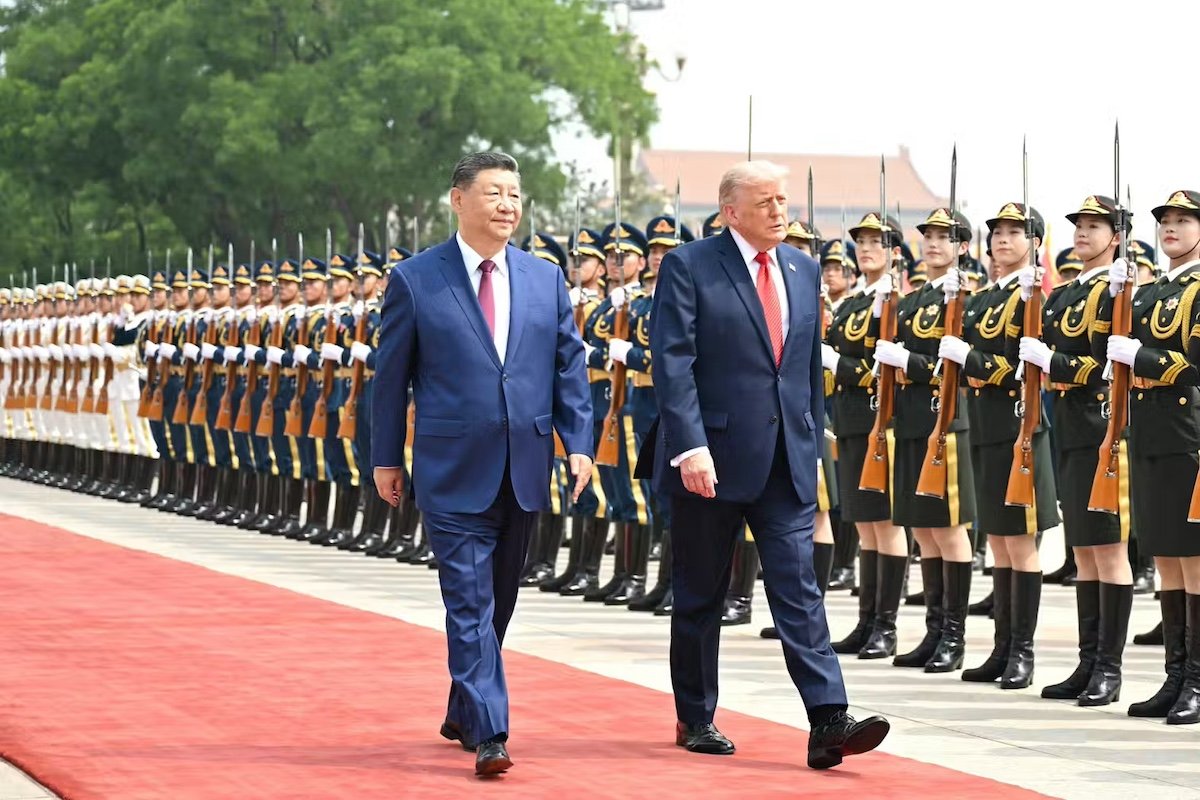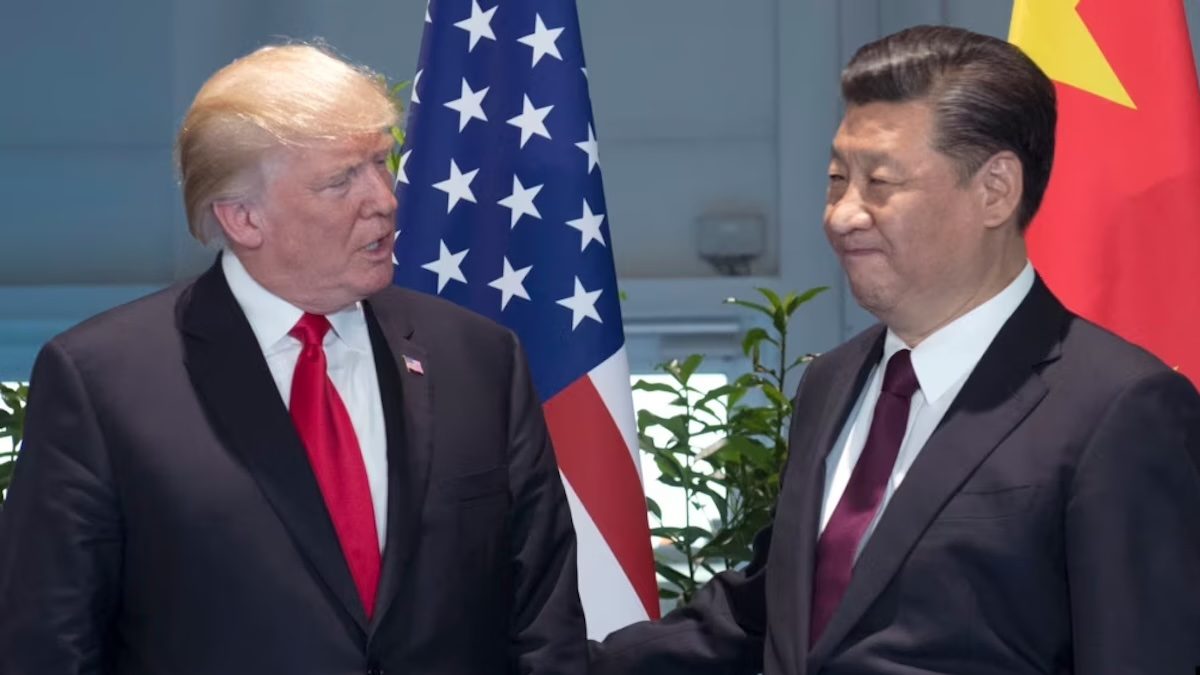
When President Donald Trump arrives in Beijing next week to meet President Xi Jinping, the carefully choreographed rituals will mask a fundamental truth: this summit is less about reconciliation and more about managing an irreconcilable rivalry. The two leaders, representing economies that together generate over 42% of global GDP, will seek to stabilize a relationship strained by structural competition and global disruptions from conflicts in Europe and the Middle East.
Unlike the Cold War-era détente between the United States and the Soviet Union, there is no ideological softening or shared strategic horizon between Washington and Beijing. Instead, what is emerging is a search for guardrails—informal limits to escalation that can prevent crises from spiraling into open conflict. These mechanisms are unlikely to be codified in formal treaties but will exist as tacit understandings, shaped by the complex reality of stratified interdependence.
Stratified Interdependence: The New Normal
Since 2022, Washington has constructed an expansive export-control regime targeting advanced semiconductors, artificial intelligence, and other frontier technologies. Beijing has responded by leveraging its dominance in critical minerals such as gallium and germanium. Yet bilateral trade continues at scale, financial linkages endure, and production networks remain deeply integrated. Both sides have engineered a form of stratified complex interdependence—high barriers around technologies that define future power, alongside continued openness where mutual benefit outweighs strategic risk. Total decoupling is neither feasible nor desirable; what matters is how they restructure guardrails for this interdependence to survive.
The center of gravity in US-China rivalry has shifted decisively from the military to the economic domain. Export controls, sanctions, and supply-chain networks now function as instruments of strategic coercion. Economic tools are deployed to achieve geopolitical objectives, eroding the distinction between markets and strategy. Trade policy is now inseparable from national security doctrines, as seen in recent moves like US Army acceleration of anti-ship missiles for Pacific deterrence and China's deployment of blocking rules against US sanctions.
For third countries, this transformation creates acute dilemmas. States across Asia, Africa, and Latin America must navigate between two competing ecosystems, each with constantly changing codes of conduct. It is not a simple binary between Beijing and Washington but a complex landscape of constrained autonomy, where strategic flexibility is increasingly difficult to define.
What the Summit Might Deliver
If the Beijing summit produces anything of lasting value, it will not be a grand bargain or formal treaty. As with the last Xi-Trump meeting in Busan, this summit will likely yield technical, opaque, and yet consequential understandings open to varying interpretation. Recent incidents in the South China Sea and around Taiwan underscore the possibilities for inadvertent escalation. The absence of a codified crisis management mechanism amplifies such risks. Even the most modest understanding—for communication channels, operational protocols, or thresholds of escalation—can become a game changer.
Following the Cuban Missile Crisis, the US and the Soviet Union established mechanisms to prevent accidental wars. US-China ties today require codification of a similar, even if less formalized, architecture of mutually recognized guardrails. Personalized leadership styles introduce another layer of complication. Trump’s diplomatic approach is transactional, oriented toward immediate, visible outcomes. Xi’s is strategic and long-term, embedded within a broader vision of China’s rise. This disconnect will shape their outcomes: Trump will seek demonstrable gains on trade balances, symbolic concessions, or security assurances, while Xi will calibrate responses to fit China’s long-term trajectories.
Even their best results will be tactical, reversible agreements—useful for short-term stabilization but insufficient for building durable frameworks. Such arrangements will also be contingent upon leadership dynamics rather than institutionalized cooperation. Beyond the bilateral relationship, the most consequential dimension of US-China rivalry lies in how states across Asia, Africa, and Latin America are drawn into their competing visions of development, governance, and connectivity. Xi’s Belt and Road Initiative has established significant presence across regions, embedding Chinese standards and financing structures. As the Trump administration struggles to conceptualize alternatives, it has often resorted to force, as seen in Venezuela and Iran.
For the rest of the world, the question is no longer which model is normatively preferable but which one can safely deliver tangible benefits without triggering conflict. The Beijing summit may not resolve this dilemma, but it could codify the rules of coexistence that shape the region’s future.