The ongoing crisis in the Strait of Hormuz, coupled with heightened tensions in the Red Sea and the resulting oil price volatility, has laid bare a stark reality: Gulf economies and global markets remain dangerously dependent on a handful of narrow maritime chokepoints. While diplomats scramble to keep these sea lanes open, a quieter but potentially transformative project is gaining momentum on land.
For over fifteen years, the six members of the Gulf Cooperation Council (GCC)—Bahrain, Kuwait, Oman, Qatar, Saudi Arabia, and the United Arab Emirates—have been working, albeit slowly, to build a railway network that would knit their economies together. Recent events, including the US-Iran war and the near-total shutdown of shipping through the Strait of Hormuz, have given this project new urgency. As scholars of global governance and political economy, we see the GCC Railway as more than just infrastructure: it could be a tool to reshape regional politics, reduce vulnerability to external pressure, and even alter the balance of power in the Persian Gulf.
From rhetoric to rails
The Persian Gulf has long been a theater of great-power competition, from Portuguese control of Hormuz in the 16th and 17th centuries to British and American naval dominance in the modern era. Since the GCC's founding in 1981, its leaders have paid lip service to integration, but economic and political cooperation has often lagged behind the lofty declarations issued at annual summits.
The current war with Iran has changed the calculus. In April 2026, GCC leaders met in Jeddah, Saudi Arabia, against a backdrop of Iranian strikes on Gulf states and the closure of the Strait of Hormuz. The summit produced calls for deeper security cooperation, joint electricity and oil pipeline connections, and a pledge to expedite the GCC Railway project. The railway, first announced at the 30th GCC summit in 2009, is now seen as a concrete step toward resilience.
The project envisions a 2,177-kilometer (1,352-mile) standard-gauge network connecting all six member states, with freight trains running at 80-100 km/h and passenger services at up to 200 km/h, equipped with European train control systems. The estimated cost is $250 billion. After years of slow progress, largely due to low oil prices, Saudi Arabia and the UAE have taken the lead in accelerating construction.
Progress on the ground
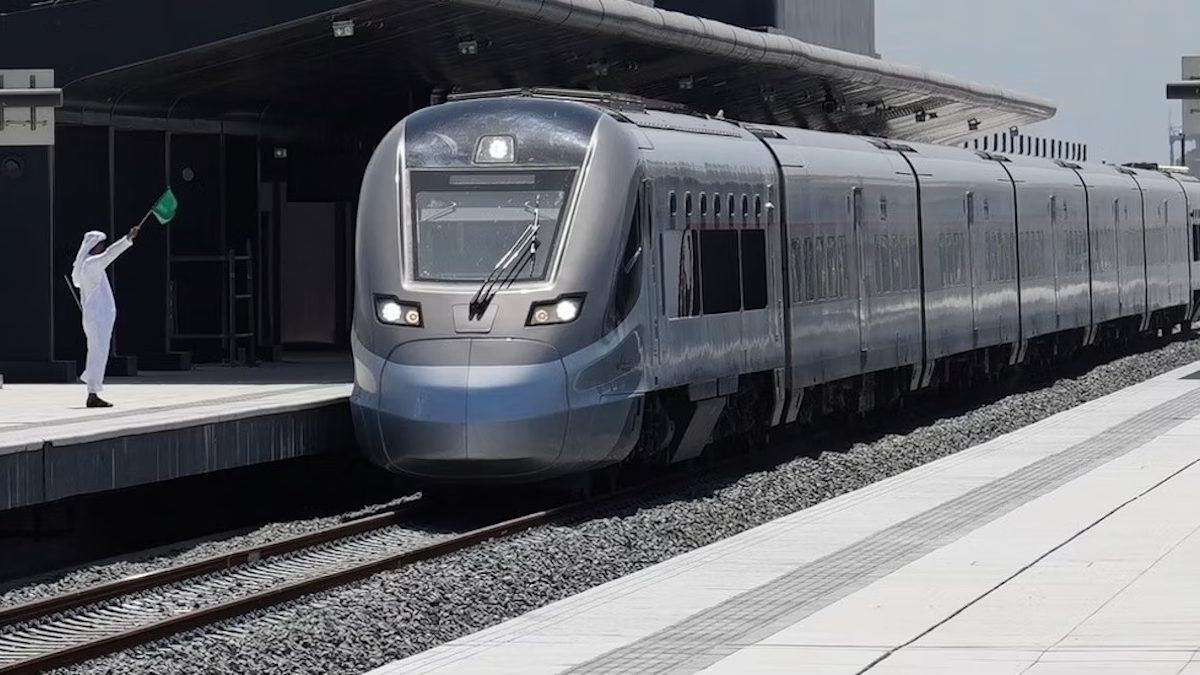
The UAE launched Etihad Rail in June 2026, initially carrying passengers between Abu Dhabi and Fujairah. A full line from the Gulf of Oman to the Saudi border is scheduled to open by the end of the year, and the UAE-Oman segment is well underway. Qatar, Bahrain, and Kuwait are moving through planning and design. The director of the GCC Rail Authority said earlier in 2026 that the project is 50% complete and on track for full operation by 2030.
Once completed, the network will create the Gulf's first integrated cross-border rail system, stretching from ports on the Gulf of Oman to Kuwait City. But the vision extends far beyond the six member states.
Connecting to Europe and Asia
Several corridors could link the GCC Railway to Europe and Asia, offering alternatives to the Strait of Hormuz during crises. Potential routes include: from Kuwait through Iraq and Turkey; across Saudi Arabia via Jordan and Syria to Turkey; through Jordan to the Israeli port of Haifa; or via Saudi Arabia's Landbridge to Red Sea ports and onward through the Suez Canal.
On the Asian side, ports at Fujairah in the UAE and Sohar in Oman will connect to the Arabian Sea and Indian Ocean, opening direct links to South and East Asian markets. These connections are being pursued through multiple initiatives, including the India-Middle East-Europe Economic Corridor (backed by India, the EU, the US, and several Gulf states), Saudi Arabia's Landbridge project (design contract already signed), and Iraq's Development Road Project.
In June 2026, Saudi Arabia and Turkey signed a memorandum of understanding on railway connectivity, including plans to revive and upgrade the century-old Hejaz Railway, reconnecting Turkey to Saudi Arabia via Jordan and Syria. All four initiatives aim to expand rail links from the Gulf to Europe or the Mediterranean.
Beyond infrastructure: a new regional order?
The GCC Railway is not just about moving goods. It will connect tens of millions of people across borders for business and tourism, creating new opportunities for a region that has long relied on air travel. Easier overland movement could also foster political stability and development. For example, Iraq's Development Road project has the potential to transform GCC-Iraq relations from a security-centric dynamic, dominated by concerns over Iranian influence, into one centered on economic cooperation.
As the Hormuz crisis reshapes economies across Asia, the railway offers a tangible alternative to maritime vulnerability. It could also reduce the leverage of external powers that have historically used naval superiority to influence Gulf affairs. The project is a bet on regional self-reliance—a bet that, if successful, could have profound implications for global energy security and the balance of power in the Indo-Pacific.
Of course, challenges remain: financing, political rivalries, and the security of the rail lines themselves. But the momentum is real. As the global oil crisis deepens, the GCC Railway represents a long-term structural response to a chronic vulnerability. It may not solve the immediate crisis, but it could fundamentally alter the strategic landscape of the Persian Gulf and beyond.