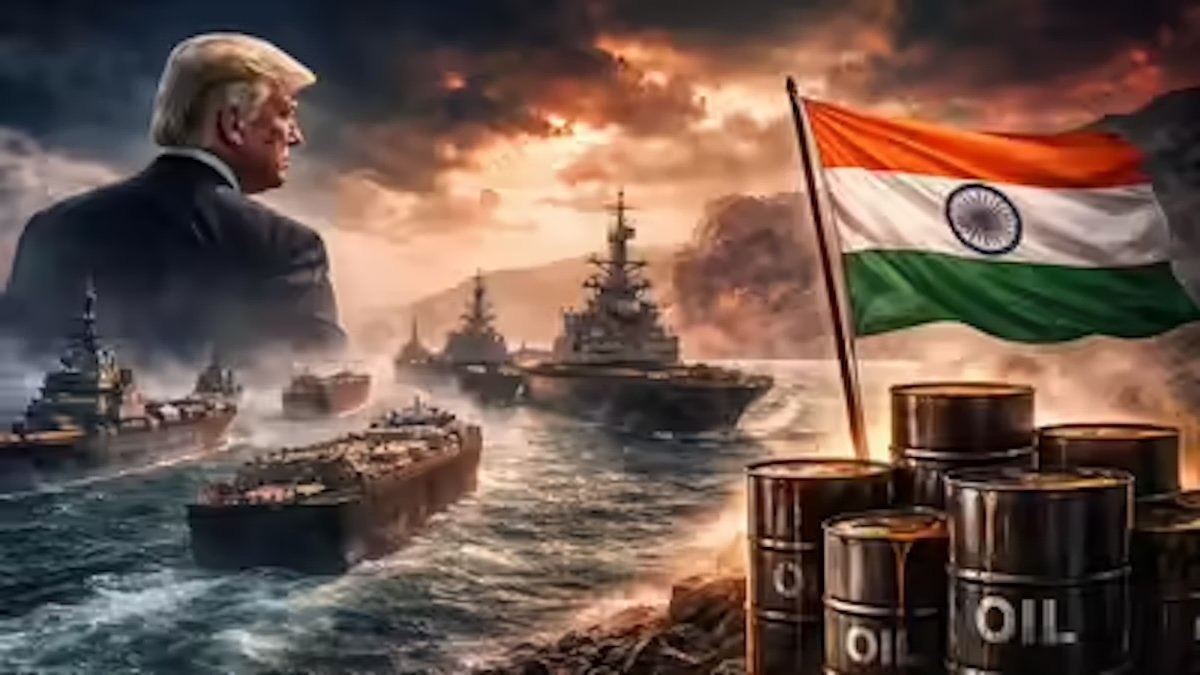
As the confrontation between the United States and Iran enters a more volatile phase, India finds itself at a crossroads. The country's foreign policy establishment is sharply divided over how to respond, with economic vulnerabilities at home and reputational stakes across the Global South hanging in the balance. The question is no longer whether India has the credibility to act on the Strait of Hormuz, but whether it possesses the political will to do so.
India's response to the West Asia crisis deserves close scrutiny. The thinking within the Ministry of External Affairs is far more nuanced than the Cold War-era tropes often invoked in London or Lucknow. Some commentators portray New Delhi as a passive bystander, pointing to Pakistan's recent diplomatic spotlight as evidence of Indian drift. But this reading may be too shallow. Could India's relative silence reflect strategic patience rather than indecision?
A Spectrum of Views
The Hormuz crisis has exposed deep divisions within India's foreign policy community. Some defend the government's multi-vector, pragmatic approach as a source of strategic autonomy. Others criticize it as overly cautious—too deferential to the United States and insufficiently bold for a rising power. Still others argue that what appears to be hesitation is in fact diplomatic sophistication: a deliberate effort to avoid entanglement while preserving flexibility.
Prime Minister Narendra Modi has offered little clarity. Addressing the Lok Sabha on March 23, 2026, he emphasized concern and a determination to protect Indian interests. "From the beginning, we have expressed deep concern over this conflict," he said. "Through diplomacy, India is continuously working to ensure safe passage for Indian ships even in this war environment." But beyond these generalities, the strategy remains opaque.
This ambiguity creates space for a more assertive initiative. Sumeer Bhasin, an Indian geopolitical analyst, argues that India must move beyond hedging and become a rule-shaping power. "India must announce a Hormuz stabilization initiative—not as mediation, but as a framework-setting exercise," he says. Such an initiative would bring together major affected powers and shift India from the margins to the center of diplomatic coordination.
From Balancer to Architect
A Hormuz stabilization framework could provide that opportunity. It might even unify India's otherwise fragmented foreign policy camps—at least temporarily—by offering a concrete, forward-looking objective. Bhasin envisions a multilateral initiative spearheaded by India, bringing together actors such as China, Russia, the European Union, and the Gulf states to establish transparent protocols for maritime passage through the Strait of Hormuz. The goal would be not confrontation but stability: constraining unilateral disruptions through collective agreement and shared incentives.
In Bhasin's formulation, "This is India's moment—not as a balancer, but as an architect." The aim is to design an "operating system of access" that makes disruption costly and cooperation beneficial. How might this work in practice? India could deploy a neutral naval presence, convene regional stakeholders, and help define consequences for interference with shipping. More broadly, it could champion an issue-based coalition model that reflects the realities of a multipolar world and gives emerging powers a greater role in shaping outcomes.
India has the assets to make this credible: strong regional ties, credibility across rival blocs, a tradition of non-alignment, and a growing global profile. It directly profits from smooth energy and trade flows through Hormuz, as well as from a working Chabahar Port in Iran on the Gulf of Oman to facilitate connectivity with Central Asia. The country's economic weight, global partnerships, and considerable maritime presence make this an ambition worth taking seriously.
Modi has said, "This is not an era of war. This is an era of dialogue and diplomacy." If that principle is to mean anything, it must be operationalized. A Hormuz stabilization initiative—whether in Bhasin's form or another—would be a concrete step in that direction. India's foreign policy establishment would do well to temper ideological infighting and focus on advancing a coherent strategy. The goal is not just to secure national interests, but to help stabilize the global order while easing economic jitters across South Asia and the Global South.
Skeptics will call this ambitious, even unrealistic. But the alternative—continued muffled passivity—carries its own risks. As India's window for restraint on the Hormuz crisis closes fast, the cost of inaction grows. Even if such an initiative falls short, the attempt itself would signal a shift—from cautious balancing to purposeful leadership. For a country that aspires to be a leading power in the Indo-Pacific, that shift may be the most consequential move of all.